













'Membership in WHO is critical': America is no longer at the helm of international outbreak responses, Emory epidemiologist says
Live Science spoke with a leading epidemiologist from Emory University about her impressions of how the hantavirus outbreak is being managed in the U.S.


When a cluster of hantavirus infections struck the cruise ship MV Hondius, about two dozen American passengers were on board. At least seven disembarked before health authorities were informed of the outbreak and headed home to the United States; 17 others remained on the ship for several weeks and have only just been repatriated. Meanwhile, a few Americans who had never been on the ship may have been exposed to the virus while on board an international flight.
Officials with the World Health Organization (WHO) say they've been in consistent communication with the U.S. Centers for Disease Control and Prevention (CDC), coordinating plans for the American passengers and exchanging technical information about hantaviruses. But this is an unusual time for the CDC, and the agency is not behaving as it usually would in such outbreaks, Jodie Guest, senior vice chair of epidemiology at Emory University's Rollins School of Public Health, told Live Science.
The U.S. is no longer a WHO member state, and the CDC has endured deep staffing cuts at the hands of the second Trump administration. The agency has been slow to issue public statements about its efforts to manage the hantavirus outbreak, and on the few occasions they've spoken with the press, CDC representatives have often been vague or imprecise.
Live Science spoke with Guest — who led Emory's COVID-19 Outbreak Response Team within Georgia and advised Atlanta city officials during the mpox outbreak — about the country's management of this outbreak. We discussed whether the CDC, once considered the world's premier public health agency, may no longer be equipped to handle infectious disease outbreaks.
Nicoletta Lanese: What is different about how the CDC is responding to this outbreak compared with prior ones?
Jodie Guest: I definitely believe that the CDC's response is less visible than we would normally anticipate. CDC normally plays a leadership role and is extremely involved in the original investigation, as well as decisions about how to move people, etc., and WHO took the lead on that, in CDC's absence.
NL: WHO officials have said they're communicating with CDC leaders. But is there less communication than we'd expect?
Get the world’s most fascinating discoveries delivered straight to your inbox.
JG: I can't speak to what communication they've had, but what I can say is that we were multiple weeks into this outbreak before CDC issued any sort of announcement about it. Additionally, it was only last Friday [May 8] that they put out a health alert to the HAN, the Health Alert Network, to clinicians in the United States. [HAN is the CDC's primary method of sharing time-sensitive, urgent public health information with officials, doctors and labs.]
While it's unusual to not have had that health alert sent out much earlier, I will say the risk to the general population is so incredibly low [in this instance]. That HAN is important to go out as a matter of procedure, but at the same time, we don't anticipate clinicians will be seeing people with hantavirus that are not already under surveillance.
The low transmission rate of the virus is definitely working in our favor, on that.
NL: What do you think is behind the CDC's delayed response?
JG: I think one of them is our removal from the WHO. So, when the U.S. left the WHO in January, that really changed our relationship, being at the table with leadership decisions and helping design protocols, surveillance, etc.
I do believe that CDC employees were there as the last disembarkment happened [on May 10 in the Canary Islands]. But generally, we would see the CDC taking the lead on how that disembarkment would happen, where they would go, how we would transfer people, and the overall international set of protocols.
There's certainly a huge amount of workforce reductions that have happened at CDC, as well as a kind of a back-and-forth with the workforce [being fired and rehired]. So some people have not been consistently employed; some people have been brought back. But there are generally about 18% fewer CDC employees than we previously saw, including outbreak investigators and specialists for things like cruise ship sanitation and port health.
Membership in WHO means that you get the early warning messages before they are available for public consumption.
Jodie Guest, senior vice chair of epidemiology at Emory University's Rollins School of Public Health
NL: Thinking back to prior outbreaks, is there a good comparison to draw to this current situation? I was thinking of the Ebola cases in 2014, for instance.
JG: I do think that Ebola is probably the best example. There's a lot of differences between the two diseases, but from a response model standpoint, the CDC's posture for Ebola was an extremely large amount of global leadership. And at this point in time for hantavirus, I would say the international leadership is limited, and it's mostly domestic monitoring — which is extremely important; I do want to highlight that.
So I think it's reduced visibility and influence, as opposed to leading a global response.
NL: Given the U.S. is taking a back seat, do you think that's hindered the WHO's response at all?
JD: I think that there was some slow uptake at the beginning, and I don't know that that's anything other than hantavirus not being what you would anticipate on a cruise ship. You know, the original case was not tested for hantavirus; testing for hantavirus is not common and not available in all locations. It's not a routine clinical test. With all of those things, it doesn't matter who was leading the effort; that's going to delay everything. It's not going to be in your top diagnostic list of things to be looking for.
But I do think that there was some additional lag that happened that perhaps the CDC could have filled in. It's a counterfactual, so we will never know for sure. But I also believe that the WHO's efforts in their surveillance and their consistent communication has been excellent. They have been very, very communicative about what is happening, and they have been doing a wonderful job taking the lead on this.
NL: In the immediate term, do you feel the sluggishness we're seeing from the CDC places Americans in danger? Or is it more of a long-term issue?
JG: I think we have a response model problem. But at this point in time, I wouldn't say that this had any impact on the actual disease risk, including the care of the people who were passengers on that ship. So that's the great news. The immediate impact of these changes for the disease burden is really very, very low.

Jodie Guest is an infectious disease epidemiologist at Emory University's Rollins School of Public Health.
It's more about the visibility of response and strategic initiatives for the next thing that will happen that is most concerning. My biggest concerns are about our preparedness in times when we don't have an outbreak. Our systematic response in regards to how we're always looking for signals of something that is amiss — we want to make sure that is a fully staffed and fully capable group at the table with all the international leadership, all doing the same thing. Our surveillance systems are critical to the health of our population.
Big picture, I would say at the moment, we're less prepared for contagious pathogens and outbreaks than we normally anticipate being. Part of that is our withdrawal from WHO and not being a leader in the conversations but instead being a secondary method of getting information.
NL: Compared with our previous relationship with the WHO, what are we missing out on?
JG: Membership in WHO means that you get the early warning messages before they are available for public consumption. When you're not a member, you cannot be guaranteed that you have access to that. You don't have access to the immediate real-time surveillance and contact tracing data that you'd have had if you were a member.
It also means you're not part of the leadership of thought, and so you don't get to be part of the conversations about how we should disembark from this cruise ship, etc. We no longer have scientists who are embedded in the WHO-led teams that include virus sequencing, field investigations and things like that.
By no means do I think the WHO is actively keeping information from the CDC. I don't want that to be the message — but membership in WHO is critical. It's critical for thought leadership, but it's also critical for speed and depth of information and the flow of that information.
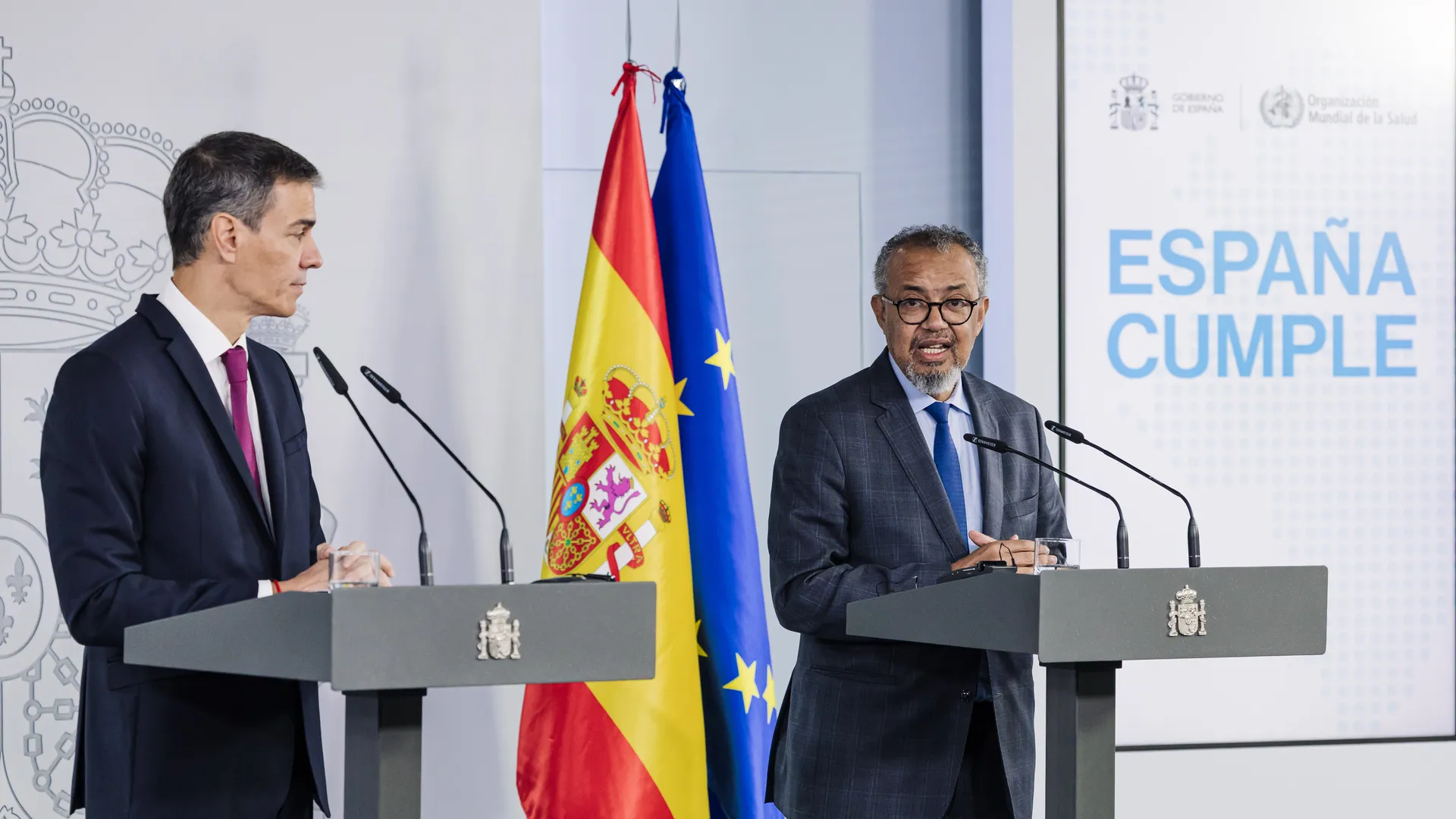
Spanish Prime Minister Pedro Sánchez (left) and WHO Director-General Tedros Adhanom Ghebreyesus (right) speak at a media conference on May 12, 2026, in Madrid. The U.S. CDC would historically hold a greater leadership role during outbreaks, but it has stepped back from that role since exiting the WHO.
NL: Are there any pathogens you're particularly worried about regarding future outbreaks?
JG: I don't have any that I would name — you know, I would not have put hantavirus on a bingo card for 2026. And so, I wouldn't put a list together, but I would say that we are spinning out outbreaks like this more commonly, given our close contact with each other, our decreasing vaccine rates for some things, and just our global travel patterns. These factors are incredibly important to take into account, as well as climate change.
NL: Do you think the CDC could regain its capacity quickly, given investment, or could it take a long time to rebuild?
JG: I hope it will be in short order. There are extraordinary scientists that are still employed at CDC, who are the best of the best at work like this. My concern is it does take longer to build back something that was dismantled than it takes to keep something going.
I also have two other concerns. We've lost a lot of really important leadership at CDC and some very high-level experts, based on the current climate. That is unfortunate, to lose thought leaders. Then, going with that, the impact on the pipeline of new people going into public health — it is the exact time where we need everyone in public health to join us, but we do have a lot of concerns from students: "Will there be a career for me in this?" And the answer is absolutely yes, but we need to make sure we are showing them that.
In a moment when there is less investment in the public health infrastructure in the United States, you can understand why they would have questions.
NL: I assume that concern also extends to international students coming to the U.S. to train?
JG: Absolutely. When you make it harder to teach and to partner with other people in public health, that is going against what we know are the best practices. Public health is a team science. We need to all be doing this together to move the health of everyone forward. We cannot look at one particular area and say we're only going to focus on that without recognizing that the health of people everywhere affects all of us.
NL: One message leaders keep reiterating in this current outbreak is that "this is not COVID." Could you compare the two viruses?
JD: A couple of huge differences between the two: First of all, hantavirus is a known virus. We do have experience with it. It is also a rare virus. COVID was a novel virus [SARS-CoV-2] that we were learning about in real time in front of everyone. It also was not rare once it began; COVID is extremely transmittable from person to person.
What we call the R0 [pronounced R-naught], which is the reproductive number, is very high for COVID. It is very low for hantavirus. One infected person with the Andes strain [the type of hantavirus implicated in the cruise outbreak] will infect maybe 1.19 people, additionally. So the transmission rate is very, very slow, which is a good thing.
[In a previous outbreak, the median R0 across the whole outbreak was 1.19, while it was around 2.1 at the outbreak's start and 0.96 after containment measures were employed.]
The fatality rate of COVID at the beginning was, unfortunately, quite high, but it never reached the fatality rate of what we see with hantavirus, either.
Another comparison with COVID is, because so few people get [hantavirus], we don't need to be worried about mutational changes the way we saw with COVID. The more people that have it, the more ability a virus has to mutate, and we just don't have enough cases of hantavirus to be concerned about the instability of the virus and it mutating.
NL: During a past outbreak in Argentina involving transmission at a birthday party, the R0 of the Andes virus was estimated to be higher. What makes the difference there?
JD: The more general R0 [of 1.19] is aggregated across our traditional, although unusual [infrequent], outbreaks of Andes virus. The one at the birthday party in Argentina was a bit higher because of the close contact in the situation. You don't often see an outbreak like this, where multiple people are going to have that level of close contact.
I think that's the role that the cruise ship is also playing in this particular outbreak. Again, cruise ships are not where we would think about hantavirus, but given that it came onto a cruise ship, there was this closed environment where, particularly in the weather that they were in, where people were not outdoors all the time. And so you were inside, in close quarters, and more people ended up being a close contact than we would normally expect to see.

Public health experts did not expect to see a cluster of hantavirus cases associated with a cruise.
NL: With the Andes virus, what degree of interaction is a concern? And how is "close contact" defined?
JD: For hantavirus, it appears to be about a 24-hour window at the onset of symptoms that someone has enough virus that they're shedding to transmit to another person. So, it's a fairly small window.
But "close contact" in previous hantavirus outbreaks and this one so far does appear to be contact where you are sleeping in the same room with someone, sharing meals for long periods of time in a smaller space than the entirety of a cruise ship, for example, [or] if you are a health professional who has been taking care of a person during that time period. So it's about prolonged time together during that window when you're most likely to transmit the virus to another person.
NL: Would "prolonged" mean a couple of hours?
JG: I don't actually know that we have a better definition on hours. When we think of a person who shares a bedroom with someone else, those are long hours that you're together, but it doesn't necessarily have to be eight hours.
In the Argentina outbreak with the birthday party, they knew how long people were in this room at this birthday party, and there's actually even tracking of exactly where everyone was situated at the tables while they were consuming food, which is another great way to transmit if it's a respiratory illness and the room is closed. [The index patient in that case was reportedly at the event for 90 minutes and had a fever.]
All of those things are going to contribute to this close contact. Close contact outdoors is really different than close contact indoors.
NL: How are we confident that asymptomatic spread isn't a likely scenario?
JG: We've not seen any human-to-human transmission from someone who's been asymptomatic. So as long as people are remaining asymptomatic, their risk of transmitting it to another human appears extremely low, if not nonexistent.
It's what we would call just basic surveillance, "shoe leather" epidemiology. It's tracking all these cases [during outbreaks]. To wrap back to the HAN, this is one of the reasons why it's important that a health alert does go out; while we don't anticipate there would be cases that aren't related to the cruise ship, we would need to know if there are any.
RELATED STORIES
- 'We have basically destroyed what capacity we had to respond to a pandemic,' says leading epidemiologist Michael Osterholm
- 'I don't know if CDC will survive, to be quite frank': Former CDC officials describe the disintegration of the agency under RFK
- RFK's proposal to let bird flu spread through poultry could set us up for a pandemic, experts warn
So the monitoring tracks each individual person who you had contact with and then ranks the type of contact it is. Doing that monitoring while people are asymptomatic, as well as if and when they become symptomatic — it is that tracking during the asymptomatic time frame that helps us feel confident that we've not seen any transmission.
NL: So, in past outbreaks, it has always come back to a symptomatic person?
JG: Yes.
NL: Do you have any final messages you'd like to share?
JG: I will just highlight one more time that, while we may be somewhat conspicuously absent from the international efforts, this does not appear to have impacted the general health of Americans at this point in time. So that's the good news.
Editor's note: This interview has been lightly edited for length and clarity. Live Science spoke with Jodie Guest on May 12, 2026; developments in the hantavirus outbreak that took place after that date may not be reflected.
This article is for informational purposes only and is not meant to offer medical advice.

Nicoletta Lanese is the health channel editor at Live Science and was previously a news editor and staff writer at the site. She is a recipient of the 2026 AHCJ International Health Study Fellowship, with a project focused on antibiotic stewardship practices in Japan and the U.S. They hold a graduate certificate in science communication from UC Santa Cruz and degrees in neuroscience and dance from the University of Florida. Beyond Live Science, Lanese's work has appeared in The Scientist, Science News, the Mercury News, Mongabay and Stanford Medicine Magazine, among other outlets. Based in NYC, she also remains involved in dance and performs in local choreographers' work.
You must confirm your public display name before commenting
Please logout and then login again, you will then be prompted to enter your display name.