An illustration of a black hole, with a bright accretion disk surrounding its event horizon — the point of no return beyond which light cannot escape. New research provides unprecedented measurements of this mysterious region.
Scientists have found evidence that gravitational waves from a spectacular black hole collision carry signals from the very edge of the newly formed black hole. If confirmed by future observations, the discovery could provide an entirely new way to investigate what happens in the immediate vicinity of a black hole without ever observing it directly.
In a new study, the researchers analyzed an exceptionally strong gravitational wave event known as GW250114. They identified a "direct wave," a subtle feature of the total gravitational wave signal predicted by theory but never previously detected in real data. The signal appears to contain information from extremely close to the black hole's event horizon, the boundary beyond which nothing, not even light, can escape.
The findings, published June 24 in the journal Nature, suggest that gravitational wave observatories may eventually allow astronomers to probe regions that have remained inaccessible since black holes were first predicted by Albert Einstein's theory of general relativity.
Listening to the edge of a black hole
Although astronomers have photographed the glowing material surrounding some supermassive black holes and have detected dozens of black hole mergers through gravitational waves, the event horizon itself has remained frustratingly difficult to study.
Unlike ordinary light, gravitational waves are tiny ripples in space-time produced when massive objects accelerate. They pass almost undisturbed through the universe, carrying information about violent cosmic events that would otherwise remain hidden.
According to study co-author Sizheng Ma, a postdoctoral researcher at the Perimeter Institute for Theoretical Physics in Canada, the newly identified signal offers a rare glimpse of what happens immediately after two black holes collide.
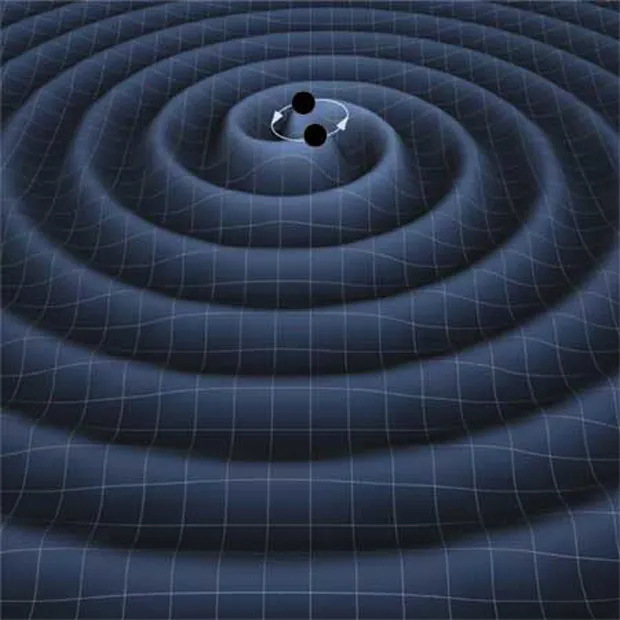
When two black holes merge, they release gravitational waves — ripples in the fabric of space time — throughout the universe. Studying these waves can provide information about the newly formed black hole.
(Image credit: K. Thorne (Caltech) and T. Carnahan (NASA GSFC))
"When two black holes merge, they violently shake space-time itself," Ma told Live Science. "For a brief moment, the region very close to the newly formed black hole's horizon is swept into a fast, fading swirl."
Sign up for the Live Science daily newsletter now
Get the world’s most fascinating discoveries delivered straight to your inbox.
Ma explained that the direct wave is the portion of the gravitational wave signal produced near the horizon and carries the imprint of that motion outward through space.
"That is why it is so interesting," he said. "It may let us 'listen' to what happens near the horizon, a region we cannot see directly with light."
A remarkable black hole collision
The team focused on GW250114, a black hole merger detected on Jan. 14, 2025, by the two Laser Interferometer Gravitational-Wave Observatory (LIGO) detectors in Hanford, Washington, and Livingston, Louisiana.
"Our earlier theoretical work predicted that black hole mergers should produce a direct-wave signal from the near-horizon region," Ma said. "The big question was whether this effect could actually be seen in real data."
GW250114 turned out to provide exactly the conditions needed to test that prediction.
"It was strong enough, clean enough, and close enough to the theoretical situation where this signal should be visible," he said.
To search for the elusive feature, the researchers first removed the best-understood part of the gravitational wave signal, which comes from the newly formed black hole settling down after the merger. Then, they examined the remaining data to determine whether it consisted only of detector noise or contained another physical signal.
"What we found was striking," Ma said. "The remaining signal followed the expected rhythm and fading pattern of a wave shaped by the region very close to the final black hole's horizon."
The team concluded that the leftover signal matches the behavior expected for a direct wave predicted by previous theoretical studies.
ESA's upcoming LISA mission will detect gravitational waves from space, offering even more insights into the mysterious ripples than Earth-based detectors currently can.
(Image credit: All About Space/Getty Images)
A new way to explore extreme gravity
The researchers stressed that their findings do not reveal what lies inside a black hole. Instead, they're providing a new observational tool for investigating the region immediately outside the event horizon.
"The gravitational wave data appear to carry an imprint from very close to the newly formed black hole's horizon — the famous point of no return," Ma said.
He explained that the measurements are consistent with space-time near the horizon being rapidly dragged around by the spinning black hole while the signal fades because of the intense gravitational field.
"For us, the exciting message is that gravitational waves may be giving us a new way to study the edge of a black hole using real observational data," Ma said.
Ma believes the method could eventually become useful for exploring ideas such as quantum gravity — which seeks to unite Einstein's theory of gravity with quantum mechanics — or the black hole information paradox, the longstanding puzzle of whether information that falls into a black hole is truly lost. However, it cannot test those questions directly yet.
"If quantum effects, or any deviations from the standard black-hole picture, leave a measurable imprint there, then direct waves could, in principle, help us search for them in the future," he said.
More observations will be needed
The researchers cautioned that the discovery is based on a single gravitational wave event. While GW250114 provided exceptionally favorable conditions, much stronger evidence will come only if similar signals are found in many additional black hole mergers.
"There are two main directions," Ma said. "The first is theory."
Current models capture the essential physics but remain simplified, and more realistic descriptions of black hole mergers will be needed.
"The second is observation," he added. "This result comes from one exceptionally loud and clean event, so the strongest confirmation would come from seeing the same kind of pattern in other black hole mergers."
As gravitational wave observatories continue to improve and detect increasing numbers of mergers, researchers hope to determine whether direct waves are a universal feature of black hole collisions.
"If the pattern appears repeatedly in the way general relativity predicts," Ma said, "direct waves could become a new way to study black hole horizons or the regions very close to them, and to test Einstein's theory in one of the most extreme environments in the universe."
If future observations confirm the team's results, scientists may have gained something they have sought for decades: a direct observational window into the very edge of a black hole.
Article Sources
Lu, N., Ma, S., Piccinni, O. J., Chen, Y., & Sun, L. (2026). GW250114 reveals signatures of post-merger black-hole horizon. Nature. https://doi.org/10.1038/s41586-026-10696-0
See how much you know about black holes with our black hole quiz!
Andrey got his B.Sc. and M.Sc. degrees in elementary particle physics from Novosibirsk State University in Russia, and a Ph.D. in string theory from the Weizmann Institute of Science in Israel. He works as a science writer, specializing in physics, space, and technology. His articles have been published in AdvancedScienceNews, PhysicsWorld, Science, and other outlets.
You must confirm your public display name before commenting
Please logout and then login again, you will then be prompted to enter your display name.