Get the world’s most fascinating discoveries delivered straight to your inbox.
You are now subscribed
Your newsletter sign-up was successful
Want to add more newsletters?
Join the club
Get full access to premium articles, exclusive features and a growing list of member rewards.
An account already exists for this email address, please log in.
Record-breaking gravitational wave puts Einstein's relativity to its toughest test yet — and proves him right again
A record-breaking gravitational wave signal let scientists "listen" to a distant black hole merger and put Einstein's gravity to its toughest test yet.
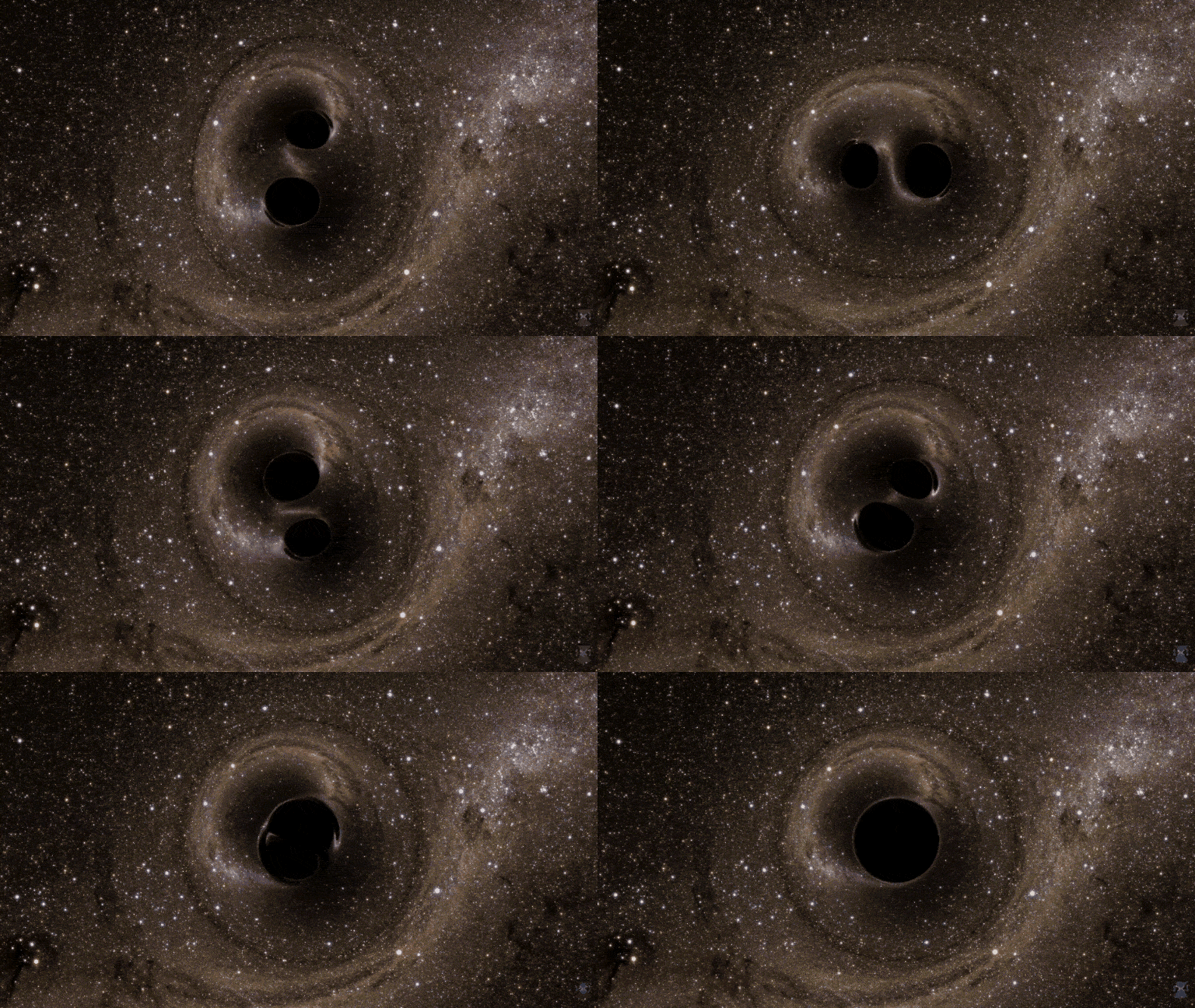
An animation of two black holes merging into one. In a new study, scientists used the clearest gravitational-wave signal ever detected to "listen" to a distant black hole merger and put Einstein's gravity to its toughest test yet.
Scientists have used the loudest gravitational-wave signal ever recorded to put Albert Einstein's more than 100-year-old theory of gravity to its toughest test yet — and once again, it passed.
The signal, called GW250114, came from the merger of two black holes — each about 30 times the mass of the sun — about 1.3 billion light-years from Earth. The event caused ripples through space-time, called gravitational waves, which washed over Earth on Jan. 14, 2025, and were detected by the U.S.-based Laser Interferometer Gravitational-Wave Observatory (LIGO).
Scientists say the event closely resembles the one that resulted in the first direct detection of gravitational waves in 2015. That suggests the black holes in both mergers were similar in size and distance from Earth.
However, this new signal was recorded with roughly three times the clarity of that groundbreaking 2015 discovery, allowing scientists to test Einstein's theory of general relativity more rigorously than ever before.
"It was very clearly the loudest event," Keefe Mitman, a postdoctoral researcher at the Cornell Center for Astrophysics and Planetary Science and co-author of the new paper, told Live Science. "This one event provided more information than everything we've seen before regarding certain tests of general relativity."
The signal's exceptional clarity stems from a decade of steady upgrades to the detectors, Mitman said. Those improvements reduced noise from sources that once interfered with cosmic signals, including seismic vibrations and even passing trucks. As a result, the detectors were sensitive enough to the minuscule distortions in space-time — changes 700 trillion times smaller than the width of a human hair — caused by the recently detected black hole merger.
The findings are detailed in a study published Jan. 29 in the journal Physical Review Letters.
Sign up for the Live Science daily newsletter now
Get the world’s most fascinating discoveries delivered straight to your inbox.
A black hole's "ring"
Because the recently detected signal was so clear, Mitman and his colleagues could zoom in on a fleeting stage after the merger known as the "ringdown." During this phase, the newly formed black hole briefly vibrates — much like a struck bell — emitting gravitational waves in distinct patterns, or "tones," that encode key properties of the black hole, including its mass and spin.
In GW250114, researchers detected the two primary tones predicted for such a merger. Each tone yielded an independent measurement of the black hole's mass and spin — and both matched, effectively verifying general relativity, the team reported in the study.
For the first time, scientists also confidently identified a more subtle, short-lived "overtone" that appears right at the start of the ringing — another feature long predicted by general relativity.
"This event made it very, very obvious that, indeed, this prediction of general relativity was present in the signal, which was really exciting," Mitman told Live Science.
Had the measurements disagreed, he added in a statement, "we would have had a lot of work to do as physicists to try to explain what's going on and what the true theory of gravity would be in our universe."
Earlier analyses of the same event, published in September 2025, confirmed another major prediction rooted in general relativity that Stephen Hawking proposed more than 50 years ago. Hawking predicted that a black hole's surface area — the size of its event horizon — can never shrink, even though enormous amounts of energy escape during a merger as gravitational waves.
The two LIGO gravitational wave observatories in Washington and Louisiana are separated by a distance of roughly 1,880 miles (3030 km). This allows scientists to measure millisecond-level differences in gravitational wave signals.
(Image credit: The Virgo collaboration/CCO 1.0)
In GW250114, scientists estimated that the two original black holes had a combined surface area of about 93,000 square miles (240,000 square kilometers) — roughly the size of Oregon. After the merger, the resulting black hole had a surface area of about 155,000 square miles (400,000 square km) — closer to the size of California — which is consistent with Hawking's prediction.
The golden age
Despite general relativity's repeated success at describing large-scale cosmic phenomena, physicists suspect the theory cannot be the complete description of gravity in our universe. For example, it cannot explain dark matter or dark energy,which are needed to hold galaxies and their clusters together and to explain the universe's accelerating expansion, respectively. Nor does it reconcile cleanly with quantum mechanics, the framework that governs nature at the smallest scales.
Scientists hope gravitational waves from energetic black hole mergers might someday show subtle deviations from Einstein's predictions, which could potentially reveal new physics.
The ringdown phase is especially promising for such tests, Mitman said. Many "beyond-Einstein" theories predict slightly different vibration patterns during the ringdown phase — so measuring more than one tone, as his team did with GW250114, can help scientists place constraints on any possible deviations from general relativity.
If a discrepancy were to be found, researchers could compare the data with predictions from alternative theories of gravity to determine which, if any, matches reality.
"There has to be some way to resolve this paradox to make our theory of gravity consistent with our theory of quantum mechanics," Mitman said in the statement.
Next-generation detectors, including the proposed Einstein Telescope in Europe and the U.S.-based Cosmic Explorer, will be 10 times more sensitive than current facilities. In addition to detecting more events like GW250114, these detectors will be able to observe lower-frequency gravitational waves, which correspond to more massive black holes, thereby allowing scientists to probe entirely new classes of these cosmic behemoths.
Researchers are also looking ahead to the European Laser Interferometer Space Antenna (LISA), which is expected to observe gravitational waves from supermassive black holes at the centers of galaxies. Planned for launch in 2035, LISA is expected to detect a flood of events and could reveal dozens of distinct tones within a single black hole merger event, Mitman said.
"We're living in the regime where we don't have enough data, and we're kind of just twiddling our thumbs waiting for more data to come in," Mitman said. "Once LISA is online, we'll be overwhelmed."
If funding for gravitational-wave science continues, he added, "we're going to see more and more of these golden events and really start to learn wonderful things about the nature of gravity in our universe."
Article Sources
Source: Abac, A. G., Abouelfettouh, I., Acernese, F., Ackley, K., Adamcewicz, C., Adhicary, S., Adhikari, D., Adhikari, N., Adhikari, R. X., Adkins, V. K., Afroz, S., Agapito, A., Agarwal, D., Agathos, M., Aggarwal, N., Aggarwal, S., Aguiar, O. D., Ahrend, I., Aiello, L., . . . Zweizig, J. (2025). Black Hole Spectroscopy and Tests of General Relativity with GW250114. Physical Review Letters, 136(4). https://doi.org/10.1103/6c61-fm1n
Albert Einstein quiz: What do you know about the life of the famous theoretical physicist?
Sharmila Kuthunur is an independent space journalist based in Bengaluru, India. Her work has also appeared in Scientific American, Science, Astronomy and Space.com, among other publications. She holds a master's degree in journalism from Northeastern University in Boston. Follow her on BlueSky @skuthunur.bsky.social
You must confirm your public display name before commenting
Please logout and then login again, you will then be prompted to enter your display name.