Get the world’s most fascinating discoveries delivered straight to your inbox.
You are now subscribed
Your newsletter sign-up was successful
Want to add more newsletters?
Join the club
Get full access to premium articles, exclusive features and a growing list of member rewards.
An account already exists for this email address, please log in.
'A collision within a collision': Neutron star merger hiding in mini-galaxy could answer 2 big astrophysics questions
A powerful "gamma-ray burst" has been seen exploding from merging neutron stars hidden within a previously unknown mini-galaxy leftover from an ancient cosmic crash. The "collision within a collision" could help answer multiple astrophysics questions, researchers say.
A new study has identified a neutron star merger (bottom box) lurking within a tiny galaxy (upper box) that was found within part of a giant stream of gas and dust. (The neutron star merger is an artist's illustration but the other two images are real photos.)
(Image credit: X-ray: NASA/CXC/Penn State Univ./S. Dichiara; IR: NASA/ESA/STScI; Illustration: ERC BHianca 2026 / Fortuna and Dichiara, CC BY-NC-SA 4.0; Image Processing: NASA/CXC/SAO/P. Edmonds)
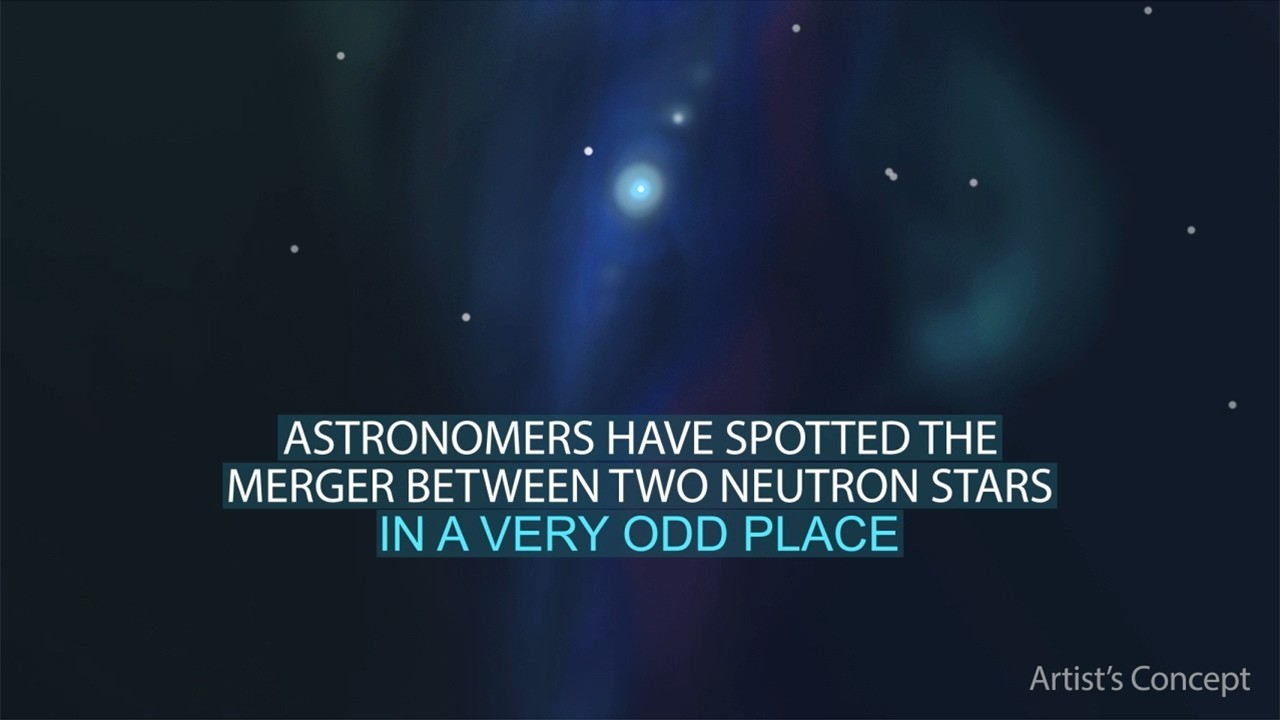
Astronomers have spotted a colossal explosion coming from a pair of merging neutron stars lurking within the remnants of an ancient galaxy pileup. The unexpected "collision within a collision" could help answer "not one, but two" major astrophysics questions, the researchers claim.
In a new study, published March 10 in The Astrophysical Journal Letters, an international team of scientists revealed the discovery of a new gamma-ray burst (GRB) — one of the universe's most powerful and luminous types of explosions — shooting a beam of radiation directly at Earth from around 4.7 billion light-years away.
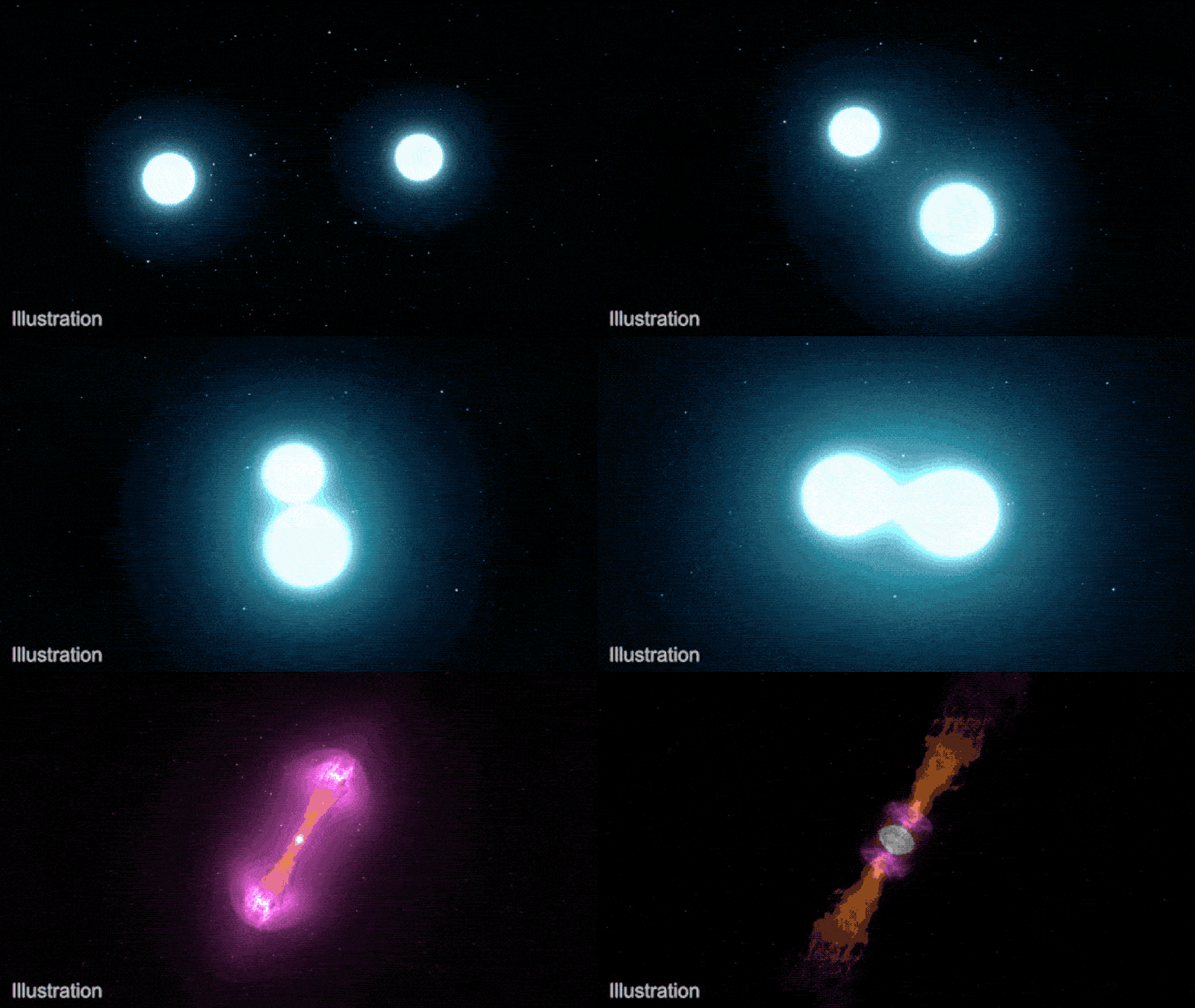
The supercharged shock wave, dubbed GRB 230906A, was spotted in 2023 by the Earth-orbiting Fermi Gamma-ray Space Telescope and likely originates from two neutron stars — ultradense stellar remnants that pack the mass of a sunlike star into an object just a few miles across — that were merging into a single massive entity. Such a merger can also shoot out ripples in the fabric of space-time, known as gravitational waves, and seed their surroundings with valuable metals like gold and platinum.
The GRB was spotted in the middle of supposedly empty space, with no clear origin in the visible-light or the radio spectrums. This surprised the researchers, as these types of signals normally come from near the centers of large galaxies, like the Milky Way.
But when the study team turned other telescopes — including the Hubble Space Telescope, the Chandra X-ray Observatory and the Neil Gehrels Swift Observatory (all of which orbit Earth) — toward the signal, they found that the energy pulse was actually coming from a tiny, never-before-seen galaxy.
When neutron stars collide, they explode, unleashing bright flashes of radiation known as gamma-ray bursts (GRBs).
(Image credit: NASA’s Goddard Space Flight Center/Conceptual Image Lab)
This mini-galaxy lies within a giant stream of gas and dust that stretches around 600,000 light-years across, which is roughly six times wider than our galaxy. The researchers have not measured the new galaxy's exact size yet, but the stellar cluster is likely very small, given that it was not seen until now.
The giant gas stream is likely left over from when multiple galaxies crashed together and got dragged apart in the early universe, the team said. The newfound mini-galaxy lies within a particularly dense patch of gas that would have been a prime spot for new stars to form in the aftermath of this epic collision. The researchers predict that the progenitor stars that eventually birthed the merging neutron stars could have been born around 700 million years ago.
Sign up for the Live Science daily newsletter now
Get the world’s most fascinating discoveries delivered straight to your inbox.
"We found a collision within a collision," study co-author Eleonora Troja, an astrophysicist at the University of Rome, said in a statement. "The galaxy collision triggered a wave of star formation that, over hundreds of millions of years, led to the birth and eventual collision of these neutron stars."
Double cosmic mystery
The discovery of the GRB, coupled with its location in a mini-galaxy, offers new clues to explain previous anomalous findings.
"Finding a neutron star collision where we did is game-changing," study lead author Simone Dichiara, an assistant research professor in the Department of Astronomy and Astrophysics at Penn State, said in the statement. "It may be the key to unlocking not one, but two important questions in astrophysics."
The new findings could help explain why other GRBs and heavy metals like gold and platinum are occasionally spotted outside major galaxies.
(Image credit: Credit: X-ray: NASA/CXC/Penn State Univ./S. Dichiara; IR: NASA/ESA/STScI; Illustration: ERC BHianca 2026 / Fortuna and Dichiara, CC BY-NC-SA 4.0; Image Processing: NASA/CXC/SAO/P. Edmonds)
The first mystery that could be solved is why we occasionally detect GRBs coming from places other than large galaxies, where star formation is much less frequent. This is rare, but when it does happen, astrophysicists are often left scratching their heads. However, the new study suggests that GRBs could be coming from similar tiny galaxies that we cannot easily see.
"This discovery reveals new homes for these cosmic collisions and shows they don't just happen in big galaxies," Dichiara and Troja jointly wrote in an article in The Conversation.
The second mystery that could be solved is why astronomers infrequently find elements like gold and platinum, as well as other heavy metals, outside big galaxies. The researchers were unable to detect which metals were given off by this particular GRB. However, as with the previous mystery, this explosion proves that it is possible for these metals to be seeded beyond major star-forming regions.
"It points to a new path for spreading heavy metals where we least expect them," Dichiara and Troja wrote.
Quick Look: NASA Discovers Crash of Extreme Stars in Unexpected Site - YouTube
Harry is a U.K.-based senior staff writer at Live Science. He studied marine biology at the University of Exeter before training to become a journalist. He covers a wide range of topics including space exploration, planetary science, space weather, climate change, animal behavior and paleontology. His recent work on the solar maximum won "best space submission" at the 2024 Aerospace Media Awards and was shortlisted in the "top scoop" category at the NCTJ Awards for Excellence in 2023. He also writes Live Science's weekly Earth from space series.
You must confirm your public display name before commenting
Please logout and then login again, you will then be prompted to enter your display name.