Get the world’s most fascinating discoveries delivered straight to your inbox.
You are now subscribed
Your newsletter sign-up was successful
Want to add more newsletters?
Join the club
Get full access to premium articles, exclusive features and a growing list of member rewards.
An account already exists for this email address, please log in.
Hubble watches neutron stars collide and explode to create black hole and 'birth atoms'
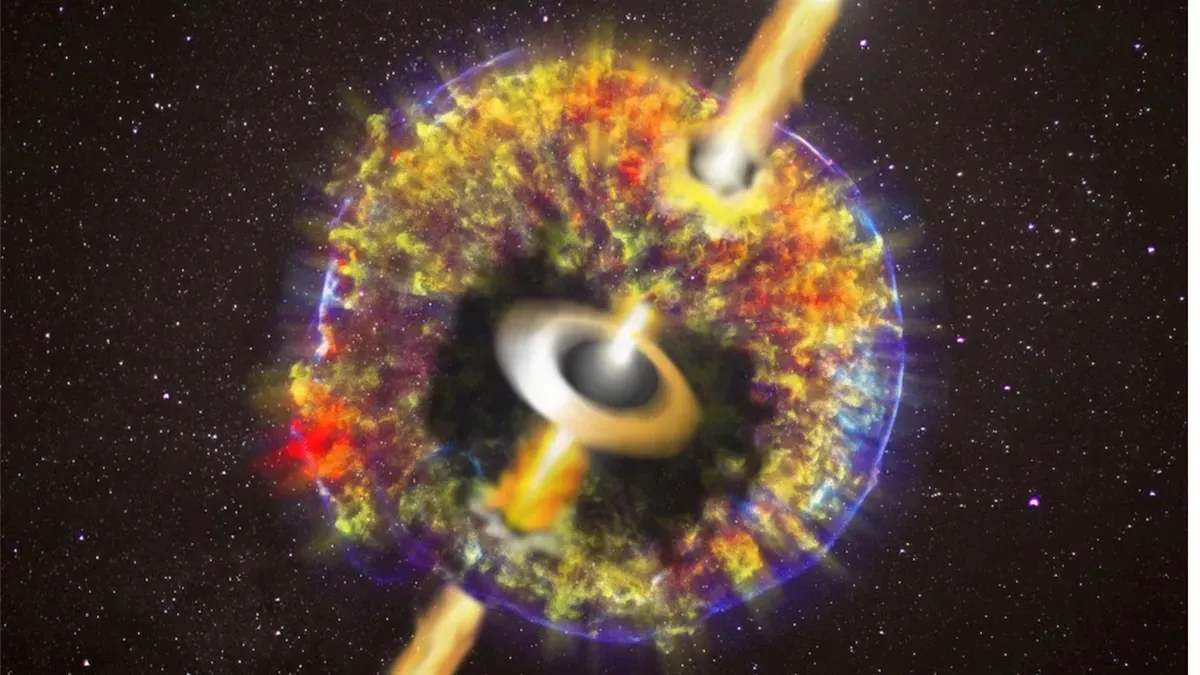
Astronomers have used a range of telescopes, including Hubble, to watch as particles dance around a neutron star collision that created the smallest black hole ever seen.
Astronomers have witnessed the titanic collision between two neutron stars that resulted in the birth of the smallest black hole ever seen and forged precious metals like gold, silver, and uranium.
The team's snapshot of this violent and powerful collision, which occurred 130 million light-years away from us in the galaxy NGC 4993, was created with a range of instruments, including the Hubble Space Telescope. It will hopefully paint a picture of the "past, present, and future" of the mergers of these dense dead stars. This could reveal the origins of elements heavier than iron, which can't be forged in even the most massive stars.
The collision and merger of the neutron stars results in a powerful blast of light called a "kilonova." As the wreckage of this event expands at nearly the speed of light, the kilonova illuminates its surroundings with light as bright as hundreds of millions of suns.
A team of researchers led by scientists for the Cosmic DAWN Center at the Neils Bohr Institute arrived at this new picture of neutron star mergers when they set about investigating the mysteries of kilonovas.
"We can now see the moment where atomic nuclei and electrons are uniting in the afterglow," team member Rasmus Damgaard, a researcher at the Cosmic DAWN Center, said in a statement. For the first time, we see the creation of atoms, we can measure the temperature of the matter, and we can see the microphysics in this remote explosion."
"It is like admiring three cosmic background radiation surrounding us from all sides, but here, we get to see everything from the outside. We see before, during, and after the moment of birth of the atoms."
Sign up for the Live Science daily newsletter now
Get the world’s most fascinating discoveries delivered straight to your inbox.
The gold in your jewelry came from the universe's most violents events
Neutron stars are born when stars at least 8 times as massive as the sun exhaust their fuel for nuclear fusion and can no longer support themselves against their own gravity.
The outer layers of these stars are blasted away in supernova explosions, leaving a stellar remnant with a mass equal to between 1 and 2 suns crushed into a diameter of around 12 miles (20 kilometers).
The collapse of the core forces electrons and protons together, creating a sea of particles called neutrons. This material is so dense that a mere sugar cube's worth of neutron star matter would weigh 1 billion tons if brought to Earth. That's about the same as cramming 150,000,000 elephants into the same space that a sugar cube occupies.
It is probably no surprise that this extreme and exotic matter plays a key role in creating elements heavier than iron.
An illustration shows a cloud of material erupting from a collision of neutron stars
(Image credit: NASA Goddard/CI Lab)
Neutron stars don't always live in isolation. Some of these dead stars occupy binary systems along with a companion living star. In rare instances, this companion star is also massive enough to create a neutron star, and it isn't "kicked away" by the supernova explosion that creates the first neutron star.
The result is a system with two neutron stars orbiting each other. These objects are so dense that as they swirl around each other, they generate ripples in spacetime (the four-dimensional unification of space and time) called gravitational waves that ripple through space, carrying away angular momentum.
As the system loses angular momentum, the orbit of the neutron stars tightens, meaning that the neutron stars move closer to each other. This results in gravitational waves rippling away faster and faster, carrying away more and more angular momentum.
This situation ends when neutron stars are close enough for their immense gravity to take over and drag these extremely dense dead stars together to collide and merge.
This collision sprays out neutron-rich matter with temperatures of many billions of degrees, thousands of times hotter than the sun. These temperatures are so hot that they are similar to those of the rapidly inflating universe just one second after the Big Bang.
An artist's depiction of colliding neutron stars sending out ripples in spacetime called gravitational waves.
(Image credit: R. Hurt/Caltech-JPL)
Ejected particles like electrons and neutrons dance around the body, birthed by the colliding neutron stars, which rapidly collapse to form a black hole in a fog of plasma that cools over the next few days.
Atoms in this cooling cloud of plasma quickly grab free neutrons via what is called the rapid neutron capture process (r-process) and also ensnare free electrons. This creates very heavy but unstable particles that rapidly decay. This decay releases the light that astronomers see as kilonovas, but it also creates lighter elements that are still heavier than iron, like gold, silver and uranium.
This team saw the afterglow of particles being snatched to forge heavy elements like Strontium and Yttrium, reasoning that other heavy elements were undoubtedly created in the aftermath of this neutron star collision.
"The matter expands so fast and gains in size so rapidly, to the extent where it takes hours for the light to travel across the explosion," team member Kasper Heintz, a researcher at the Niels Bohr Institute, said. "This is why, just by observing the remote end of the fireball, we can see further back in the history of the explosion. Closer to us, the electrons have hooked to atomic nuclei, but on the other side, on the far side of the newborn black hole, the 'present' is still just the future."
The team's results wouldn't have been possible without the collaboration of telescopes across the globe and beyond.
"This astrophysical explosion develops dramatically hour by hour, so no single telescope can follow its entire story. The viewing angle of the individual telescopes to the event is blocked by the rotation of the Earth," team leader and Neils Bohr Institute researcher Albert Sneppen said in the statement. "But by combining the existing measurements from Australia, South Africa, and the Hubble Space Telescope, we can follow its development in great detail."
Robert Lea is a science journalist in the U.K. who specializes in science, space, physics, astronomy, astrophysics, cosmology, quantum mechanics and technology. Rob's articles have been published in Physics World, New Scientist, Astronomy Magazine, All About Space and ZME Science. He also writes about science communication for Elsevier and the European Journal of Physics. Rob holds a bachelor of science degree in physics and astronomy from the U.K.’s Open University