
















James Webb Space Telescope sees lonely supermassive black hole-powered quasars in the early universe
The James Webb Space Telescope has discovered lonely quasars in the early universe, with "empty larders" that defy theories surrounding their growth to monster sizes.

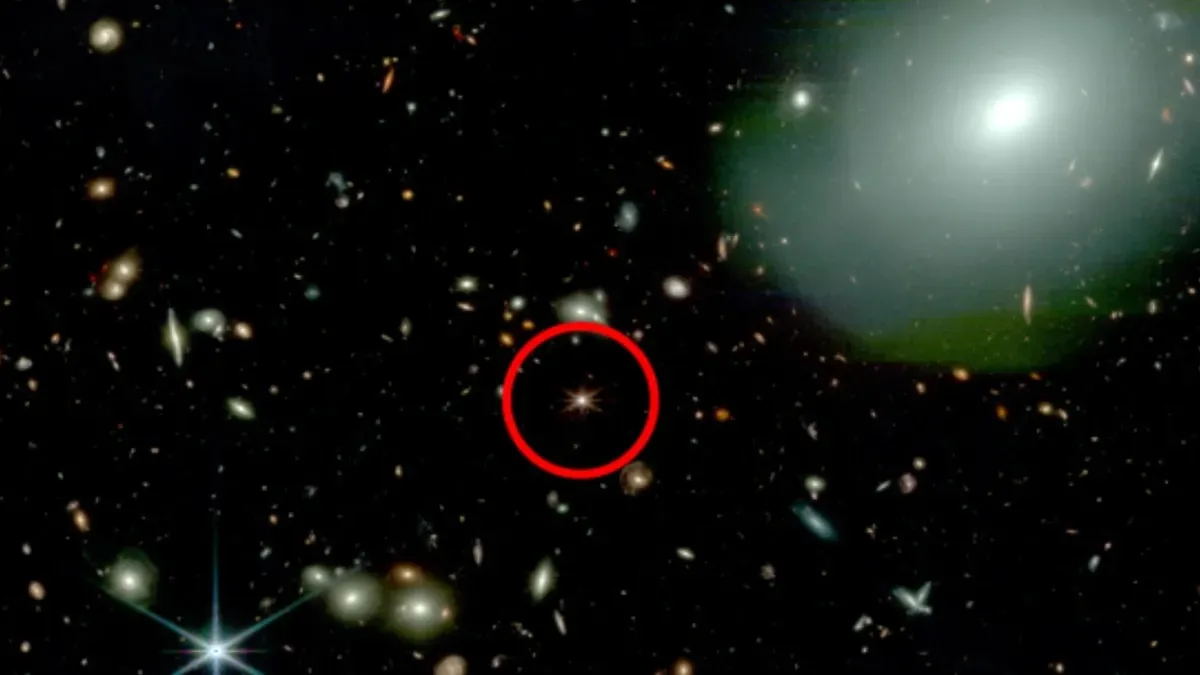
Using the James Webb Space Telescope, astronomers have peered back 13 billion years to discover surprisingly lonely supermassive black hole-powered quasars.
The James Webb Space Telescope's (JWST) observations are confusing because isolated black holes should struggle to gather enough mass to reach supermassive status, especially just a few hundred million years after the Big Bang. The discovery further muddies the waters when it comes to the puzzle of how some black holes grew to masses equivalent to millions or even billions of suns when the universe was less than a billion years old.
The findings came about after a team of scientists used the JWST to study the environments of five of the earliest known quasars, which formed when the cosmos was between 600 and 700 million years old. The team found that the surroundings of these quasars, known as "quasar fields," were surprisingly varied. Some were the densely packed environments scientists predict, but others were sparsely populated "empty-larders" that would struggle to feed the growth of supermassive black holes.
"Contrary to previous belief, we find, on average, these quasars are not necessarily in those highest-density regions of the early universe. Some of them seem to be sitting in the middle of nowhere," Anna-Christina Eilers, assistant professor of physics at Massachusetts Institute of Technology, said in a statement. "It's difficult to explain how these quasars could have grown so big if they appear to have nothing to feed from."
Related: Biggest black hole jets ever seen are as long as 140 Milky Ways
Quasars need full larders
Supermassive black holes are believed to lurk at the hearts of all large galaxies in the relatively modern universe. Because no star is large enough to collapse and black holes with such monstrous masses, scientists know supermassive black holes must form in different ways than so-called "stellar-mass black holes" with masses between 10 and 100 times that of the sun, born from the deaths of massive stars.
Supermassive black holes may grow through progressive mergers of larger and larger black holes, models suggest — however, the problem is that this process should take over 1 billion years. Yet, the JWST is seeing supermassive black holes that formed in way less time.
Get the world’s most fascinating discoveries delivered straight to your inbox.
It is possible to see these supermassive black holes because they sit in turbulent gas-rich immediate environments called active galactic nuclei (AGN) from which they feed. That also facilitates their growth. The immense mass of the black holes in these environments causes flattened clouds of gas and dust around them to glow brightly, often outshining the combined light of every star in the galaxy that homes them. This light, trillions of times brighter than the sun, indicates a quasar.
However, supermassive black holes need a "delivery service" to keep their immediate surroundings well-stocked with gas and dust to achieve this incredible luminosity.
"It's just phenomenal that we now have a telescope that can capture light from 13 billion years ago in so much detail," Eilers said. "For the first time, JWST enabled us to look at the environment of these quasars, where they grew up, and what their neighborhood was like."

An illustration shows a supermassive black hole powered quasar.
To investigate the wider surroundings of quasars, the team selected five supermassive black hole-powered regions studied by the JWST between August 2022 and June 2023. This required "stitching together" multiple images to create a quasar field mosaic for each supermassive black hole neighborhood.
By processing the multiple wavelengths of light in the images, it was also possible to determine if the light came from a quasar's neighbor galaxy and measure how distant that galaxy originated in the bright central quasar.
"We found that the only difference between these five quasars is that their environments look so different," Eilers said. "For instance, one quasar has almost 50 galaxies around it, while another has just two. And both quasars are within the same size, volume, brightness and time of the universe.
"That was really surprising to see."
Did early supermassive black holes have 'growth spurts?'
The team's findings challenge the idea of supermassive black hole growth, and even galaxy formation as a whole. The current understanding is that this evolution was guided by a vast "cosmic web" of dark matter; dark matter accounts for around 85% of all matter but remains effectively invisible to us.
Filaments of dark matter in the cosmic web guided gas and dust in the early universe, attracting primordial matter along its vast tendrils. Where the strands of this cosmic web met, overly dense regions of matter accumulated. Here, early galaxies were built, and the first quasars should be found.
"The cosmic web of dark matter is a solid prediction of our cosmological model of the universe, and it can be described in detail using numerical simulations," team leader Elia Pizzati, a graduate student at Leiden University, said in the statement. "By comparing our observations to these simulations, we can determine where in the cosmic web quasars are located."

A illustration of a galaxy with a quasar heart growing where filaments of the "cosmic web" meet
The supermassive black holes situated at these nodes in the cosmic web should grow via the steady and rapid accretion of gas and dust supplied by the cosmic web like a galactic Grub Hub —this would allow the quasars to achieve monstrous masses and extreme brightness — but scientists still need to know how this happened so early in the universe's history.
"The main question we're trying to answer is, how do these billion-solar-mass black holes form at a time when the universe is still really, really young? It's still in its infancy," Eilers said.
Unfortunately, this research appears to have raised more questions than answer the ones already troubling scientists. The barren neighborhoods seem to signify a lack of dark matter and cosmic web node overdensities. If that's the case, current growth mechanism theories can't account for these quasars.
RELATED STORIES
One potential solution to this mystery is that these early quasars are actually surrounded by cosmic dust and are, therefore, not visible. The team now intends to "tune" their observations of these potentially empty quasar fields to discover any such shrouded galaxies.
"Our results show that there's still a significant piece of the puzzle missing of how these supermassive black holes grow," Eilers concluded. "If there's not enough material around for some quasars to be able to grow continuously, that means there must be some other way that they can grow that we have yet to figure out."
The team's research was published on Oct. 17 in The Astrophysical Journal.
Originally posted on Space.com.

Robert Lea is a science journalist in the U.K. who specializes in science, space, physics, astronomy, astrophysics, cosmology, quantum mechanics and technology. Rob's articles have been published in Physics World, New Scientist, Astronomy Magazine, All About Space and ZME Science. He also writes about science communication for Elsevier and the European Journal of Physics. Rob holds a bachelor of science degree in physics and astronomy from the U.K.’s Open University