
 Live Science Plus


Mammals ballooned in size after the dinosaurs went extinct. Here's how they did it.
A new fossil analysis gives hints.

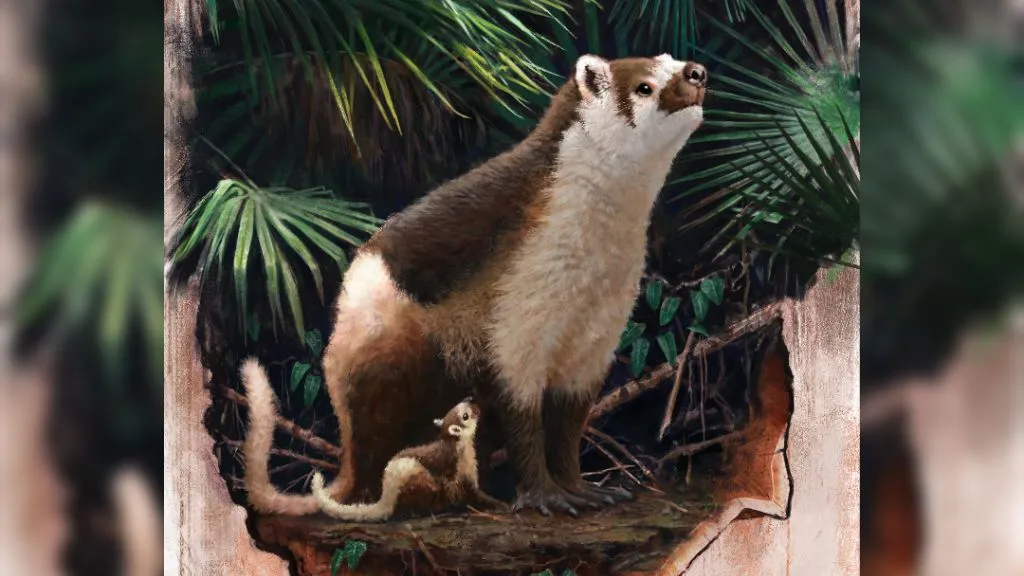
About 62 million years ago — only 4 million years after an Everest-size asteroid hit Earth and ended the age of dinosaurs — fuzzy creatures with finger-like digits on their feet emerged as some of the first large mammals to ever roam the planet. These animals, about the size of a big dog, towered over the shrew- to possum-size mammals that existed before the space rock struck, and now, scientists think they know how the critters outgrew their diminutive mammal cousins.
In a new study, published Wednesday (Aug. 31) in the journal Nature, researchers analyzed the fossilized teeth and bones of Pantolambda bathmodon, a stocky, now-extinct mammal that weighed roughly 92 pounds (42 kilograms) when fully grown.
"They probably got a little bit bigger [than the analyzed specimens], so that's pushing 100 pounds [45 kg], which is pretty large when you think about the fact that this is a mammal that lived only four million years after T. rex went extinct," said lead author Gregory Funston, who was a research fellow at the University of Edinburgh during the study. "Mammals hadn't gotten bigger than a badger for the whole Mesozoic [252 million to 66 million years ago], so Pantolambda was two or three times that size," said Funston, who is now at the Royal Ontario Museum in Toronto, Canada.
But what was the secret to their impressive size? According to the new study, P. bathmodon likely evolved to birth big, highly developed babies that, similar to the newborns of modern giraffes and hippos, popped out of the womb ready to walk. To be able to hit the ground running, P. bathmodon babies likely first gestated in their mothers' wombs for about seven months, nourished by a placenta.
Related: What happened when the dinosaur-killing asteroid slammed into Earth?
"Today, placentals seem to be unique among mammal groups in having long gestation periods, resulting in larger and more developed young, but it is not clear when in their evolutionary history placental mammals evolved to have a longer gestation," said Gemma Louise Benevento, a postdoctoral researcher in macroevolutionary palaeobiology at the Senckenberg Biodiversity and Climate Research Centre (SBiK-F) in Germany, who was not involved in the study.
The new research provides evidence that 62 million years ago, P. bathmodon was capable of carrying months-long pregnancies, and suggests that this reproductive strategy could have helped diverse placental mammals explode in size following the extinction of nonavian dinosaurs, Benevento told Live Science in an email.
Get the world’s most fascinating discoveries delivered straight to your inbox.

These photographs show the skull of Pantolambda, as seen from above (left) and below (right). The image on the right shows the animal's teeth, the sharp ridges and grooves of which were used for chewing plant material.
How mammals got so big
Physically, P. bathmodon looked like a mash-up of several modern mammals that exist today.
"In some ways, it would have looked dog-like, in other ways it would have looked bear-like," Funston told Live Science. The animal had a long, thin tail and feet that somewhat resembled human hands, complete with fingers and nails. And notably, P. bathmodon didn't have a proportionately large head to match its bulky body, hinting that its ancestors’ body size increased before their brain size did; recent research suggests that this "brawn before brains" pattern of evolution can be seen in many placental mammals that emerged after the end-Cretaceous extinction.
To learn more about the life history of this quirky mammal, Funston and his colleagues analyzed 12 P. bathmodon specimens, which together included 23 bones and a mixture of 22 teeth from adults and juveniles. All the fossils originated from the San Juan Basin of New Mexico, where paleontologists previously uncovered a bone bed, or a rock layer packed with fossils, most of which were P. bathmodon specimens.
"By sampling all these specimens from a single site, a single bonebed, it gives us a bit of an advantage because it represents a single community in time," Funston said. Collecting samples across many individuals, whose ages ranged from about 2 years to 11 years old at the time of death, enabled the team to estimate how quickly the animals grew and how long they lived for.
What's more, by hunting for specific chemical signatures in the animals' teeth and bones, the study authors could even determine how long each individual gestated in the womb, when they were born and roughly how long they suckled. Such tooth analyses have previously only been performed on modern animals and some primate fossils up to 2.6 million years old, but never before on an animal as old as P. bathmodon.
The technique takes advantage of the fact that, as teeth develop, the hard outer enamel and underlying dentine tissue accumulate daily, in layers similar to the growth lines of a tree. In addition, the cementum, the hard tissue that covers the tooth root, gains a new layer each year. Nestled among these growth rings is a distinctive "birth line" that appears in both adult and baby teeth, although in slightly different positions within the tooth structure.
Related: How little, furry mammals that scurried under dinosaurs' feet came to rule the world
The birth line contains a high concentration of zinc, because shortly after birth, mammalian mothers produce a special, high-nutrient milk called colostrum that carries a large amount of the mineral. Then, after the mother stops producing colostrum and starts making normal breastmilk, the birth line gives way to tooth tissue layers imbued with lots of barium — an element that gets incorporated into teeth and bones during the suckling period, in a manner similar to calcium.
By taking thin slices of the P. bathmodon teeth — thin enough for light to shine through — the researchers were able to spot these distinctive lines of zinc and barium. The analysis suggested that P. bathmodon carried pregnancies for just over seven months and that their babies suckled for only one to two months. By that time, the youngsters would have weighed about 20 pounds (9 kg), based on an analysis of their bones, Funston said.

This photo shows the exact site where the specimens analyzed in the study were found. This site is what palaeontologists call a bone bed, where many individuals of one or more species are found in the same layer. Specimens from this site include very young and very old individuals of Pantolambda.
At birth, a P. bathmodon newborn "probably would have been mobile. It probably would have had fur all over its body. Its eyes were probably open, and it probably had a full mouth of teeth," Funston said. And shortly after birth, the animal's growth rate, as recorded in its bones, was so fast that it likely reached sexual maturity within the first year of life. According to the study, most P. bathmodon individuals died between the ages of 2 and 5 years old, although the oldest individual survived to age 11.
"Most of the specimens we have died at about 3 or 4 years old, so that's really, really quick," when compared with lifespans of comparably sized wild mammals, Funston said.
If this strange dog-bear mash-up carried its young for an extended period of time and then birthed large babies, other placental mammals may have been doing the same. This could explain how mammals suddenly ballooned in size after the dino-killing asteroid slammed into Earth, he said.
RELATED STORIES
If applied to additional fossils, the geochemical tooth analysis used in the study could shed new light on prehistoric life, Benevento told Live Science.
"The authors show that it is possible to directly measure changes in the teeth of 60+ million year old mammals, and from this data infer the gestation length, weaning age, and age of death of individuals," she said. "Teeth are abundant in the mammal fossil record, and therefore the application of this technique to Mesozoic and Cenozoic [66 million years ago to now] mammal fossils opens up new and exciting possibilities."
"In the future I hope to see this technique used, if possible, on even older mammal groups from the Mesozoic," she said.
Originally published on Live Science.

Nicoletta Lanese is the health channel editor at Live Science and was previously a news editor and staff writer at the site. She is a recipient of the 2026 AHCJ International Health Study Fellowship, with a project focused on antibiotic stewardship practices in Japan and the U.S. They hold a graduate certificate in science communication from UC Santa Cruz and degrees in neuroscience and dance from the University of Florida. Beyond Live Science, Lanese's work has appeared in The Scientist, Science News, the Mercury News, Mongabay and Stanford Medicine Magazine, among other outlets. Based in NYC, she also remains involved in dance and performs in local choreographers' work.