
 Live Science Plus



Here's What SpaceX's Starlink Satellites Look Like in the Night Sky

It's been one day since SpaceX launched its first 60 Starlink internet satellites into orbit, and a skywatching sleuth has already spotted them soaring across the night sky. Netherlands-based satellite tracker Marco Langbroek stunned space fans tonight (May 24) with this jaw-dropping video of dozens of Starlink satellites soaring overhead.
"Here is the video I shot, be prepared to be mind-blown!" Langbroek wrote on his website SatTrackCam Leiden Blog, where he shared the video. He counted at least 56 objects as the satellites flew overhead.
Related: SpaceX's 1st Starlink Satellite Megaconstellation Launch in Photos!
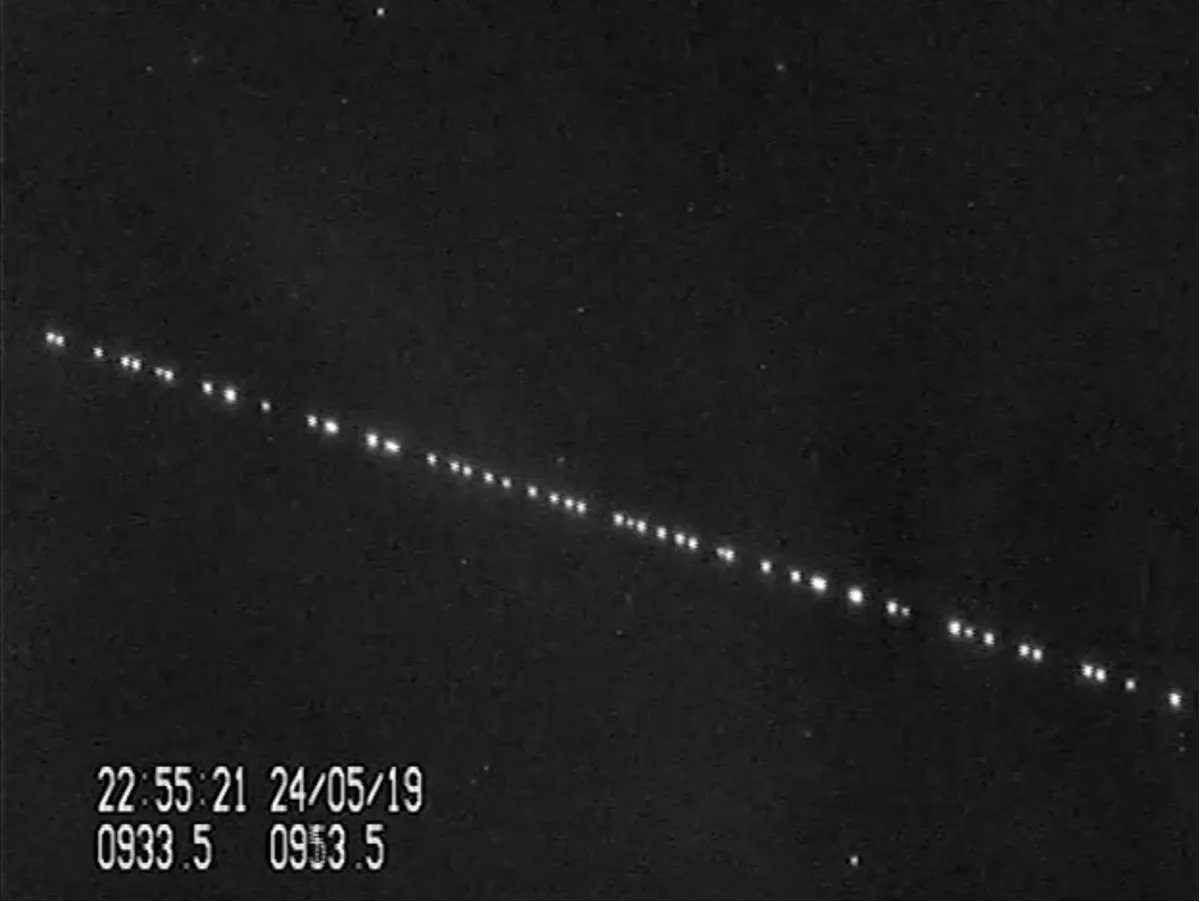
In the video, SpaceX's Starlink satellites pass overhead like a string of pearls, a brilliant trail of moving lights in the night sky. SpaceX launched the satellites into an initial orbit 273 miles (440 kilometers) above Earth. They are making their way to a final orbit 342 miles (550 km) up.
SpaceX CEO and founder Elon Musk hinted on Twitter today that the satellites are doing well. "So far, so good," he wrote.
"My search orbit turned out to be not too bad: very close in sky track, and with the objects passing some 3 minutes early on the predictions," he wrote on his website. "And what a SPECTACULAR view it was!"
He used a WATEC 902H low-light-level surveillance camera equipped with a Canon FD 1.8/50 mm lens to capture the view.
Get the world’s most fascinating discoveries delivered straight to your inbox.

"This was quite an amazing sight, and I was shouting 'Owowowow!' when the bright 'train' of objects entered into view," Langbroek told Space.com via email. "They were brighter than I had anticipated."
We'd shout "Owowowow!" too.
After all, it's not every day you can see a fleet of small satellites passing overhead at the same time. And according to Langbroek, this sight won't last.
"Over the coming days the 'train' of objects will be making 2-3 passes each night," he wrote on his website. "As they are actively manoeuvering with their ion thrusters, they will be more spread out with each pass, so the 'train' will probably quickly dissipate."
Each Starlink satellite is equipped with Krypton ion thrusters to adjust its orbit. They'll use those thrusters to spread apart over time.
"Krypton thrusters operative, satellites initiating orbit raise every 90 mins," Musk wrote in a Twitter update today.
SpaceX is building its Starlink megaconstellation to provide affordable internet access to people around the world. The spaceflight company aims to launch 12,000 satellites in all for the constellation. At least 400 satellites are needed for "minor" coverage and 800 for "moderate" coverage, Musk has said.
For comparison: There are only about 2,000 operational spacecraft in Earth orbit today. The sheer number of Starlink satellites planned by SpaceX is staggering, according to Langbroek.
"I do worry a bit what this will do to the night sky when there are thousands of them," he told Space.com. "I wonder if SpaceX has realised how bright they are. Of course they will manoeuvre some 100 km higher, but still, they are bright."
SpaceX isn't alone in its pursuit of a massive fleet of communications satellites in orbit. Similar megaconstellations are being developed by companies such as OneWeb, Telesat and Amazon.
Editor's note: If you snap an amazing photo of SpaceX's Starlink satellites in orbit and would like to share them for a story or photo gallery, send images and comments to spacephotos@space.com!
- See the Evolution of SpaceX's Rockets in Pictures
- Elon Musk: Private Space Entrepreneur
- In Photos: SpaceX's 1st Falcon Heavy Rocket Test Launch Success!
Email Tariq Malik at tmalik@space.com or follow him @tariqjmalik. Follow us@Spacedotcom and Facebook.

Tariq is the editor-in-chief of Live Science's sister site Space.com. He joined the team in 2001 as a staff writer, and later editor, focusing on human spaceflight, exploration and space science. Before joining Space.com, Tariq was a staff reporter for The Los Angeles Times, covering education and city beats in La Habra, Fullerton and Huntington Beach. He is also an Eagle Scout (yes, he has the Space Exploration merit badge) and went to Space Camp four times. He has journalism degrees from the University of Southern California and New York University.