















Indian culture: Customs and traditions
Indian culture is built upon centuries of history and heritage, making it one of the oldest in the world.

Indian culture is among the world's oldest as the people of India can track their civilization back as far as 4,500 years ago. Many sources describe it as "Sa Prathama Sanskrati Vishvavara" — the first and the supreme culture in the world, according to the All World Gayatri Pariwar (AWGP) organization.
Western societies did not always see the culture of India very favorably, according to Christina De Rossi, an anthropologist at Barnet and Southgate College in London. Early anthropologists once considered culture as an evolutionary process, and "every aspect of human development was seen as driven by evolution," she told Live Science. "In this view, societies outside of Europe or North America, or societies that did not follow the European or Western way of life, were considered primitive and culturally inferior. Essentially this included all the colonized countries and people, such as African countries, India, and the Far East."
However, Indians made significant advances in architecture (Taj Mahal), mathematics (the invention of zero) and medicine (Ayurveda) well in advance of many western civilizations.
Population of India
Today, India is a very diverse country, with more than 1.3 billion people, according to the CIA World Factbook, making it the second most populous nation in the world after China. Some estimates, such as those by Statista, place the population at very nearly 1.4 billion. The ethnic makeup of India, according to the CIA is 72 percent Indo-Aryan (a coverall term for people of largely Central Asian descent) and 25 percent are Dravidian (being largely of South Asian descent).
About 35 percent of the population lives in urban areas with an estimated annual rate of a little over 2 percent moving to cities each year. New Delhi is the most populous city in India with a population of 31.18 million people, according to the CIA, second only to Tokyo, Japan for its population size. Mumbai is the second largest city in India with 20.67 million people, followed by Kolkata, Bangalore, Chennai and Hyderabad, all with more than 10 million people.
According to Statista, 26.16 percent of India population was under 14-years-old as of 2020, 67.27 were aged 15 to 64 and 6.57 percent were 65 or older.
Languages of India
India has 28 states and seven territories, according to the World Health Organization. There is no official language in India, according to a Gujarat High Court ruling in 2010, though Hindi is the official language of the government and English is considered a subsidiary official language. The Constitution of India officially recognizes 23 official languages.
Get the world’s most fascinating discoveries delivered straight to your inbox.
Many people living in India write in Devanagari script. In fact, it is a misconception that the majority of people in India speak Hindi. Though many people speak Hindi in India, at least 56 percent of Indian residents speak something other than Hindi, according to the CIA. Bengali,, Marathi, Telugu Tamil, Gujarati and Urdu are some other languages spoken in the country.
Sanskrit, an ancient Indo-European language, came from Northern India. How the language started has been a point of argument amongst linguists. It shares many similarities with English, French, Farsi and Russian languages.
New DNA research in 2017 found that an Aryan migration may have introduced the beginnings of Sanskrit. "People have been debating the arrival of the Indo-European languages in India for hundreds of years," said study co-author Martin Richards, an archaeogeneticist at the University of Huddersfield in England. "There's been a very long-running debate about whether the Indo-European languages were brought from migrations from outside, which is what most linguists would accept, or if they evolved indigenously."
Religion in India
India is identified as the birthplace of Hinduism and Buddhism, the third and fourth largest religions in the world. About 84 percent of the population identifies as Hindu, according to the "Handbook of Research on Development and Religion," edited by Matthew Clarke (Edward Elgar Publishing, 2013).
There are many variations of Hinduism, and four predominant sects — Shaiva, Vaishnava, Shakteya and Smarta.
About 13 percent of Indians are Muslim, making it one of the largest Islamic nations in the world. Christians and Sikhs make up a small percentage of the population, and there are even fewer Buddhists and Jains, according to the "Handbook."
The CIA cited similar figures. According to its World Factbook, around 80 percent of the population is Hindu, 14.2 percent is Muslim, 2.3 percent is Christian, 1.7 percent is Sikh and 2 percent is unspecified.
Indian food

Indian cuisine is especially known for its varied use of spices and is hugely popular around the world.
When the Mughul Empire invaded during the sixteenth century, they left a significant mark on Indian cuisine. "The influence of the Mughal rulers who ruled India is distinctly perceptible in the style of cooking made famous by them. This cuisine is a fusion of Turkish and Persian cuisine, where mostly ground spices are used in the preparation of unique flavor and taste," wrote Krishna Gopal Dubey in "The Indian Cuisine" (PHI Publisher, 2010). Indian cuisine is also influenced by many other countries. It is known for its large assortment of dishes and its liberal use of herbs and spices. Cooking styles vary from region to region.
Wheat, Basmati rice and pulses with chana (Bengal gram) are important staples of the Indian diet. The food is rich with curries and spices, including ginger, coriander, cardamom, turmeric, dried hot peppers, and cinnamon, among others. Chutneys — thick condiments and spreads made from assorted fruits and vegetables such as tamarind and tomatoes and mint, cilantro and other herbs — are used generously in Indian cooking.
Many Hindus are vegetarian, but lamb and chicken are common in main dishes for non-vegetarians. "The Guardian" reports that between 20 percent and 40 percent of India's population is vegetarian. A tradition of vegetarianism appears to go back to the ancient past. "India may have been vegetarian during the Mohenjodaro and Harappan civilizations. We do not know for sure as its script has not been unlocked, but it has been proven that the ancient Dravidian civilization was truly vegetarian," wrote Dubey.
Much of Indian food is eaten with fingers or bread used as utensils. There are a wide array of breads served with meals, including naan, a leavened, oven-baked flatbread; and bhatoora, a fried, fluffy flatbread common in North India and eaten with chickpea curry.
Indian architecture and art
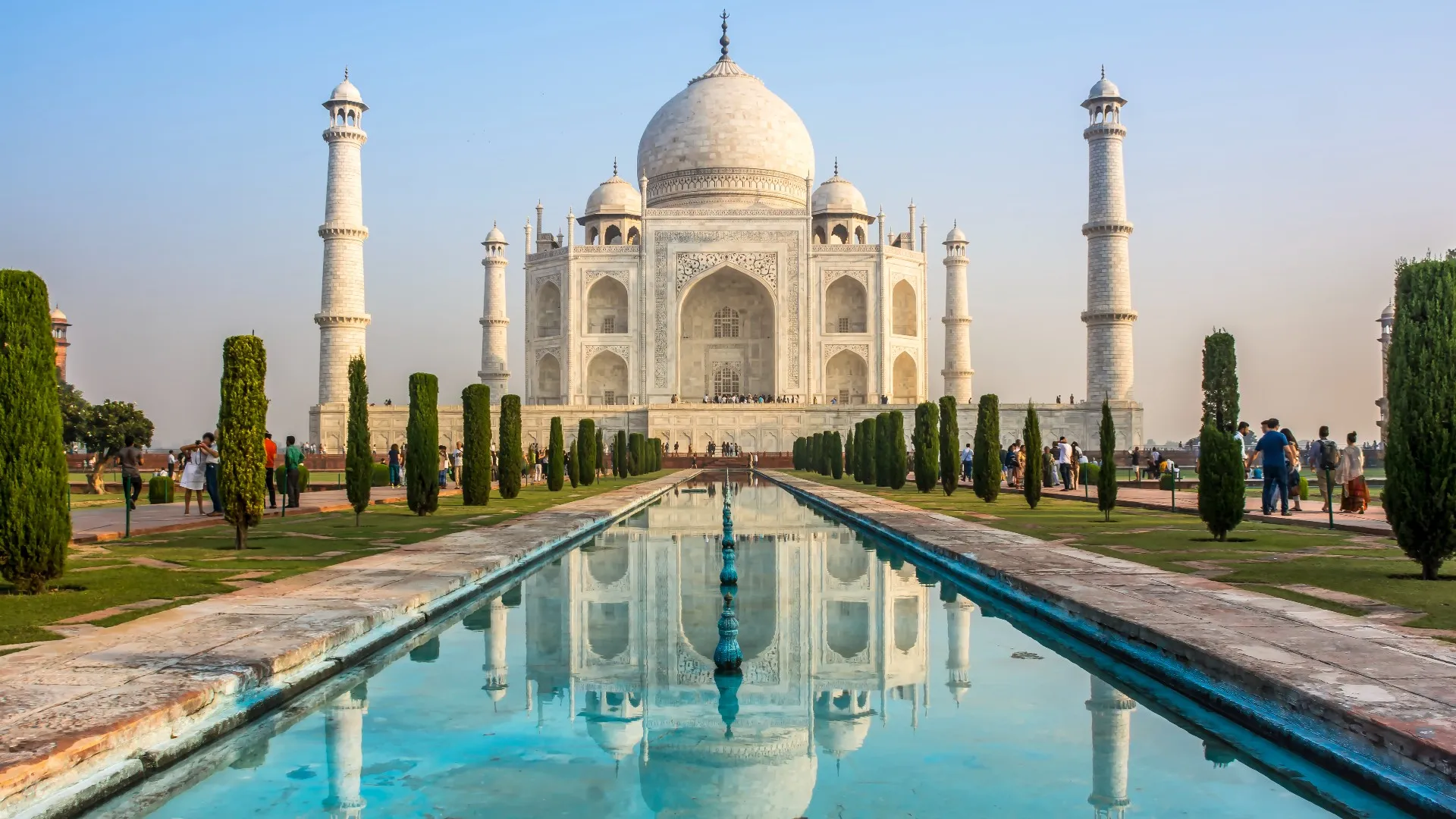
The most well-known example of Indian architecture is the Taj Mahal, built by Mughal emperor Shah Jahan to honor his third wife, Mumtaz Mahal. It combines elements from Islamic, Persian, Ottoman Turkish and Indian architectural styles. India also has many ancient temples.
India is well known for its film industry, which is commonly referred to as Bollywood. The country's movie history began in 1896 when the Lumière brothers demonstrated the art of cinema in Mumbai, according to the Golden Globes. Today, the films are known for their elaborate singing and dancing as well as their elaborate action sequences.
Indian dance, music and theater traditions span back more than 2,000 years, according to Nilima Bhadbhade, author of "Contract Law in India" (Wolters Kluwer, 2016). The major classical dance traditions — Bharata Natyam, Kathak, Odissi, Manipuri, Kuchipudi, Mohiniattam and Kathakali — draw on themes from mythology and literature and have rigid presentation rules.
RELATED STORIES
A study published in April 2016 in the Journal of Indian Ocean Archaeology found that some Indian horns have many similarities with horns made in Ireland. This research may suggest that the two countries may have exchanged ideas and techniques in making musical instruments during the Bronze Age.
"Some horns are frankly shockingly similar, to the point where it is like witnessing time travel," study author Billy Ó Foghlú, an archaeologist and doctoral student at the Australian National University in Canberra, told Live Science. "If I were to find one of these modern Indian instruments in an Irish archaeological excavation and I didn't know what I was looking at, I would likely assume it was a Late Bronze Age Irish artifact."
Indian fashion

The sari can trace its origins back to Ancient India, but has changed with passing generations and new manufacturing techniques.
Indian clothing is closely identified with the colorful silk saris worn by many of the country's women. The origins of this garment go back to Ancient India and evolved over time to include more expensive fabrics and adornments as they came to the country, according to "The Times of India". A traditional piece of clothing for men is the dhoti, an unstitched piece of cloth that is tied around the waist and legs. Men also wear a kurta, a loose shirt that is worn about knee-length.
For special occasions, men wear a sherwani or achkan, which is a long coat with a collar having no lapel. It is buttoned up to the collar and down to the knees. A shorter version of a sherwani is called a Nehru jacket. It is named after Jawaharlal Nehru, India's prime minister from 1947 to 1964. He actually preferred the achkan, according to Tehelka, an Indian newspaper. The Nehru jacket was primarily marketed to Westerners and made famous by The Beatles and The Monkees as well as being worn by a number of James Bond villains.
Doing business in India
India's currency is the rupee. Almost 62 percent of the country's GDP comes from the service sector with industry making up 23 percent and agriculture contributing 15.4 percent, according to the CIA World Factbook. Its primary agricultural products are sugar cane, rice, wheat, buffalo milk, milk, potatoes, vegetables, bananas, maize, and mangoes.
Indian business culture places emphasis on strong hierarchies and formalities, according to Santander, with decisions, particularly important ones, being considered for a length of time and ultimately made by those at the top of a company.
Indian holidays and celebrations
Diwali is the largest and most important holiday to India. It is a five-day festival known as the festival of lights because of the lights lit during the celebration to symbolize the inner light that protects them from spiritual darkness.
Holi, the festival of colors, also called the festival of love, is popular in the spring. The country also celebrates Republic Day (Jan. 26), Independence Day (Aug. 15) and Mahatma Gandhi's birthday (Oct. 2).
Additional resources and reading
For a deep dive into another element of Indian culture, learn when yoga originated and more about the ancient practice.
For a closer look at an important cultural artifact, you can read all about the golf-ball sized Star of India sapphire that was once stolen in a heist.
Bibliography
- "Indian Culture" All World Gayatri Pariwar
- "India " CIA World Factbook
- "India - Statistics & Facts" Statista
- "Handbook of Research on Development and Religion," edited by Matthew Clarke (Edward Elgar Publishing, 2013)
- "The Indian Cuisine" by Krishna Gopal Dubey (PHI Publisher, 2010)
- "The best countries in the world for vegetarians" "The Guardian"
- "Contract Law in India" by Nilima Bhadbhade (Wolters Kluwer, 2016)
- "Ancient Irish musical history found in modern India" Australian National University
- "The history of sari: The nine yard wonder," "The Times of India"
- "Nehru’s style statement" Tehelka
Kim Ann Zimmermann is a contributor to Live Science and sister site Space.com, writing mainly evergreen reference articles that provide background on myriad scientific topics, from astronauts to climate, and from culture to medicine. Her work can also be found in Business News Daily and KM World. She holds a bachelor’s degree in communications from Glassboro State College (now known as Rowan University) in New Jersey.