Alternative to X-Rays Makes Its First Step

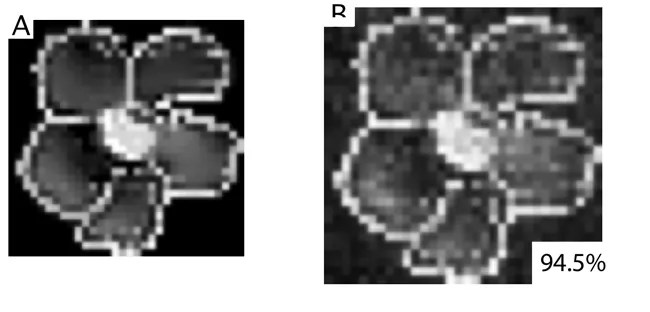
A day when doctors need only visible light instead of X-rays to view a patient's innards can now be more easily imagined, with the announcement of a way to decipher the little light that passes through opaque materials.
Normally, one cannot see through opaque barriers such as paint, skin, fabric or eggshells because any light that does manage to make it through such materials is scattered in complicated and seemingly random ways. [Infographic: How Light Works]
Now, however, a physicist in Paris and fellow researchers say they have found they can actually reconstruct complex images from light passing through these barriers. The key is to know precisely how the barriers' substances interfere with this light.
Sylvain Gigan at the Industrial Physics and Chemistry Higher Educational Institution and his colleagues first shone a green laser beam at a layer of zinc oxide — a common ingredient in white paints — that was roughly 80 microns thick, or slightly thinner than a human hair.
By analyzing the pattern of light that passed through, the researchers generated a formula called a transmission matrix that made sense of the seemingly random way the light was scattered by the barrier. With this knowledge, they were able to reconstruct a 32-pixel by 32-pixel image of a five-petal flower projected onto the zinc oxide.
The see-through vision is not perfect, since a lot of the information needed to reconstruct images gets lost when the light gets scattered. As such, the resulting images may be grainy. It also won't find use in trying to look through walls, unless they are very thin indeed — looking through a 100-millimeter wall would prove a million times harder than looking through a wall 100 microns thick.
Still, Gigan told LiveScience, their method could one day be used to peer inside bodies.
Get the world’s most fascinating discoveries delivered straight to your inbox.
That would require their system to be roughly 1,000 times faster than it currently is, to make up for all the scattering generated by the movements of living tissue. A microelectromechanical array that uses tiny mirrors to quickly divert laser beams back and forth over a surface to scan it "should provide for the 1,000 times speed increase we are looking for," Gigan said.
Gigan and his colleagues detail their findings online today (Sept. 21) in the journal Nature Communications.
- 10 Profound Innovations Ahead
- Video: The Naked Truth Under Clothes
- 10 Technologies That Will Transform Your Life