













Study Reveals How Your Brain Sleeps

Your brain never stops working. But it does cease talking to itself when you lose consciousness, a new study shows.
Scientists have long wondered what the brain does and doesn't do during deep sleep. It remains active, they know. So what's the difference between consciousness and the lack of it?
When we're awake, different parts of the brain use chemicals and nerve cells to communicate constantly across the entire network, similar to the perpetual flow of data between all the different computers, routers and servers that make up the Internet.
In the deepest part of sleep, however, the various nodes of your cranial Internet all lose their connections.
"The brain breaks down into little islands that can't talk to one another," said study leader Giulio Tononi of the University of Wisconsin-Madison.
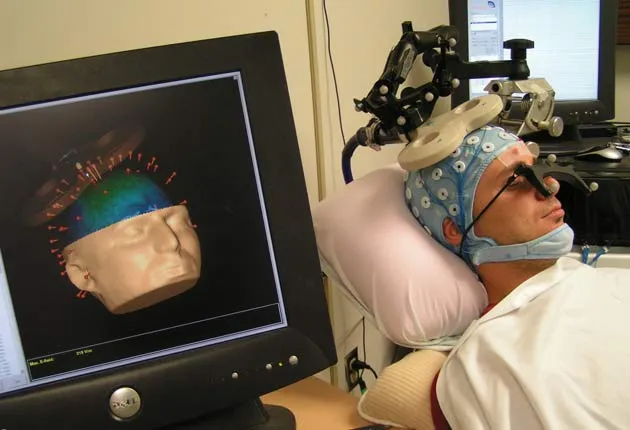
Tononi's team used a non-invasive procedure to activate select parts of the brain. Subjects had electrodes attached to their heads to monitor how each stimulation triggered reactions elsewhere.
In the early morning, when subjects were dreaming, signals careened around the noggin similarly to when they were awake. But at night, during deeper sleep, the picture was much different.
Get the world’s most fascinating discoveries delivered straight to your inbox.
"During deep sleep early in the night," Tononi said, "the response is short-lived and doesn't propagate at all."
Consciousness has long mystified scientists. The new finding suggests that it depends on the brain's ability to integrate information, Tononi says.
The compartmentalization might also help the brain's synapses, which make all the connections that give us thought, to take a break, according to Tononi's colleague, Marcello Massimini.
"This process would allow cortical circuits to eliminate noisy synapses and renormalize in order to be ready for the next day," Massimini told LiveScience. The reduced activity might also help explain why performance in various tasks improves after sleep, he said.
The machine used to conduct the experiments is new. It generates a magnetic field to provide stimulation, and Tononi's team expects this to be the first of many similar studies that will help researchers better understand the mind and specific disorders of the brain.
The study is detailed in the Sept. 30 issue of the journal Science.
- Why Great Minds Can't Grasp Consciousness
- Some Imagination! How Memory Fails Us
- Where Dreams Are Made, Really
- You Learn Without Knowing It

Robert is an independent health and science journalist and writer based in Phoenix, Arizona. He is a former editor-in-chief of Live Science with over 20 years of experience as a reporter and editor. He has worked on websites such as Space.com and Tom's Guide, and is a contributor on Medium, covering how we age and how to optimize the mind and body through time. He has a journalism degree from Humboldt State University in California.