













What Drives Seasonal Flu Patterns?
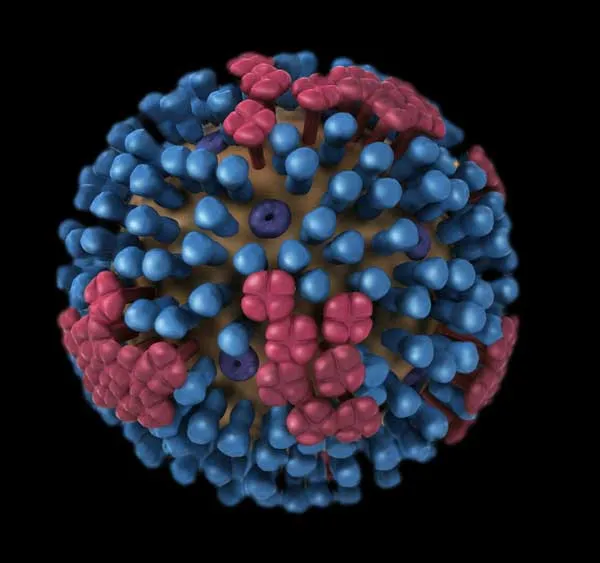
Another winter, another flu season. Theories of why seasonal flu outbreaks happen in the colder months in temperate climes have ranged from people staying cooped up in chilly weather to having weaker immune systems. Now a single culprit may explain it best: absolute humidity, or the amount of water vapor in the air. The drier the air, the better flu spreads.
The idea that humidity affects flu survival and transmission isn’t new. However, previous studies focused on relative humidity, or how close the air is to saturation. Relative humidity varies with the temperature, so 10 percent relative humidity on a 90-degree day is higher than 10 percent relative humidity on a 30-degree day. It turns out that relative humidity is a less reliable measurement than absolute humidity for studying flu patterns.
Higher Absolute Humidity, Less Flu
To see how well absolute humidity accounted for flu patterns, a National Institutes of Health-supported disease modeling research team led by Oregon State University climatologist Jeffrey Shaman and Harvard School of Public Health epidemiologist Marc Lipsitch analyzed 30 years of U.S. flu and weather data. They then built a computer model that reproduced historical patterns of seasonal flu spread.
The model used absolute humidity as the main control over the flu's basic reproductive number—the average number of other people a single sick person infects. The basic reproductive number depends on factors such as how much contact people have with each other, how infectious a person is and how long a person remains infectious.
Using absolute humidity, “we found that we could reproduce the seasonal cycle of influenza very nicely in basically the whole country,” says Shaman.
The scientists found that the virus survived longer and transmitted more easily from person to person in the low absolute humidity typical of U.S. winters. It didn’t live as long and had more trouble transmitting in the high absolute humidity typical of summers, says Shaman.
Get the world’s most fascinating discoveries delivered straight to your inbox.
They also noticed a significant drop in humidity in the weeks before most outbreaks began.
“If you had a real snap of cold, dry air, it was typically increasing the likelihood that you would have an outbreak,” says Shaman. “It could potentially be used in the future to make some sort of flu forecast.”
Ruling Out Other Causes
So does this finally put all the other seasonal flu theories to rest?
Yes and no. When Shaman and his team examined other potential causes of seasonal flu fluctuations, such as the school calendar, they found that while they could be influential, absolute humidity was still the best explanation.
For instance, says Shaman, “I do think the school calendar has an effect. I do think it's very important when you mix populations and you bring people together. But I just don't think it's the dominant force at work here.”
Next, Shaman wants to investigate the role of geography in flu spread.
“Each year, influenza moves around the globe. It's not an exact pattern, but there are consistent ways it moves from the tropics to temperate regions,” he explains. “If we can fold humidity into an understanding of that, it might give us a better sense of how and why influenza moves around as it does.”
All this work could improve flu research, help manage contagion and even forecast seasonal outbreaks. Unfortunately, it doesn’t mean people can avoid the flu by using humidifiers.
"The best defense remains vaccination," says Shaman.
Learn more:
- Listen to a podcast of Shaman talking about his findings on seasonal flu and humidity
This Inside Life Science article was provided to LiveScience in cooperation with the National Institute of General Medical Sciences, part of the National Institutes of Health.