













Chimps More Evolved Than Humans
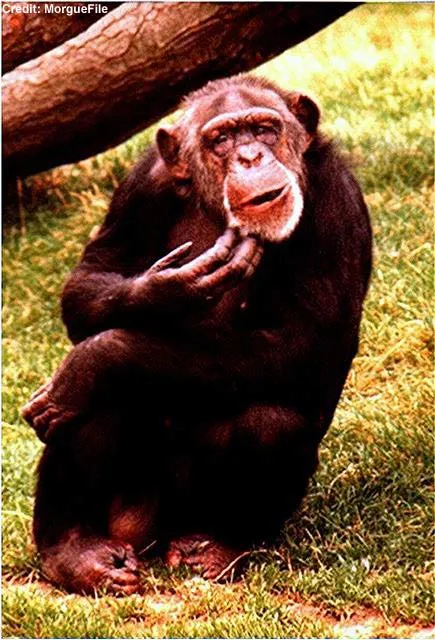
Since the human-chimp split about 6 million years ago, chimpanzee genes can be said to have evolved more than human genes, a new study suggests.
The results, detailed online this week in the Proceedings of the National Academy of Sciences, contradict the conventional wisdom that humans are the result of a high degree of genetic selection, evidenced by our relatively large brains, cognitive abilities and bi-pedalism.
Jianzhi Zhang of the University of Michigan and his colleagues analyzed strings of DNA from nearly 14,000 protein-coding genes shared by chimps and humans. They looked for differences gene by gene and whether they caused changes in the generated proteins.
Genes act as instructions that organisms use to make proteins and thus are integral to carrying out biological functions, such as transporting oxygen to the body’s cells. Different versions of the same gene are called alleles.
Changes in DNA that affect the making of proteins are considered functional changes, while “silent” changes do not affect the proteins. “If we see an excess of functional changes (compared to silent changes) the inference is these functional changes occurred because they were positively selected, because they were useful in some way to the organism,” said study team member Margaret Bakewell, also of UM.
Bakewell, Zhang and a colleague found that substantially more genes in chimps evolved in ways that were beneficial than was the case with human genes.
The results could be due to the fact that over the long term humans have had a smaller effective population size compared with chimps.
Get the world’s most fascinating discoveries delivered straight to your inbox.
“Although there are now many more humans than chimps, in the past, human populations were much smaller, and may have been fragmented into even smaller groups,” Bakewell told LiveScience. So random events would play a more dominant role than natural selection in humans.
Here is why: Under the process of natural selection, gene variants that are beneficial get selected for and become more common in a population over time. But genetic drift, a random process in which chance “decides” which alleles survive, also occurs. In smaller populations, a fortuitous break for one or two alleles can have a disproportionately greater impact on the overall genes of that population compared with a larger one.
Chance events could also explain why the scientists found more gene variants that were either neutral and had no functional impact or negative changes that are involved in diseases.
There is still much to learn, the scientists say, about human and chimp evolution. “There are possibly a lot of differences between human and chimps that we don’t know about, [perhaps] because there are differences in chimps that nobody has studied; a lot of studies tend to focus on humans,” Bakewell said.
- Top 10 Missing Links
- Hundreds of Human Genes Still Evolving
- How Evolution Works
Jeanna Bryner is managing editor of Scientific American. Previously she was editor in chief of Live Science and, prior to that, an editor at Scholastic's Science World magazine. Bryner has an English degree from Salisbury University, a master's degree in biogeochemistry and environmental sciences from the University of Maryland and a graduate science journalism degree from New York University. She has worked as a biologist in Florida, where she monitored wetlands and did field surveys for endangered species, including the gorgeous Florida Scrub Jay. She also received an ocean sciences journalism fellowship from the Woods Hole Oceanographic Institution. She is a firm believer that science is for everyone and that just about everything can be viewed through the lens of science.