

















Mini Frog, Among Smallest in the World, Discovered

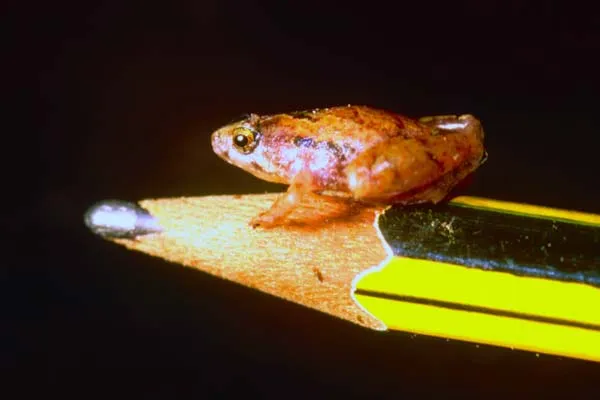
One of the tiniest frogs in the world, and the smallest ever seen outside of North and South America, has been discovered in the forests of the Southeast Asian island of Borneo.
The pea-sized amphibians (Microhyla nepenthicola) were found near a mountain in Kubah National Park.
"I saw some specimens in museum collections that are over 100 years old. Scientists presumably thought they were juveniles of other species, but it turns out they are adults of this newly discovered micro species," said Indraneil Das of the Universiti Malaysia Sarawak, who, along with Alexander Haas of the Biozentrum Grindel und Zoologisches Museum of Hamburg, Germany, discovered the tiny creatures.
The mini frog was named after the plant on which it depends for survival, the Nepenthes ampullaria, one of many species of pitcher plants in Borneo. These plants have a pitcher-shaped, open cavity and grow in damp, shady forests. The frogs deposit their eggs on the sides of the pitcher, and tadpoles grow in the liquid accumulated inside the plant.
Adult males of the newly discovered frog species are just shy of a half inch (10.6 to 12.8 millimeters) long — about the size of a pea. Because they are so tiny, finding them proved to be a challenge.
The frogs were tracked by their call, and then made to jump onto a piece of white cloth to be examined closer. Their singing normally starts at dusk, with males gathering within and around the pitcher plants. They call in a series of harsh rasping notes that last for a few minutes with brief intervals of silence. This "amphibian symphony" goes on from sundown until peaking in the early hours of the evening.
Amphibians are the most threatened group of animals in the world, with a third of them in danger of extinction. They provide important services to humans, such as controlling the populations of insects that spread disease and damage crops, and helping to maintain healthy freshwater systems.
Get the world’s most fascinating discoveries delivered straight to your inbox.
"Amphibians are quite sensitive to changes in their surroundings, so we hope the discovery of these miniature frogs will help us to understand what changes in the global environment are having an impact on these fascinating animals," said Conservation International's Robin Moore.
Conservation International has launched a worldwide search for so-called "lost amphibians," species that have not been seen in several years that could possibly be extinct.
The discovery of the frog is detailed in the journal Zootaxa.
- Mug Shots: 10 Lost Amphibians
- 10 Species You Can Kiss Goodbye
- Before and After: Deadly Fungus Wipes Out Amphibians
This article was provided by OurAmazingPlanet, a sister site to LiveScience.
