













Hidden Cameras Capture Remote Jaguars

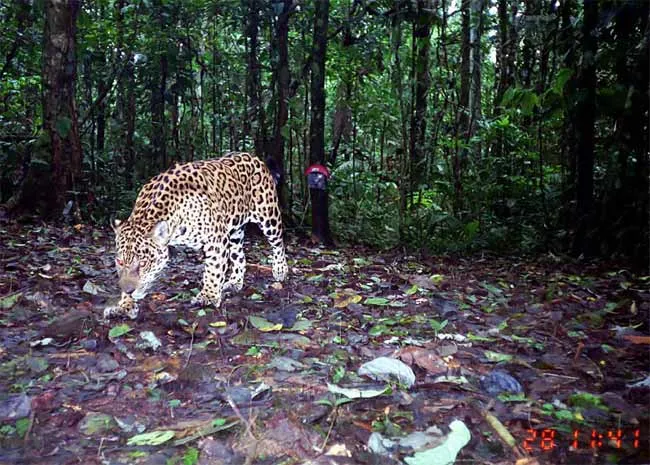
Wild jaguars in the Amazon are nearly five times more abundant in a remote region compared with a heavily hunted site of Ecuador, new images reveal.
This may come as no big surprise, but it's useful data to have in hand for conservation efforts.
Researchers set up camera traps that remotely snap photographs when an animal trips a heat-detecting sensor. So far, the remote photo shoot has generated 75 images of jaguars, along with images showing jaguar prey species, such as white-lipped peccaries, and other rarely seen species, including two pictures of a short-eared dog, a relative of foxes and wolves.
Largest cat
The jaguar photos, released this week, are part of an ongoing census that began in 2007 with the goal of establishing baseline population numbers of jaguars as oil exploration and subsequent development put growing pressure on wildlife in Ecuador's Yasuni National Park and adjacent Waorani Ethnic Reserve. Together, the two protected areas make up some 6,500 square miles (16,800 square kilometers) of wilderness.
The jaguar (Panthera onca) is considered the largest cat and top land predator in the Western hemisphere, with adults weighing between 124 and 211 pounds (56 to 96 kg), though larger individuals have been reported to weigh more than 300 pounds (136 kg).
The cats take up residence in several types of forest, grassland and dry habitat, though their range has been greatly reduced since 1900, according to the Wildlife Conservation Society, which took the new photos. The largest contiguous area of habitat for jaguars centers in the Amazon Basin.
Get the world’s most fascinating discoveries delivered straight to your inbox.
"The main threats to jaguars in Ecuador are habitat degradation and loss due to various human activities," said Santiago Espinosa, a WCS research fellow. "Bushmeat hunting by local communities has increased due to road development that provides access to otherwise isolated areas. Additionally, people hunt bushmeat to sell commercially in local markets, rather than simply for their own consumption."
System upset
Such hunting can wreak havoc on the natural predator-prey system.
"There is competition for food as people hunt the same prey species as the jaguar. If the prey species disappear, the jaguar will be gone," Espinosa said.
Preliminary analysis of the images shows fewer jaguars in more hunted areas compared with remote study spots.
For instance, in one survey, Espinosa recorded just three individual jaguars at a heavily hunted site within Yasuni National Park. At another study site in a rarely hunted, remote area, he distinguished 14 different jaguars. (Researchers can identify individual jaguars through the animals' unique pattern of spots.)
Espinosa and WCS plan to extend the jaguar camera trap surveys to other areas of Ecuador, working with local communities in both the Amazon region and along the coast where most of the forests are gone but still may provide refuge to jaguars.
The research is being funded by WCS, WWF and the University of Florida.
- Cat News, Information and Images
- How a Leopard Changed its Spots
- Jaguar Hams It Up for Camera
