Mind-Machine Breakthrough: People Type With Just Thoughts

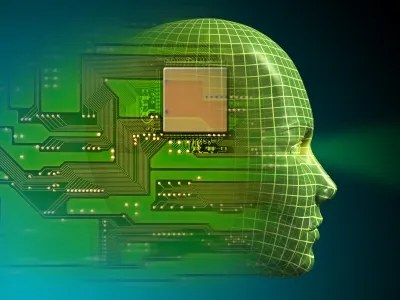
By focusing on images of letters, people with electrodes in their brains can type with just their minds, scientists now reveal.
These findings make up one more step on the road to mind-machine interfaces that may one day help people communicate with just their thoughts. Researchers have recently employed brain scans to see numbers and maybe even pull videos from inside people's heads.
The neuroscientists were monitoring two patients with epilepsy for seizure activity with electrodes placed directly on the surface of their brains to record electrical activity generated by the firing of nerve cells. This kind of procedure requires a craniotomy, a surgical incision into the skull.
How it works
Lead investigator Jerry Shih, a neurologist at the Mayo Clinic campus in Jacksonville, Fla., wanted to test how well their fledgling mind-machine interface functioned in these patients. He reasoned it would perform better when electrodes were placed directly on the brain instead of when placed on the scalp, as is done with electroencephalography, or EEG.
Most studies of mind-machine interaction have employed EEG, Shih explained.
"The scalp and bony skull diffuses and distorts the signal, rather like how the Earth's atmosphere blurs the light from stars," Shih said. "That's why progress to date on developing these kind of mind interfaces has been slow."
Get the world’s most fascinating discoveries delivered straight to your inbox.
The patients sat in front of a screen that displayed a 6-by-6 grid with a single letter inside each square. Every time a square with a certain letter flashed and the patient focused on it, the electrodes relayed the brain's response to a computer. The patients were then asked to focus on specific letters, and the computer recorded that data as well.
After the system was calibrated to each patient's specific brain waves, when the patient focused on a letter, the letter appeared on the screen.
"We were able to consistently predict the desired letters for our patients at or near 100 percent accuracy," Shih said. "While this is comparable to other researchers' results with EEGs, this approach is more localized and can potentially provide a faster communication rate. Our goal is to find a way to effectively and consistently use a patient's brain waves to perform certain tasks."
How to use it
Once the technique is perfected, its will require patients to have a craniotomy, although it remains uncertain how many electrodes would have to be implanted. The computers would also have to calibrate each person's brain waves to desired actions, such as movement of a prosthetic arm, Shih said.
"Over 2 million people in the United States may benefit from assistive devices controlled by a brain-computer interface," Shih said. "This study constitutes a baby step on the road toward that future, but it represents tangible progress in using brain waves to do certain tasks."
These patients would have to use a computer to interpret their brain waves, "but these devices are getting so small, there is a possibility that they could be implanted at some point," Shih said. "We find our progress so far to be very encouraging."
The scientists detailed their findings Sunday in Boston at the annual meeting of the American Epilepsy Society.
- 10 Profound Innovations Ahead
- Scientists Can See Brain Blunders Coming
- More Mind-Reading News