













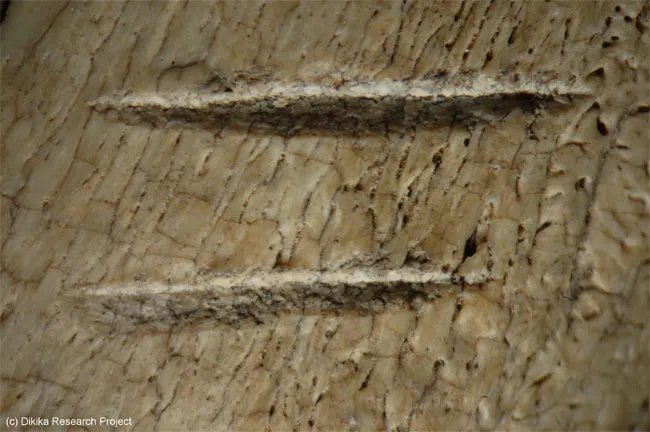
Cut marks on two 3.4-million-year-old animal bones from Ethiopia were thought to be evidence that the beasts had been trampled by other animals long ago, but new research suggests that's not the case.
The new results debunk one theory for how the bones got their marks, and support — but do not, on their own, definitively prove — the alternative hypothesis that ancient human ancestors cut the bones. If that latter hypothesis turns out to be true, it would mean hominins — the group of species that consists of humans and their relatives after the split from the chimpanzee lineage — were butchering animals 800,000 years earlier than scientists had previously thought.
Combined with recent evidence that human predecessors used stone tools about 3.3 million years ago, the new study could help change the picture of human ancestors of the genus Australopithecus, whose members include the famous "Lucy" skeleton. [In Photos: 'Little Foot' Human Ancestor Walked With Lucy]
Complicated history
The bones were found several years ago in the history-rich sediments of Dikika, an area in the Awash River valley in Ethiopia. This arid region — part of the East African Rift valley, where two continental plates are peeling apart — has yielded some of the best examples of both early hominin fossils and fossils from anatomically modern early humans. At the time the bones were deposited, the region was a patchwork of swampy forest areas dotted with lakes, and a more open savanna where bigger animals roamed, said lead study author Jessica Thompson, an assistant professor of anthropology at Emory University in Georgia. The tree-swinging Australopithecus likely lived in the forested regions, Thompson said.
Though archaeologists have not found hominin fossils at this particular site, just a few hundred meters away, other research teams previously found the nearly intact skeleton of a 3.3-million-year-old baby girl Australopithecus, dubbed "the Dikika baby" or "Lucy's baby." (The Dikika baby is not truly Lucy's baby, since she lived 100,000 years before Lucy.)
At this particular spot, other paleoanthropologists sifting through 3.4-million-year-old sediments found two bones — one from an antelope-size creature and another from a buffalo-size animal — that had a total of 12 distinctive marks. In a 2010 study published in the journal Nature, researchers proposed that someone used a cutting tool to make those marks.
Get the world’s most fascinating discoveries delivered straight to your inbox.
But the news was considered shocking: In 2010, the earliest known stone tools, from Gona, Ethiopia, dated to 2.6 million years ago. In 2011, another research group weighed in, writing in a paper in the journal Proceedings of the National Academy of Sciences that the marks on the bones were likely not cut marks, but instead the marks of sediments rubbing over the bones as wild beasts trampled them over the millennia.
While the debate about the bones simmered, in May of this year, researchers reported the discovery of 3.3-million-year-old tools at a site in Kenya, making the idea that butchery predated all Homo species slightly less controversial, Thompson said. [See Photos of Our Closest Human Ancestor]
Statistical analysis
To help settle the question of whether the animals were trampled, Thompson and her colleagues used a more statistical approach than had been used in the past. Instead of analyzing just the cut marks, the team looked at all the marks in the bone samples found in the region.
They tossed a marker — in this case, a hammer — randomly into the bone bed, and then drew a circle around it. They collected all the bones within the circle and studied and catalogued their surfaces under a microscope, repeating the sampling process at various locations in the bone bed.
In a separate test, they analyzed all the marks generated on a set of bones that had been experimentally trampled — for a study by other researchers. Then, they compared the bones in both groups with the two bones that appeared to have cut marks.
The two bones looked significantly different from both types of samples, suggesting that whatever process left those marks, it wasn't trampling or natural processes in the area, the researchers reported Aug. 13 in the Journal of Human Evolution.
Cognitive leap
If early hominins were using tools so early, that means their cognitive abilities were also more advanced than previously thought, said Briana Pobiner, a paleoanthropologist at the Smithsonian Institution in Washington, D.C., who was not involved in the current study.
For instance, humans' closest living relatives, chimpanzees, may crack nuts using stones or may sharpen sticks to hunt other primates called bush babies, but they do that with their teeth. Making stone tools involves bashing one stone on another rock to make the desired pointy shape.
"To make a stone tool, you use a tool to make a second tool," Pobiner told Live Science.
That's a different cognitive process, she said.
"There's a lot of planning and forethought involved," Pobiner said, from picking the right kind of rock, to striking with the tool in just the right way to get the stone flaked off.
Either way, the new study, combined with the discovery of similarly aged tools in Kenya, make the notion that ancient human ancestors cut the Dikika bones much more likely, Pobiner said.
Follow Tia Ghose on Twitterand Google+. Follow Live Science @livescience, Facebook & Google+. Original article on Live Science.

Tia is the editor-in-chief (premium) and was formerly managing editor and senior writer for Live Science. Her work has appeared in Scientific American, Wired.com, Science News and other outlets. She holds a master's degree in bioengineering from the University of Washington, a graduate certificate in science writing from UC Santa Cruz and a bachelor's degree in mechanical engineering from the University of Texas at Austin. Tia was part of a team at the Milwaukee Journal Sentinel that published the Empty Cradles series on preterm births, which won multiple awards, including the 2012 Casey Medal for Meritorious Journalism.