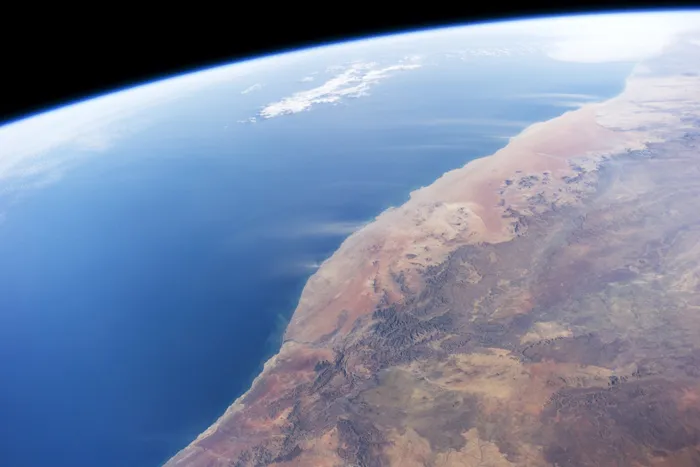
Africa's Dry Dusty Winds Seen from Space (Photo)
Get the world’s most fascinating discoveries delivered straight to your inbox.
You are now subscribed
Your newsletter sign-up was successful
Want to add more newsletters?
Delivered Daily
Daily Newsletter
Sign up for the latest discoveries, groundbreaking research and fascinating breakthroughs that impact you and the wider world direct to your inbox.
Once a week
Life's Little Mysteries
Feed your curiosity with an exclusive mystery every week, solved with science and delivered direct to your inbox before it's seen anywhere else.
Once a week
How It Works
Sign up to our free science & technology newsletter for your weekly fix of fascinating articles, quick quizzes, amazing images, and more
Delivered daily
Space.com Newsletter
Breaking space news, the latest updates on rocket launches, skywatching events and more!
Once a month
Watch This Space
Sign up to our monthly entertainment newsletter to keep up with all our coverage of the latest sci-fi and space movies, tv shows, games and books.
Once a week
Night Sky This Week
Discover this week's must-see night sky events, moon phases, and stunning astrophotos. Sign up for our skywatching newsletter and explore the universe with us!
Join the club
Get full access to premium articles, exclusive features and a growing list of member rewards.
Hot winds send dust streaking out to sea in a new astronaut photograph of Namibia's coast.
These dust plumes are created by mountain, or berg, winds, according to NASA's Earth Observatory. Much like the Santa Ana winds in California, these winds flow from inland mountains. When air hits the mountain ranges, it rises and drops its moisture on the inland side of the slopes. After cresting, the now-dry air rushes downhill and encounters increasing atmospheric pressure, which causes it to contract — and in the process, heat up.
This phenomenon is the reason for the "rain shadow" on the downwind, or lee, side of mountains, where the lee slope is much drier than the windward side. Berg winds are also known as Foehn winds or "snow-eaters," the latter because they melt snow on the lee side of mountains so rapidly.
Foehn winds can fuel wildfires, particularly when they are strong. The berg winds of southern Africa can gust up to 62 mph (100 km/h), as can the Santa Ana winds of California.
This astronaut image was snapped on June 21. Visible below the line of dust plumes, the Orange River can be seen flowing into the Atlantic Ocean. The river marks the border between Namibia and South Africa. Up the coast, a huge sandy expanse is the Namib Desert sand sea, a UNESCO World Heritage Site. This sand field covers more than 3 million hectares, and is frequently bathed in fog, the main source of water for the dune ecosystem.
Editor's Note: If you have an amazing nature or general science photo you'd like to share for a possible story or image gallery, please contact managing editor Jeanna Bryner at LSphotos@livescience.com.
Follow Stephanie Pappas on Twitter and Google+. Follow us @livescience, Facebook & Google+. Original article on Live Science.
Get the world’s most fascinating discoveries delivered straight to your inbox.

Stephanie Pappas is a contributing writer for Live Science, covering topics ranging from geoscience to archaeology to the human brain and behavior. She was previously a senior writer for Live Science but is now a freelancer based in Denver, Colorado, and regularly contributes to Scientific American and The Monitor, the monthly magazine of the American Psychological Association. Stephanie received a bachelor's degree in psychology from the University of South Carolina and a graduate certificate in science communication from the University of California, Santa Cruz.