 Live Science Plus





You are now subscribed
Your newsletter sign-up was successful
Want to add more newsletters?

Delivered Daily
Daily Newsletter
Sign up for the latest discoveries, groundbreaking research and fascinating breakthroughs that impact you and the wider world direct to your inbox.

Once a week
Life's Little Mysteries
Feed your curiosity with an exclusive mystery every week, solved with science and delivered direct to your inbox before it's seen anywhere else.

Once a week
How It Works
Sign up to our free science & technology newsletter for your weekly fix of fascinating articles, quick quizzes, amazing images, and more

Delivered daily
Space.com Newsletter
Breaking space news, the latest updates on rocket launches, skywatching events and more!

Once a month
Watch This Space
Sign up to our monthly entertainment newsletter to keep up with all our coverage of the latest sci-fi and space movies, tv shows, games and books.

Once a week
Night Sky This Week
Discover this week's must-see night sky events, moon phases, and stunning astrophotos. Sign up for our skywatching newsletter and explore the universe with us!
Join the club
Get full access to premium articles, exclusive features and a growing list of member rewards.
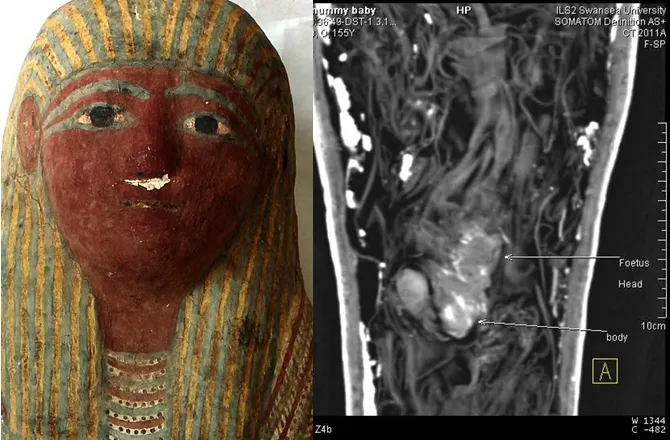
A suspected fake mummy currently on display at an Egypt center in Wales, in fact contains a fetus 12 to 16 weeks into development, CT scan has revealed.
Known as W1013, the 20-inch artifact is a case made of cartonnage — layers of linen stiffened with plaster or glue — and belongs to the Wellcome collection at Swansea University’s Egypt Center, which houses more than 5,000 objects. Most of them were collected by the Victorian pharmaceutical entrepreneur and archaeologist Sir Henry Wellcome on excavations in Egypt.
Video: Why Did We Stop Building Pyramids?
The mummy has long puzzled experts. It is colorfully decorated in a style dating back to the 26th Dynasty, around 600 B.C. .
The inconclusive results of an X-ray carried out in 1998 combined with meaningless inscriptions painted on the cartonnage case, suggested the mummy could have been a 19th century forgery.
“But it’s not unusual for sham hieroglyphs to be placed on coffins. Undoubtedly this would indicate that the maker of the piece was not literate,” curator Carolyn Graves-Brown told Discovery News.
Further research solved the mystery.
Photos: Mystery Pharaoh Found in Egypt
Last month, Swansea University’s Paola Griffiths of the Clinical Imaging College of Medicine, CT scanned the artifact.
It was then revealed the majority of the interior of the case is taken up by what appears to be linen bandages.
Within those folded strips of material, the CT scan showed a darker area about 3 inches long which researchers identified as a fetus in fetal position and with a placental sac. What could be the fetus’s femur was also identified.
“The length of the femur together with the size of the dark patch is consistent with that of a 12 to 16-week-old fetus,” Graves-Brown said.
Photos: Mummy Stash Found in Italian Church
“Another dark patch suggests the presence of an amulet and there are several areas with dark circles resembling strings of beads or tassels,” she added.
Decorated with criss-cross pattern of rhombus shapes perhaps imitating the bead net placed over some other mummies, the cartonnage case might provide some clues on the unborn baby’s sex.
The face is painted in reddish-brown, a color usually associated with men. Moreover, the heavy, yellow and blue striped wig and wide collar are most common on male coffins.
But Graves-Brown cautions: “As the fetus is only 12-16 weeks and is not in a perfect state of preservation I would not guess the sex,” he said.
2,400-Year-Old Myths of Mummy-Making Busted
The finding revealed the care with which even the fetus was treated in ancient Egypt.
“For example, two coffins holding fetuses were found in the tomb of Tutankhamun. In New Kingdom (around 1550-1070 B.C.) Deir el-Medina, a part of the Eastern cemetery seems to have been set aside for child burials, but also fetuses and even placentas in bloody cloths,” Graves-Brown said.
The fact that fetuses and infants were buried with such care indicate that deaths of young children as well as miscarriages were not treated casually.
“We can imagine that the probable fetus within W1013 represents someone’s terrible loss; an occasion of great grief and public mourning,” Graves-Brown said.
This story was provided by Discovery News.
