













What is a solar eclipse?
Solar eclipses are some of nature's most dramatic celestial performances. Here's a look at the science behind the eclipse, and how to watch the next one on April 8, 2024.

Solar eclipses are perhaps the most dazzling celestial phenomena that you can see clearly from Earth.
A solar eclipse occurs when the Earth, moon and sun are aligned in the same plane, and the moon passes between the Earth and the sun. During a total solar eclipse, the moon completely covers the sun, resulting in several minutes of "totality," or evening-like darkness in the daytime, as the center of the moon's dark shadow falls over Earth. During a partial solar eclipse, the moon only blocks a portion of the sun's disk, and viewers do not experience totality.
Please note: Totality is the ONLY time when it is safe to look directly at the sun without wearing protective eyewear, such as official solar eclipse glasses.
"During this period when any of the disk is visible, one must use protective equipment to view the sun," William Teets, director of the Vanderbilt Dyer Observatory at Vanderbilt University, in Nashville, Tennessee, told Live Science in an email. That could include solar eclipse glasses, specially filtered telescopes or binoculars, or by using a projection method, Teets said.
Eclipses occur over Earth several times a year, with total solar eclipses occuring roughly once every 18 months, according to the Natural History Museum, London. However, most eclipses are not visible from inhabited areas, making viewing opportunities somewhat rare. As such, eclipses entice droves of skywatchers to travel around the world in hopes of catching totality.
Here's everything you need to know about the science of solar eclipses, and where to catch the next one.
When is the next solar eclipse?

A map showing where the Moon’s shadow will cross the U.S. during the 2023 annular solar eclipse and 2024 total solar eclipses.
The next solar eclipse is a total solar eclipse on Monday, April 8, 2024.
The April 8 total solar eclipse will cross North America in a diagonal line from the southwest to the northeast, crossing parts of Mexico, the United States and Canada. The path of the eclipse, also called the path of totality, will pass over 15 U.S. states: Texas, Oklahoma, Arkansas, Missouri, Illinois, Kentucky, Tennessee, Michigan, Indiana, Ohio, Pennsylvania, New York, Vermont, New Hampshire and Maine.
Related: April 8 total solar eclipse: The best places to stargaze near the path of totality
Get the world’s most fascinating discoveries delivered straight to your inbox.
In Canada, parts of Ontario, Quebec, New Brunswick, Prince Edward Island, Nova Scotia and Newfoundland will also experience totality. In Mexico, parts of Sinaloa, Nayarit, Durango, Chihuahua and Coahuila will fall in the path of the eclipse.
The last partial solar eclipse visible to North America was a "ring of fire," or annular, solar eclipse on Oct. 14, 2023.
The last total solar eclipse visible over the U.S. occured on Aug. 21, 2017. The 2017 total solar eclipse was visible in parts of Oregon, Idaho, Wyoming, Nebraska, Kansas, Missouri, Illinois, Kentucky, Tennessee, Georgia, North Carolina and South Carolina.
The next total solar eclipse visible in North America (after April 8) occurs on March 30, 2033, and will only be visible from Alaska.
| Date | Type of solar eclipse | Visibility |
|---|---|---|
| Oct. 14, 2023 | Annular | Parts of Africa, N. America, S. America, Pacific & Atlantic, and Arctic |
| April 8, 2024 | Total | Totality: Parts of Mexico, U.S. and Canada |
| Oct. 2, 2024 | Annular | Parts of South America, Pacific & Atlantic, and Antarctica |
| Mar. 30, 2033 | Total | Totality: Parts of Alaska and Russia |
What is a total solar eclipse?
There are four varieties of solar eclipse: Total, partial, annular and hybrid.
All four varieties of solar eclipse are a happy accident of nature. The sun stretches some 864,000 miles (1.4 million kilometers) across, according to NASA, making our host star 400 times bigger thanEarth's moon, which measures just about 2,160 miles (nearly 3,500 km) in diameter. But the moon also happens to be about 400 times closer to Earth than the sun is (the ratio varies as the orbits of both the sun and moon are elliptical); and as a result, when the orbital planes intersect and the distances align favorably, the moon (called a "new moon" in this alignment) can appear to completely blot out the disk of the sun. As for how rare this phenomenon is: On average, a total solar eclipse is visible somewhere on Earth about every 18 months.
During a total solar eclipse, the moon casts two types of shadows. The umbra is the darkest part of the shadow where all sunlight gets blocked out. The umbra takes the shape of a dark, slender cone. It is surrounded by the penumbra, a lighter, funnel-shaped shadow from which sunlight is partially obscured.
In order to view a total solar eclipse, you must be located in the direct path of the umbra, which can sweep a third of the way around the planet in just a few hours. When in that direct path, you would see the sun's disk diminish into a crescent as the moon's dark shadow rushes toward you across the landscape.
Don't look directly at the sun
REMEMBER: Looking directly at the sun, even when it is partially covered by the moon, can cause serious eye damage or blindness. NEVER look at a partial solar eclipse without proper eye protection.
During the brief period of totality, when the sun is completely covered, the beautiful corona — the tenuous outer atmosphere of the sun — is revealed. A total solar eclipse typically lasts for only a few minutes, NASA solar astronomer Mitzi Adams of the Marshall Space Flight Center in Huntsville, Alabama, said in a NASA webchat. The longest solar eclipse in history, on June 15, 743 B.C., lasted about 7 minutes and 28 seconds, according to NASA.
Total eclipses are rarely seen because totality — when the sun appears totally hidden by the moon — only exists along a narrow path on Earth's surface, as opposed to partial eclipses, which can be viewed across a much wider region.
What is a partial solar eclipse?

A partial eclipse is seen as the sun rises behind the United States Capitol Building, Thursday, June 10, 2021, as seen from Arlington, Virginia.
During a partial solar eclipse, the moon's penumbra (the partial shadow) passes between the Earth and the sun. In these cases, a part of the sun always remains in view during the eclipse. How much of the sun remains in view depends on the specific circumstances.
Usually the penumbra gives just a glancing blow to the planet over the polar regions; in such cases, places far away from the poles but still within the zone of the penumbra might not see much more than a small scallop of the sun hidden by the moon. In a different scenario, those who are positioned within a couple of thousand miles of the path of a total eclipse will see a partial solar eclipse.
The closer you are to the path of totality, the greater the solar obscuration. If, for instance, you are positioned just outside of the path of the total eclipse, you will see the sun wane to a narrow crescent, then thicken up again as the shadow passes by.
Annular solar eclipse

A composite image of the annular solar eclipse on Jan. 15, 2010
An annular eclipse is far different from a total one. The sky will darken ... somewhat, causing a sort of weird "counterfeit twilight" since so much of the sun still shows. The annular eclipse is a subspecies of a partial not total, eclipse. The maximum duration for an annular eclipse is 12 minutes 30 seconds.
An annular solar eclipse is similar to a total eclipse in that the moon appears to pass centrally across the sun. The difference is, due to the moon’s position, during an annular eclipse the moon appears too small to cover the disk of the sun completely. Because the moon circles Earth in an elliptical orbit, its distance from Earth can vary from 221,457 miles to 252,712 miles (356,400 to 406,700 km). But the dark shadow cone of the moon's umbra can extend out for no longer than 235,700 miles (379,322 km); that's less than the moon's average distance from Earth.
So if the moon is at some greater distance than the umbra's limit, the tip of the umbra does not reach Earth. During such an eclipse, the antumbra, a theoretical continuation of the umbra, reaches the ground, and anyone situated within it can look up past either side of the umbra and see an annulus, or "ring of fire" around the moon. A good analogy is putting a penny atop a nickel, the penny being the moon, the nickel being the sun.
What is a hybrid solar eclipse?
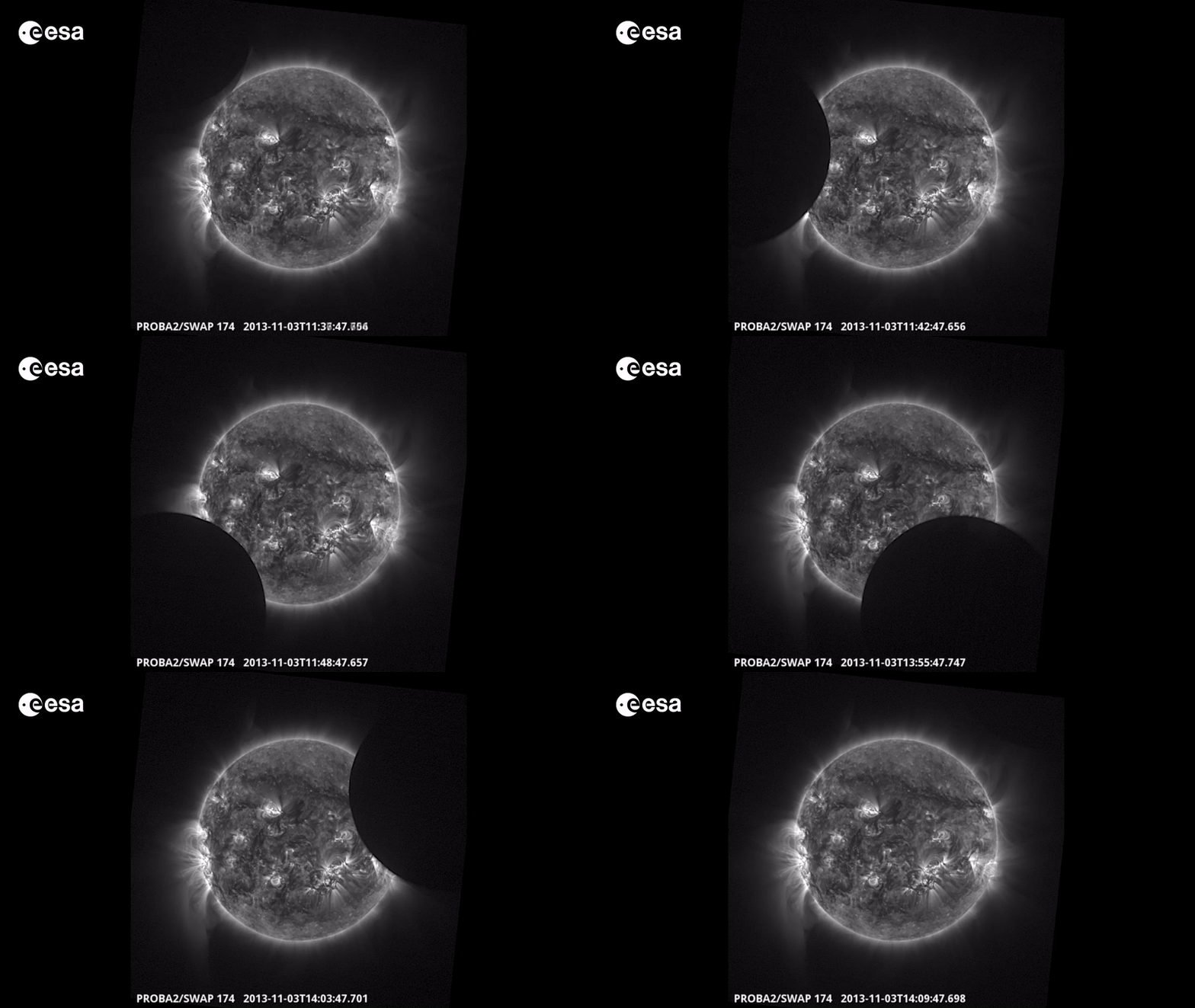
Three partial solar eclipses are seen in this movie from ESA’s Proba-2 Sun-watching satellite as it dipped in and out of the Moon’s shadow during a ‘hybrid’ solar eclipse in 2013.
These are also called annular-total ("A-T") eclipses. This special type of eclipse occurs when the moon's distance is near its limit for the umbra to reach Earth. In most cases, an A-T eclipse starts as an annular eclipse because the tip of the umbra falls just short of making contact with Earth; then it becomes total, because the roundness of the planet reaches up and intercepts the shadow tip near the middle of the path, then finally it returns to annular toward the end of the path.
Because the moon appears to pass directly in front of the sun, total, annular and hybrid eclipses are also called "central" eclipses to distinguish them from eclipses that are merely partial.
Of all solar eclipses, about 28% are total; 35% are partial; 32% annular; and just 5% are hybrids.
How to view a solar eclipse

An astronomer in India projects the solar eclipse onto a white screen for safe viewing on Dec. 26, 2019.
Do not look directly at any part of the sun without protective equipment, even near totality.
"This equipment could be approved solar eclipse glasses (not sunglasses) or a properly filtered telescope or properly filtered pair of binoculars."
Teets added that a skywatcher should "never put on solar eclipse glasses and then use them to try to look through an unfiltered telescope or pair of binoculars — the unfiltered light will burn right through the glasses and start burning/blinding you as well."
Projection method: In addition to viewing an eclipse through specialty glasses, properly filtered telescopes/binoculars, you can also use a projection method to view a solar eclipse. To do so, you take out the eyepiece from a telescope and instead project the image onto a sheet of paper behind the telescope. By moving the sheet of paper back and forth, you can find the spot with the most focused image, according to Sky & Telescope.
Pinhole camera: A pinhole or small opening is used to form an image of the sun on a screen placed about 3 feet (1 meter) behind the opening, according to Sky & Telescope. Binoculars or a small telescope mounted on a tripod can also be used to project a magnified image of the sun onto a white card. The farther away the card, the larger you can focus the image. Look for sunspots. Notice that the sun appears somewhat darker around its limb or edge. This method of solar viewing is safe so long as you remember not to look through the binoculars or telescope when they are pointed toward the sun; put another way, never look directly at the sun when any part of its blindingly bright surface is visible.
Here's how to make your own pinhole eclipse viewer with materials you probably have at home.
Pinhole mirror: A variation on the pinhole theme is the "pinhole mirror." Cover a pocket-mirror with a piece of paper that has a quarter-inch hole punched in it. Open a sun-facing window and place the covered mirror on the sunlit sill so it reflects a disk of light onto the far wall inside. The disk of light is an image of the sun's face. The farther away from the wall the better; the image will be only 1 inch across for every 9 feet (or 3 centimeters for every 3 m) from the mirror, according to Sky & Telescope. Modeling clay works well to hold the mirror in place. Experiment with different-size holes in the paper. Again, a large hole makes the image bright, but fuzzy, and a small one makes it dim but sharp. Darken the room as much as possible. Be sure to try this out beforehand to make sure the mirror's optical quality is good enough to project a clean, round image. Of course, don't let anyone look at the sun in the mirror.
If you're around leafy trees, look at the shadow cast by them during the partial phases. What do you see? Is it worth a photograph? You will see scores of partially eclipsed suns projected through pinhole gaps between the leaves. This is caused by diffraction, a property of light. According to Vince Huegele, an optical physicist at the NASA Marshall Space Flight Center, the light rays do not shoot straight by the rim of the gaps, or a pinhole, but bend around the edge. This wave effect creates a pattern of rings that resembles a bull's eye.
Acceptable filters for unaided visual solar observations include aluminized Mylar. Some astronomy dealers carry Mylar filter material specially designed for solar observing. Also acceptable is shade 14 arc-welder's glass, available for just a few dollars at welding supply shops. Of course, it is always a good idea to test your filters and/or observing techniques before eclipse day.
Unacceptable filters include sunglasses, old color film negatives, black-and-white film that contains no silver, photographic neutral-density filters and polarizing filters. These materials have very low visible-light transmittance levels, but they transmit an unacceptably high level of near-infrared radiation that can burn your retinas. The fact that the sun appears dim, or that you feel no discomfort when looking at the sun through these types of filters, is no guarantee that your eyes are safe.
Sun features to look for during an eclipse

NASA’s Solar Dynamics Observatory captured this image of a solar flare – as seen in the bright flash in the upper left portion of the image– on April 20, 2022. The image shows a subset of extreme ultraviolet light that highlights the extremely hot material in flares, and which is colorized in yellow.
Sunspots: These relatively cool patches on the sun's surface appear dark. They will look like black spots on the disk of the sun, Teets said. These spots can be alone or in clusters of several. To see these spots, you will likely need a properly filtered telescope, as they are too small typically to view through your solar eclipse glasses.
Prominences: If you are eclipse-viewing with a “hydrogen-alpha solar telescope,” you might catch a glimpse of more than sunspots. With this gear, you should be able to see prominences and the chromosphere, which is the second of the three layers of the sun's atmosphere.
"Prominences are clouds of material lofted up from the sun, and they sometimes look like flames on the edge of the sun," Teets said. "If they happen to be present across the disk of the sun, they will appear like slightly darkened streaks."
Related: April 8 solar eclipse: What will happen during totality?
Chromosphere: With that same specialized telescope, you could also witness what might appear as undulating ruby gems dancing around the outer disk of the sun. That would be the chromosphere, the lower atmosphere of the sun that is about a million times less dense than Earth's atmosphere, according to the University Corporation for Atmospheric Research. On typical days, the light from this atmospheric layer is drowned out by the much brighter photosphere underneath it, UCAR said.
Corona: There is one time when you can safely look directly at the sun: during totality in a total eclipse, when the sun's disk is entirely covered. During those few precious seconds or minutes, the magnificent corona — the outer atmosphere that lies just above the chromosphere — shines forth in all its glory like a halo around the darkened sun — a marvelous fringe of pearly white light. "It appears as a beautiful white wisp that completely encircles the sun," Teets told Live Science.
It differs in size, in tints and patterns from eclipse to eclipse. It is always faint and delicate, with a sheen like a pale aurora. Sometimes the corona appears as a soft continuous structure; at other times, long rays of it shoot out in three or four directions. The corona can also pop out from the disk in filmy petals and streamers. But when the sun begins to emerge into view again, the corona quickly disappears and you'll need to protect your eyes once again.
Additional resources
UCAR has a great compilation of sun and solar eclipse resources, along with some instructions for teaching activities.
If you're interested in photographing an eclipse, this Nikon guide provides instructions for how to do that for different types of solar eclipses.
This NASA resource provides a look at the history of eclipses and some of the oldest records of solar eclipses.
Jeanna Bryner is managing editor of Scientific American. Previously she was editor in chief of Live Science and, prior to that, an editor at Scholastic's Science World magazine. Bryner has an English degree from Salisbury University, a master's degree in biogeochemistry and environmental sciences from the University of Maryland and a graduate science journalism degree from New York University. She has worked as a biologist in Florida, where she monitored wetlands and did field surveys for endangered species, including the gorgeous Florida Scrub Jay. She also received an ocean sciences journalism fellowship from the Woods Hole Oceanographic Institution. She is a firm believer that science is for everyone and that just about everything can be viewed through the lens of science.
- Joe RaoMeteorologist
- Denise ChowLive Science Contributor
- Brandon SpecktorEditor