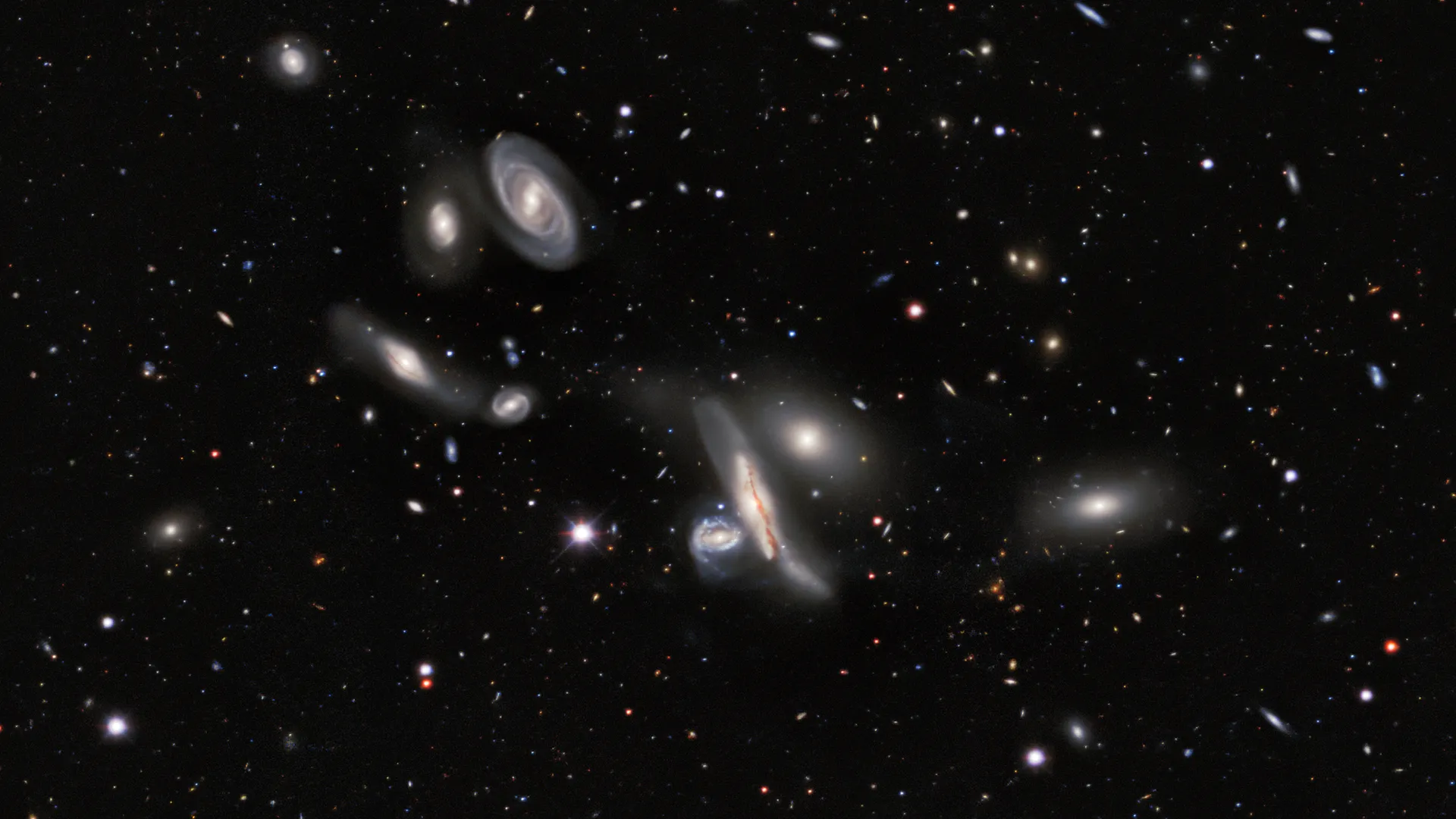
The largest 2D map of the universe just dropped, and it’s a stunner. Compiled from more than a decade of observations, the new map charts 4 billion stars, galaxies, black holes, asteroids and other objects of interest throughout the cosmos.
The map reveals about three-quarters of the night sky in high resolution, spanning both visible and near-infrared light wavelengths and charting the areas of the universe not blocked by dust or gas. The map is so big, in fact, that it’s impossible to reproduce as a single image here; instead, astronomers invite you to explore their vision of the universe using the free Legacy Survey Sky Browser webpage.
It took 13 years and three ground-based sky surveys, using telescopes from the National Science Foundation (NSF) and the University of Arizona to gather the information for the map. The results are available for other scientific investigators to use and will likely help other telescopes to search the cosmos.
"Astronomers and citizen scientists can combine the map with their own observations to better understand our universe," NSF officials from NOIRLab said in a statement Aug. 10.
"Researchers can search for rare phenomena like gravitational lenses, observe fleeting events like supernovae, and investigate two of physics' biggest mysteries: dark matter, the invisible substance that accounts for most of the mass in our universe, and dark energy, the force driving our universe's accelerating expansion," the statement added.
The spiral galaxy Messier 96, another stunning detail captured in the new map of the cosmos.
Past versions of the map have generated at least 1,800 science papers, according to the statement. The latest map is expected to inform newer observing projects, such as the Vera C. Rubin Observatory and the Nancy Grace Roman Space Telescope. Additionally, these maps laid the groundwork for the Dark Energy Spectroscopic Instrument (DESI) survey, which is creating a 3D map of the cosmos by measuring the light of celestial objects to figure out their distances.
DESI's first five-year survey wrapped up in April, and the early results suggest dark energy may be getting weaker with time. As physicists grapple with the implications, including how the universe may end, more data from DESI is coming shortly, with improved results from the first five years expected next year. DESI's work will continue into 2028, so even more is to come.
Sign up for the Live Science daily newsletter now
Get the world’s most fascinating discoveries delivered straight to your inbox.
The three telescopes behind the map are The Dark Energy Camera, mounted on the NSF’s Victor M. Blanco 4-meter Telescope in Chile, the NSF Nicholas U. Mayall 4-meter Telescope at Kitt Peak National Observatory in Arizona, and the UA Bok 2.3-meter Telescope, also at Kitt Peak. The observations were supplemented by years of data from NASA’s Wide-field Infrared Survey Explorer (WISE) satellite mission.
Elizabeth Howell was staff reporter at Space.com between 2022 and 2024 and a regular contributor to Live Science and Space.com between 2012 and 2022. Elizabeth's reporting includes multiple exclusives with the White House, speaking several times with the International Space Station, witnessing five human spaceflight launches on two continents, flying parabolic, working inside a spacesuit, and participating in a simulated Mars mission. Her latest book, "Why Am I Taller?" (ECW Press, 2022) is co-written with astronaut Dave Williams.
You must confirm your public display name before commenting
Please logout and then login again, you will then be prompted to enter your display name.