













'The universe has thrown us a curveball': Largest-ever map of space reveals we might have gotten dark energy totally wrong
Findings from the Dark Energy Spectroscopic Instrument (DESI) suggest that dark energy could be evolving over time. If they're right, cosmology will need a new model.

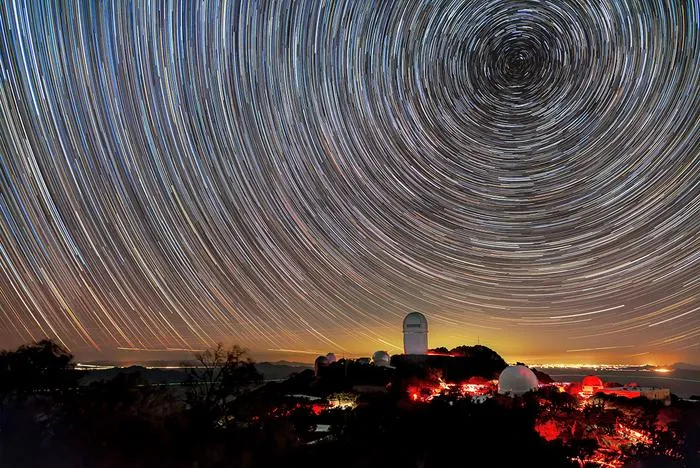
Astronomers studying the largest-ever map of the cosmos have found hints that our best understanding of the universe is due a major rewrite.
The analysis, which looked at nearly 15 million galaxies and quasars spanning 11 billion years of cosmic time, found that dark energy — the presumed-to-be constant force driving the accelerating expansion of our universe — could be weakening.
Or at least this is what the data, collected by the Dark Energy Spectroscopic Instrument (DESI), suggest when combined with information taken from star explosions, the cosmic microwave background and weak gravitational lensing.
If the findings hold up, it means that one of the most mysterious forces controlling the fate of our universe is even weirder than first thought — and that something is very wrong with our current model of the cosmos. The researchers' findings were published in multiple papers on the preprint server arXiv and presented March 19 at the American Physical Society's Global Physics Summit in Anaheim, California, so they have not yet been peer-reviewed.
"It's true that the DESI results alone are consistent with the simplest explanation for dark energy, which would be an unchanging cosmological constant," co-author David Schlegel, a DESI project scientist at the Lawrence Berkeley National Laboratory in California, told Live Science. "But we can't ignore other data that extend to both the earlier and later universe. Combining [DESI's results] with those other data is when it gets truly weird, and it appears that this dark energy must be 'dynamic,' meaning that it changes with time."
The evolving cosmos
Dark energy and dark matter are two of the universe's most puzzling components. Together they make up roughly 95% of the cosmos, but because they do not interact with light, they can't be detected directly.
Yet these components are key ingredients in the reigning Lambda cold dark matter (Lambda-CDM) model of cosmology, which maps the growth of the cosmos and predicts its end. In this model, dark matter is responsible for holding galaxies together and accounts for their otherwise inexplicably powerful gravitational pulls, while dark energy explains why the universe's expansion is accelerating.
Get the world’s most fascinating discoveries delivered straight to your inbox.
Related: Could the universe ever stop expanding? New theory proposes a cosmic 'off switch'
But despite countless observations of these hypothetical dark entities shaping our universe, scientists are still unsure where they came from, or what they even are. Currently, the best theoretical explanation for dark energy is made by quantum field theory, which describes the vacuum of space as filled with a sea of quantum fields that fluctuate, creating an intrinsic energy density in empty space.
In the aftermath of the Big Bang, this energy increases as space expands, creating more vacuum and more energy to push the universe apart faster. This suggestion helped scientists to tie dark energy to the cosmological constant — a hypothetical inflationary energy, growing with the fabric of space-time throughout the universe's life. Einstein named it Lambda in his theory of general relativity.
"The problem with that theory is that the numbers don't add up," said Catherine Heymans, a professor of astrophysics at the University of Edinburgh and the Astronomer Royal for Scotland who was not involved in the study. "If you say: 'Well, what sort of energy would I expect from this sort of vacuum?' It's very, very, very, very different from what we measure," she told Live Science.
"It's kind of exciting that the universe has thrown us a curveball here," she added.
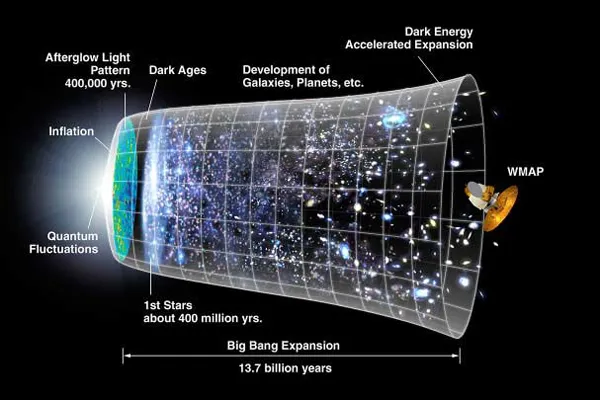
An artist's illustration of the universe's evolution to the present day, with its expansion being driven by dark energy.
Scanning the dark universe
To figure out if dark energy is changing over time, the astronomers turned to three years' worth of data from DESI, which is mounted on the Nicholas U. Mayall 4-meter Telescope in Arizona. DESI pinpoints the monthly positions of millions of galaxies to study how the universe expanded up to the present day.
By compiling DESI's observations, which includes nearly 15 million of the best measured galaxies and quasars (ultra-bright objects powered by supermassive black holes), the researchers came up with a strange result.
Taken on their own, the telescope's observations are in "weak tension" with the Lambda-CDM model, suggesting dark energy may be losing strength as the universe ages, but without enough statistical significance to break with the model.
But when paired with other observations, such as the universe's leftover light from the cosmic microwave background, supernovas, and the gravitational warping of light from distant galaxies, the likelihood that dark energy is evolving grows.
In fact, it pushes the observations' disagreement with the standard model as far as 4.2 Sigma, a statistical measure on the cusp of the five-Sigma result physicists use as the "gold standard" for heralding a new discovery.
Related: After 2 years in space, the James Webb telescope has broken cosmology. Can it be fixed?
Whether this result will hold or fade over time with more data is unclear, but astrophysicists are growing confident that the discrepancy is less likely to disappear.
RELATED STORIES
"These data seem to indicate that either dark energy is becoming less important today, or it was more important early in the universe," Schlegel said.
Astronomers say that further answers will come from a flotilla of new experiments investigating the nature of dark matter and dark energy in our universe. These include the Euclid space telescope, NASA's Nancy Grace Roman Space Telescope, and DESI itself, which is now in its fourth of five years scanning the sky and will measure 50 million galaxies and quasars by the time it's done.
"I think it's fair to say that this result, taken at face-value, appears to be the biggest hint we have about the nature of dark energy in the [rough] 25 years since we discovered it," Adam Riess, a professor of astronomy at Johns Hopkins University who won the 2011 Nobel Prize in physics for his team's 1998 discovery of dark energy, told Live Science. "If confirmed, it literally says dark energy is not what most everyone thought, a static source of energy, but perhaps something even more exotic."

Ben Turner is a U.K. based writer and editor at Live Science. He covers physics and astronomy, tech and climate change. He graduated from University College London with a degree in particle physics before training as a journalist. When he's not writing, Ben enjoys reading literature, playing the guitar and embarrassing himself with chess.
You must confirm your public display name before commenting
Please logout and then login again, you will then be prompted to enter your display name.