














Did King Arthur really exist?
The stories about King Arthur are almost certainly false or greatly exaggerated, but did the man himself exist?

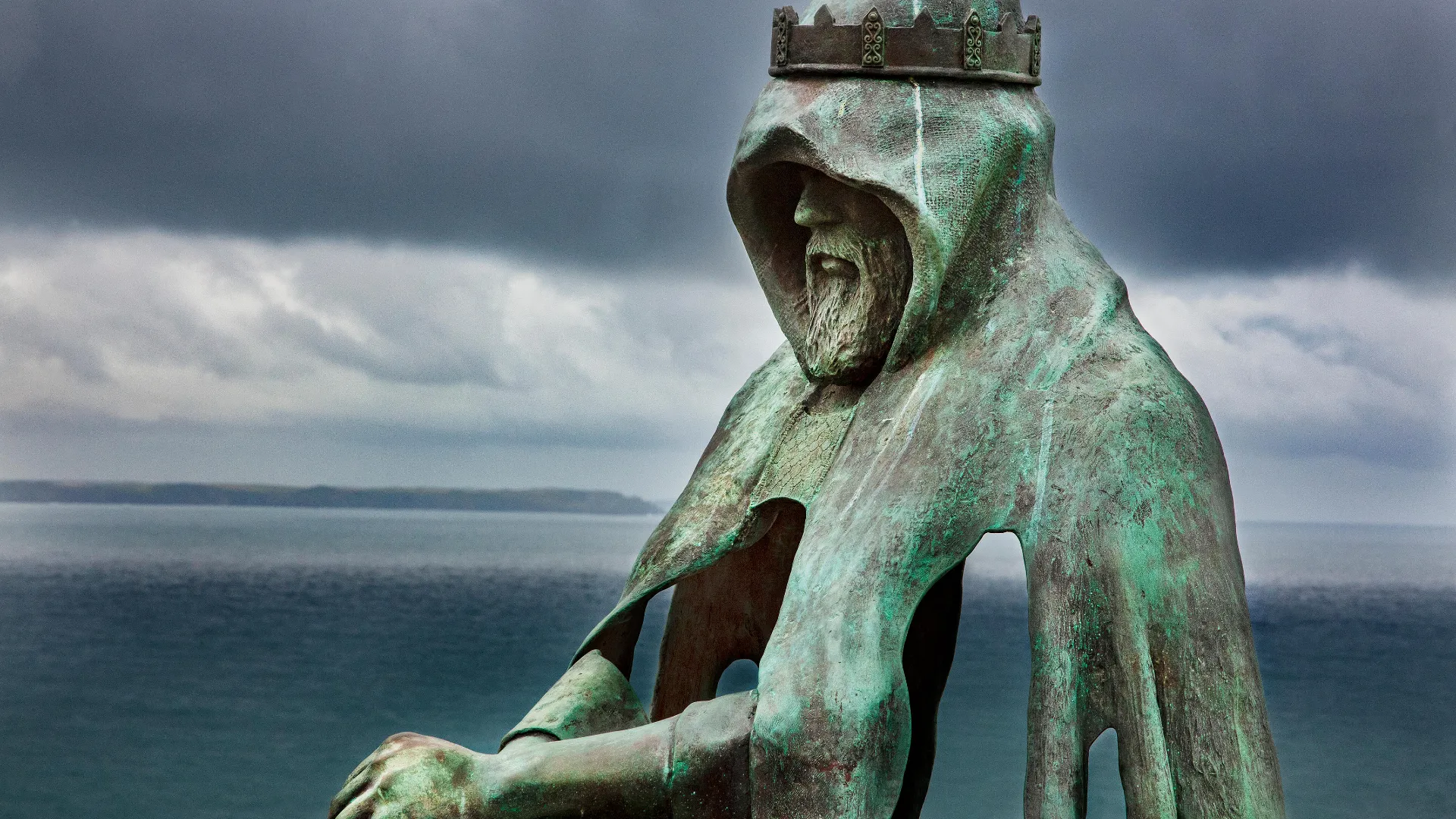
Legend has it that King Arthur and the Knights of the Round Table were busy heroes, with tales of them slaying a giant, organizing a successful search for the Holy Grail, and ruling a kingdom from a city called Camelot.
Some stories say Arthur was conceived or born at Tintagel, a site in Cornwall, England, that flourished between the fifth and seventh centuries. While many stories of King Arthur are likely false or greatly exaggerated, there is one question that scholars have long debated: Did King Arthur really exist?
There is currently no consensus, although each side lays out their arguments in interviews, scholarly papers and books, Live Science found.
A work of fiction?
SIGN UP FOR OUR NEWSLETTER

Sign up for our weekly Life's Little Mysteries newsletter to get the latest mysteries before they appear online.
Some scholars believe that Arthur is fictional.
The "king" was conceptualized in the ninth century, Nicholas Higham, a professor emeritus of early medieval history at the University of Manchester in the U.K., told Live Science in an email. He added that the earliest evidence for King Arthur is from a text called "Historia Brittonum" (Latin for "History of the Britons") that was written in Wales around A.D. 829, possibly by a monk named Nennius.
The book refers to King Arthur not as a king but as a war leader who defended Britain against Saxon invaders around A.D. 500.
The text "displays obvious signs of having been stitched together, apparently in Latin, from a variety of conflicts noted in earlier literature," Higham said. However, the earlier literature that the ninth-century writer draws from makes no mention of Arthur, and it seems that the writer invented him.
"The Arthurian tradition rests on what must be judged a ninth-century fiction, therefore, an extraordinarily successful one needless to say, but a fiction nonetheless," Higham wrote in his book "King Arthur: The Making of the Legend" (Yale University Press, 2018).
During the early ninth century, Anglo-Saxon kingdoms controlled much of Britain and were encroaching into Wales. The ninth-century writer would have wanted to create a character who could successfully fight them, Higham said.

A 15th-century illustration showing King Arthur feasting in Camelot.
We "can be reasonably confident that the Arthur with whom we are familiar was made up by one imaginative clerk early in the ninth century as the last of a string of courageous British war-leaders through whom he was seeking to deliver a vision of British success in warfare against foreign interlopers," Higham wrote in his book.
Other scholars agree that King Arthur was not a real person.
"Personally I don't think Arthur existed, as he is not named in any early source material" and isn't mentioned until the ninth century, Helen Fulton, a professor of medieval languages and literature at the University of Bristol, told Live Science in an email.
That era in Britain had no shortage of rulers, she noted. "Clearly there were British kings and war-leaders who emerged from the Roman occupation of Britain and fought with each other and with the incoming Saxons," Fulton said.
A real man?
But some scholars argue that King Arthur was, in fact, real. For evidence, some researchers have turned to "Annales Cambriae" (Latin for "Annals of Wales"), a series of texts that records historical events in Wales and other parts of the region. An analysis of two of these annals that discuss Arthur suggests that these passages were originally composed during the sixth century, Bernard Mees, a researcher of history at Monash University in Australia who did the analysis, wrote in his book "King Arthur and the Languages of Britain" (Bloomsbury, 2025).
While the earliest surviving copy of the "Annales Cambriae" dates to around 1100, Mees noted that some of the language used in the annals about Arthur is anachronistic, reflecting spelling that was used in the sixth century, after the Roman Empire had collapsed in Britain. This suggests that the annals mentioning King Arthur were composed during the sixth century and that Arthur actually existed, Mees wrote in his book.
The real-life Arthur would have been a king or a prince, he said. "The earliest records don't specifically call Arthur a king, but it's difficult to see what else he would have been," Mees told Live Science in an email.
Ken Dark, an archaeology professor at the University of Cambridge, told Live Science that "in all probability, a historical Arthur did exist, but we can't absolutely say that he did."
Of the two Arthur annals in "Annales Cambriae," the second could potentially be accurate, Dark said. That annal dates to 537 and discusses Arthur and Medraut (also known as Mordred), who was possibly Arthur's son or nephew. The annal reports that both died in the Battle of Camlann. In some Arthurian stories, Mordred kills Arthur, although the annal doesn't say this.

The ruins of Tintagel castle, a location that some stories associate with King Arthur.
The annal also mentions there was plague in Britain and Ireland at the time. We know from other historical texts and archaeological remains that an epidemic — possibly the bubonic plague — swept through the Mediterranean region in 536, and it could have made its way to Britain and Ireland by 537, Dark said. Additionally, the annal is fairly brief, similar to other annals, and has no obvious legendary material.
Interestingly, between the mid-sixth and mid-seventh centuries, there was a relatively high number of royal family members named Arthur in Britain and Ireland, Dark noted. This suggests that the kings who named them "were basing their name on a famous Arthur," Dark said. This famous Arthur could have been a real person who was a war leader, although we can't be certain.
If Arthur were real, he would have been quite a different person from the Arthur in the stories, Dark said, adding that people like Lancelot, Guinevere and the Knights of the Round Table would have been fictional characters added later.
RELATED MYSTERIES
"Nobody claims that any figure of the fifth, sixth or even seventh centuries would have been anything like the Arthur of legends," said Dark, who is writing a book called "Tyrants and Traders: Tintagel, Arthur and the Lost Kings" (Bloomsbury, 2026), which is set to come out later this year.
Mary Bateman, an English lecturer at the University of Bristol who has studied the Arthurian stories extensively, said Arthur can be both fictional and real at the same time.
Arthur is either a figure or figures "of history that have picked up a lot of myths along the way," Bateman told Live Science in an email, "or else was originally a figure of myth [that] acquired new stories/narrative threads etc from historical figures."

Owen Jarus is a regular contributor to Live Science who writes about archaeology and humans' past. He has also written for The Independent (UK), The Canadian Press (CP) and The Associated Press (AP), among others. Owen has a bachelor of arts degree from the University of Toronto and a journalism degree from Ryerson University.
You must confirm your public display name before commenting
Please logout and then login again, you will then be prompted to enter your display name.