Get the world’s most fascinating discoveries delivered straight to your inbox.
You are now subscribed
Your newsletter sign-up was successful
Want to add more newsletters?
Join the club
Get full access to premium articles, exclusive features and a growing list of member rewards.
An account already exists for this email address, please log in.
Gold glitters around Ghana's 'lake of souls' thanks to catastrophic meteor strike — Earth from space
A 2015 satellite photo shows a series of golden tendrils surrounding Ghana's Lake Bosumtwi, which is considered sacred to the local Asante people. The lake and its surroundings were shaped by a massive meteor impact around 1 million years ago.
Ghana's Lake Bosumtwi was formed around 1 million years ago when a hefty space rock slammed into Earth. This also brought lots of valuable metals, such as gold, to the planet's surface.
What's in the photo? Ghana's only natural lake, surrounded by exposed veins of gold
Which satellite took the photo? Landsat 8
When was it taken? Dec. 29, 2015
This shimmering satellite image shows tendrils of gold surrounding Ghana's sacred "lake of souls," which was carved out by a devastating asteroid strike around 1 million years ago.
Lake Bosumtwi (also spelled Bosomtwe) spans 19 square miles (19 square kilometers) — a little smaller than Manhattan — and is located just to the southeast of Ghana's second-largest city, Kumasi (partially visible in the top left of the photo). The roughly circular body of water, which is up to 240 feet (70 meters) deep, is the country's only natural lake.
To the Indigenous Asante people, the lake is a sacred site. According to their mythology, a hunter named Akora Bompe chased a wounded antelope into a small magical pond, causing the small body of water to rapidly swell into the lake we see today. It is also considered a "place where souls bid farewell to Earth before entering the afterlife," according to NASA's Earth Observatory.
In reality, the lake actually formed around 1 million years ago, when a roughly 3,300-foot-wide (1 km) meteor slammed into our planet, creating "arguably the best-preserved complex young impact structure known on Earth," according to the International Commission on Geoheritage.
The catastrophic collision likely triggered "a blinding flash of light and an immense fireball [that] would have incinerated life for dozens of kilometers," Marian Selorm Sapah, a senior lecturer in the University of Ghana's Department of Earth Science, told the Earth Observatory. If the same event occurred today, it would likely obliterate the city of Kumasi, she added.
Lake Bosumtwi is Ghana's only natural freshwater lake.
(Image credit: International Commission on Geoheritage)
Remote sensing analysis has revealed that the material blasted out of the impact settled in a raised, lobed pattern known as a "rampart" crater. This suggests the area was covered in a layer of groundwater when the collision occurred, according to the Earth Observatory.
Rampart craters are rare on Earth but are more common throughout the solar system, including on Mars, as well as on smaller bodies, such as Ganymede, Dione, Tethys and Charon. As a result, studying Lake Bosumtwi could provide insight into how these extraterrestrial craters formed, Sapah said.
Sign up for the Live Science daily newsletter now
Get the world’s most fascinating discoveries delivered straight to your inbox.
The impact also fractured Earth's crust and allowed mineral-rich magma to rise to Earth's surface, forming shallow veins of gold and other valuable elements that have been mined for generations. This activity has resulted in the golden flecks and lines visible in this satellite image.
The rate of gold mining has accelerated in recent years due to advances in technology. Another satellite photo taken in 2024 (see below) shows much more visible gold, which has been exposed by this increased activity. (The lake also appears green in the newer photo due to higher concentrations of phytoplankton in its waters.)
A more recent satellite photo, captured in 2024, shows that the level of gold mining around Lake Bosumtwi has increased significantly over the last decade.
(Image credit: NASA/Landsat)
"The stark visual evidence of anthropogenic [human-caused] change juxtaposed with a million-year-old geological landmark is striking," Sapah said.
A 2017 astronaut photo shows two sets of solar evaporation ponds alongside the Colorado River. The stripy structures are used to refine potassium chloride, or "potash," which is mined nearby.
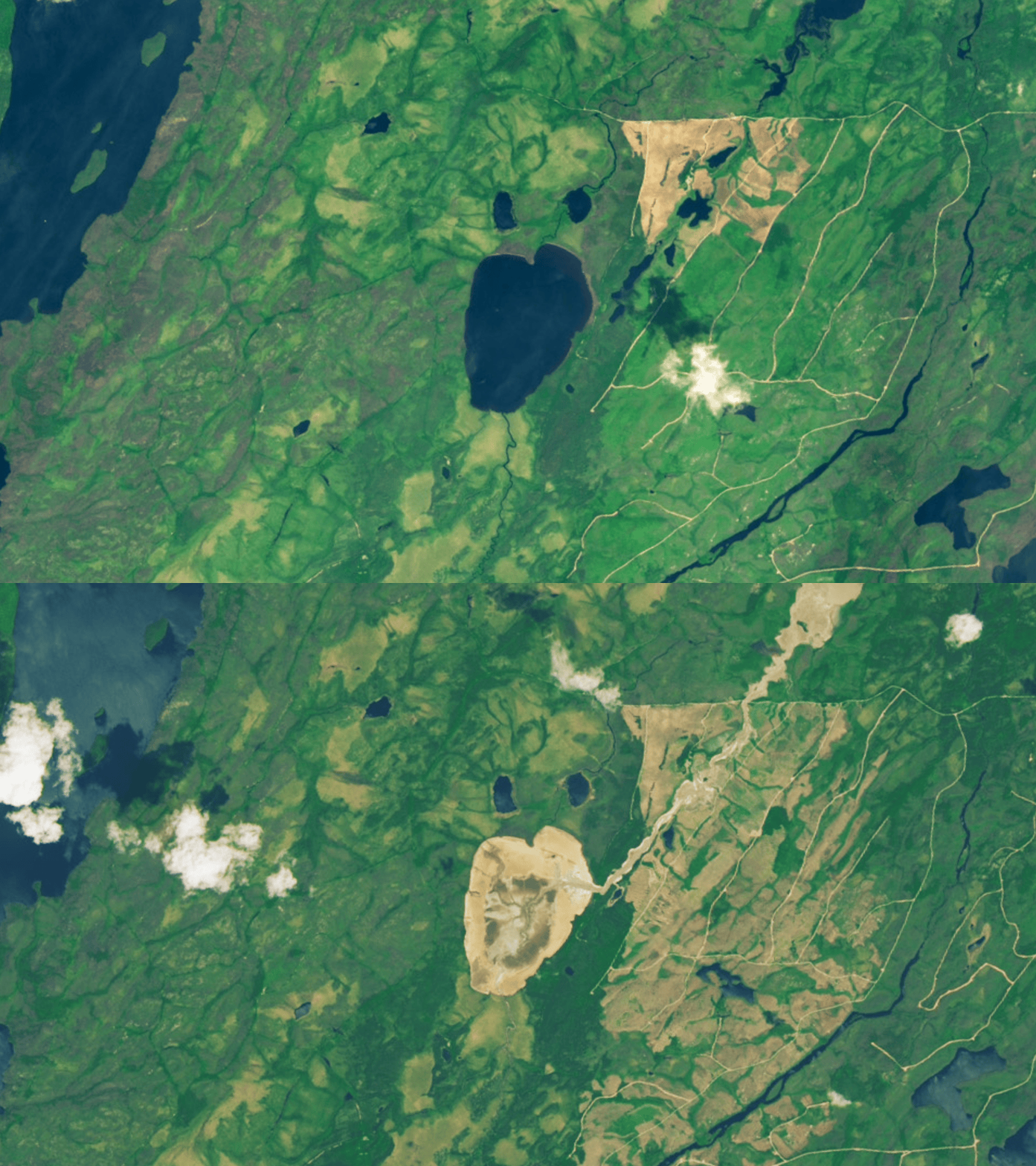
A pair of satellite photos reveals the drastic transformation of Canada's Lake Rouge, which was fully drained after the sudden collapse of one of its banks. A multitude of factors led to the demise of the shocked-emoji-like lake, experts say.
A 2011 astronaut photo shows off a series of colorful mini-lakes that appeared around the edge of a giant salt flat, known as the Etosha Pan, following a major flooding event.
Harry is a U.K.-based senior staff writer at Live Science. He studied marine biology at the University of Exeter before training to become a journalist. He covers a wide range of topics including space exploration, planetary science, space weather, climate change, animal behavior and paleontology. His recent work on the solar maximum won "best space submission" at the 2024 Aerospace Media Awards and was shortlisted in the "top scoop" category at the NCTJ Awards for Excellence in 2023. He also writes Live Science's weekly Earth from space series.
You must confirm your public display name before commenting
Please logout and then login again, you will then be prompted to enter your display name.