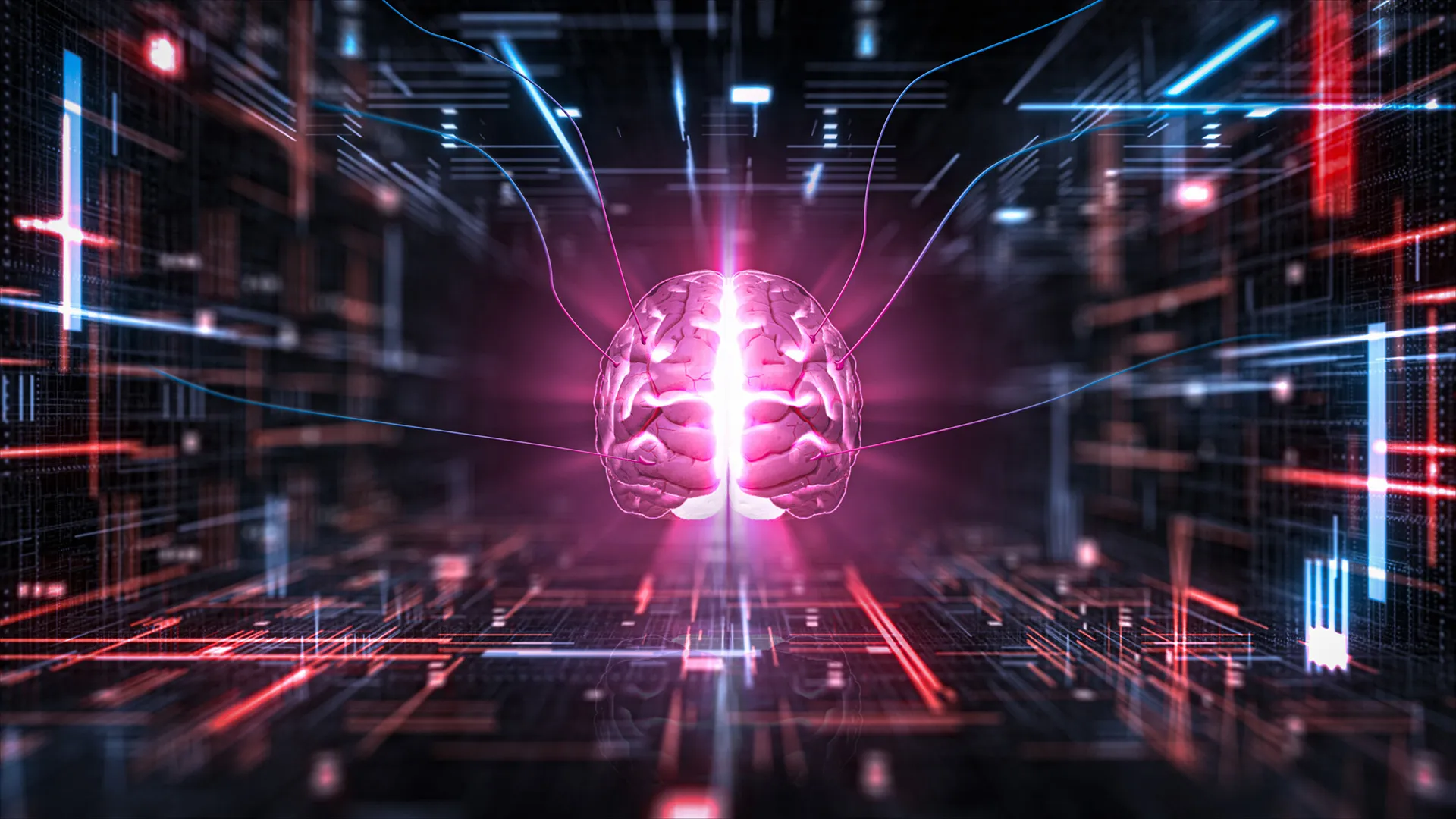
Researchers have developed a method to reduce uncertainty in artificial intelligence (AI) systems by tapping into the power of quantum computers. They say their work represents the first demonstration of "quantum enhancement" in a production-scale, pretrained large language model (LLM).
One of the key metrics used to measure the quality and capabilities of AI systems such as Anthropic's Claude, OpenAI's ChatGPT and similar services is a unit known as "perplexity" — often expressed as PPL. This measures a system's general ability to properly predict the next word in a sentence or sequence of words.
A system with a low PPL is considered better at predicting the next word, while one with a high PPL is mathematically more likely to produce erratic outputs. There are multiple methods to reduce PPL in large AI models, including fine-tuning, training on larger datasets, and adding parameters.
GPT-5.5, for example, is estimated to have somewhere between 2 trillion and 5 trillion parameters. In all standard LLMs, each parameter takes up space in the system’s memory, meaning that as these models become larger and more capable, they require increasingly larger infrastructure.
But scientists at Multiverse Computing have found an alternative to scaling up the infrastructure around AI. In a new study uploaded May 7 to the arXiv preprint database, they proposed that a relatively small boost in the number of parameters in an AI model can lead to a significant reduction in perplexity when running them using quantum circuit blocks — the fundamental units of quantum computations.
"The results reported here constitute, to our knowledge, the first demonstration of end-to-end quantum enhancement of a production-scale, widely-deployed LLM on real superconducting quantum hardware for autoregressive language generation," the scientists wrote in the study. "Their significance lies not in the magnitude of the perplexity improvements — which will grow with hardware fidelity and qubit count — but in the fact that they exist at all."
A step forward for quantum-enhanced AI
In the study, the researchers created and executed quantum circuit blocks called Cayley-parameterized unitary adapters (CUAs).
Sign up for the Live Science daily newsletter now
Get the world’s most fascinating discoveries delivered straight to your inbox.
Cayley parameters are a set of mathematical matrices that can be "trained" by weighting them towards specific matrix components. They’re inserted into a specific layer of an LLM for training on a classical computer.
The LLM's original parameters are frozen during this process so that they remain unchanged. The new hybrid system containing both the trained Cayley parameters and the original model parameters is then executed on the 156-qubit IBM Quantum System Two superconducting quantum processing unit (QPU).
IBM has unveiled its plans to build Starling, the world's first fault-tolerant quantum computer, by 2029.
(Image credit: IBM)
The resulting quantum-classical hybrid model lowered the perplexity of Llama 3.1 8B — an 8 billion-parameter model created by Meta — by 1.4% while adding only 6,000 parameters (a 0.000075% increase).
Borja Aizpurua, a senior research scientist at Multiverse Computing and first author of the study, described the new technique as a proof of concept for further development. Speaking with Live Science, he explained that quantum computers can provide some advantages over a strictly classical paradigm — but they come with a trade-off.
"The first thing you do is encode [the parameters] in the quantum computer. Once you have encoded the state, you are ready to apply the Cayley unitary adapter, which we train classically and then implement in quantum hardware," he said.
He explained that these adapters are small, which is important because the bigger the circuit, the more "noise" there is. Noise generated during quantum computations — which can come from interactions with nearby qubits, disturbances from the Earth’s magnetic field, radiation from Wi-Fi or phones, and even cosmic rays — may cause errors and render outputs and measurements meaningless.
As in much of quantum computing research, quantum error correction is one of the main areas of interest. In this study, mitigating errors caused by noise was the primary obstacle Aizpurua and the Multiverse Computing team were attempting to overcome.
Tackling real-world problems
The scientists loaded the classically trained Cayley unitary adapters into the quantum system before end-to-end inference — the phase of AI use where the model executes a response — occurred. Then, the hybrid outputs could be measured against the normal non-quantum-enhanced results.
The researchers discovered that the hybrid model could answer several questions correctly that the base Llama model could not.
In one astronomy question, the original model incorrectly selected an answer indicating that only Saturn has Jovian planet rings. However, the CUA-enhanced model correctly identified all jovian planets as ringed.
In another example, the original model incorrectly answered a biology question on the population-genetic consequences of gene flow, selecting “Hardy–Weinberg disruption” while the CUA-enhanced model correctly identified increased genetic homogeneity.
"So here we can see an example in which a model doesn't answer correctly, and then you add something quantum and suddenly it answers correctly," Aizpurua said.
This result, coupled with the measured 1.4% reduction in perplexity, demonstrates a clear path forward for developing quantum hybrid AI systems, Aizpurua said. He added that this research could help researchers overcome current development bottlenecks where systems are constrained by developers' ability to scale classical computing infrastructure.
Future research would involve developing methods by which the entire quantum circuit, not just the Cayley unitary adapters, is directly encoded, Aizpurua said. This would ostensibly result in an LLM capable of achieving lower perplexity and higher accuracy, using fewer parameters than any purely classical method.
Ultimately, he said, the goal of the research is to produce higher-quality AI systems capable of reaching "quantum advantage," a term that describes a quantum-based computer system capable of performing feats unachievable by any classical computer.
Can you match these ancient devices to their pictures? Find out with our computing quiz!
Tristan is a U.S-based science and technology journalist. He covers artificial intelligence (AI), theoretical physics, and cutting-edge technology stories.
His work has been published in numerous outlets including Mother Jones, The Stack, The Next Web, and Undark Magazine.
Prior to journalism, Tristan served in the US Navy for 10 years as a programmer and engineer. When he isn’t writing, he enjoys gaming with his wife and studying military history.
You must confirm your public display name before commenting
Please logout and then login again, you will then be prompted to enter your display name.