













The solar system's largest moon may be heating up — offering clues to its mysterious origins
The largest moon in the solar system — Jupiter’s Ganymede — has a unique and inexplicable magnetic field. New research could finally explain it: the moon is heating up.
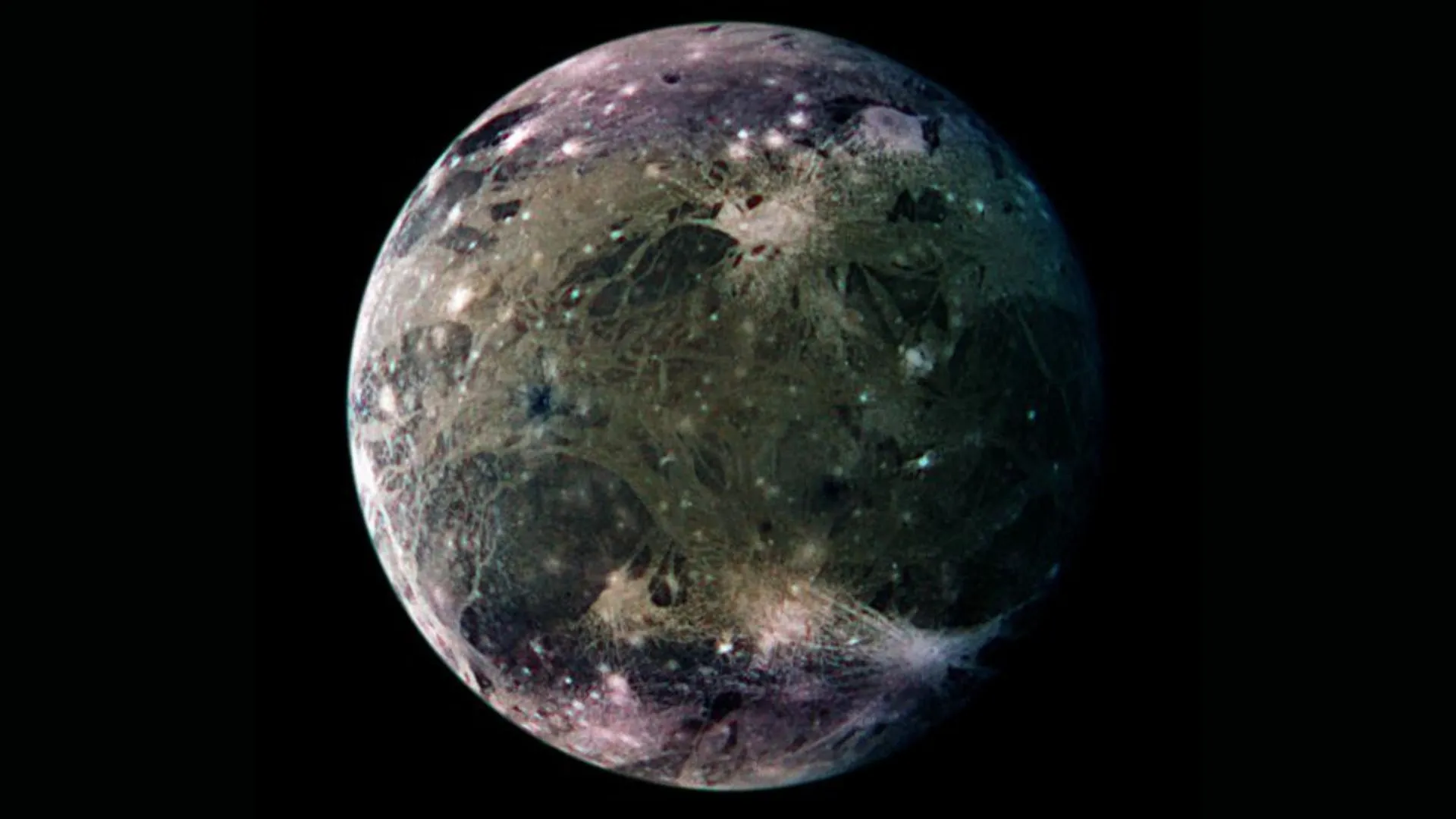
Jupiter's giant moon Ganymede is the only known moon to have its own magnetic field — and it may be heating up in a process "not yet observed anywhere else," new research suggests.
One of the four Galilean satellites swirling around Jupiter, Ganymede is the largest moon in the solar system. At nearly 3,300 miles (5,300 kilometers) in diameter, it's more than 1,000 miles (1,600 km) wider than Earth's moon and slightly bigger than Mercury, our tiniest planetary tot. (Jupiter has more than 100 confirmed moons, with the largest four known as the Galilean moons.)
This standout satellite's intrinsic magnetic field — discovered by NASA's Galileo spacecraft in 1996 — is generated through a process called a dynamo, powered by the electrically conductive, churning liquid iron in its core.
Yet the mechanism through which this process emerged is hotly debated.
"Many formation studies suggest that Ganymede formed too cold to start with a metal core," study co-author Kevin Trinh, a planetary scientist at Caltech, said in a statement. "Meanwhile, many modeling studies of Ganymede's dynamo assume that Ganymede formed its metal core roughly when the moon itself formed, as Earth did. Both of these things cannot be simultaneously true."
So, in a paper published May 6 in the journal Science Advances, researchers propose a new topsy-turvy mechanism that may have formed Ganymede's mysterious metallic core and dynamo later rather than earlier, as molten iron blobs sank into the massive moon's core. This activity may be ongoing today.
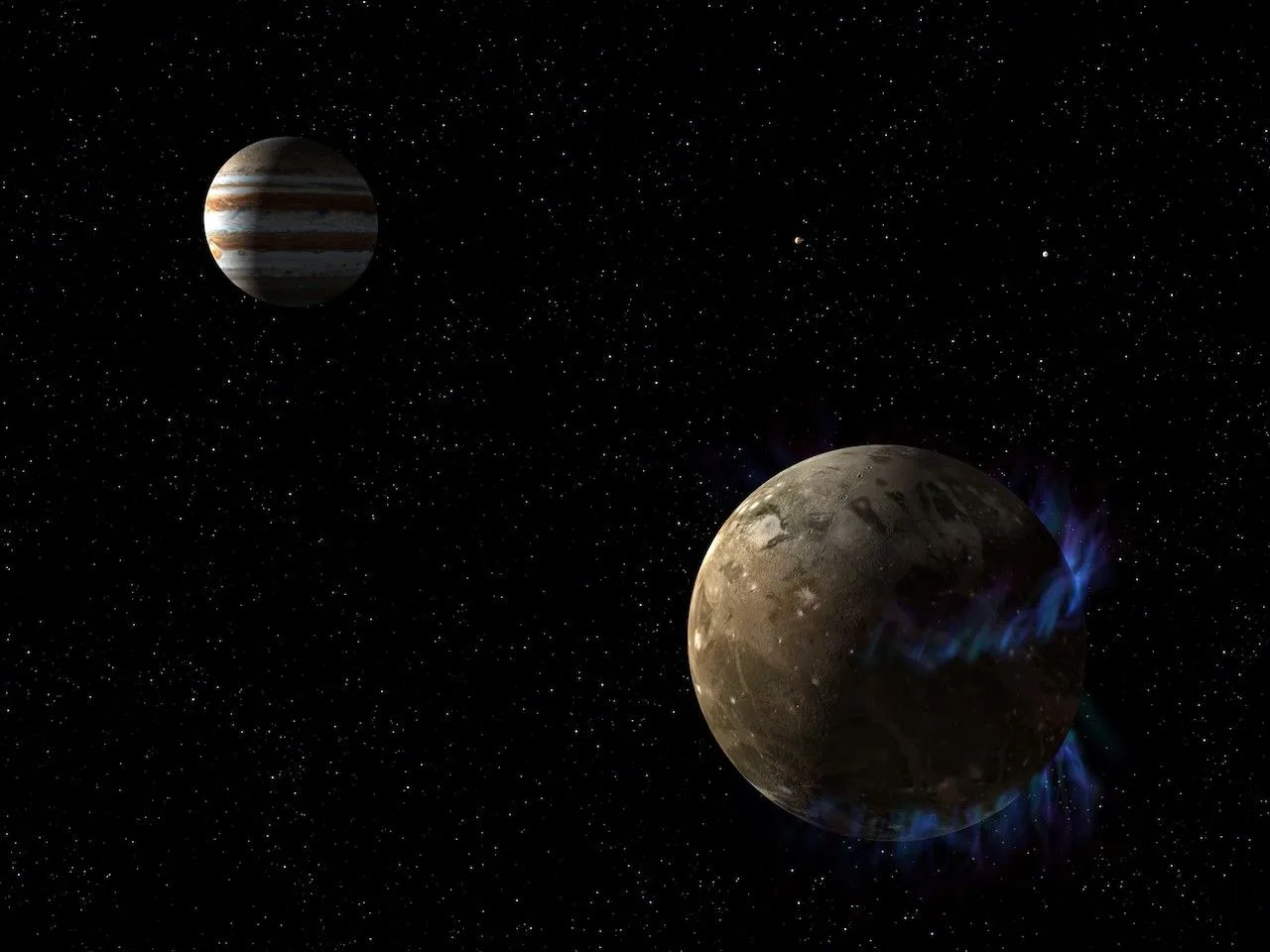
An illustration depicting Jupiter and its largest moon, Ganymede, exhibiting auroras discovered by the Hubble Space Telescope.
Hot or cold start?
The "warming-driven dynamo" presented in the study is the opposite of traditional dynamo-origin ideas, which propose that they form early in large bodies like Earth and then gradually cool.
Get the world’s most fascinating discoveries delivered straight to your inbox.
For example, metallic core formation in planetary bodies is thought to have occurred within around 200 million years of the solar system's formation. Yet moons may be too small to hold enough heat from their birth to power this process.
But all hope is not lost, because a body formed from a "cold start" may still be able to grow a magnetic-field-generating core, the researchers' new model suggests.
This model integrates and simplifies Ganymede's characteristics, such as its composition and core temperature, assuming its core is composed of iron and iron sulfide, because these components have lower melting temperatures.
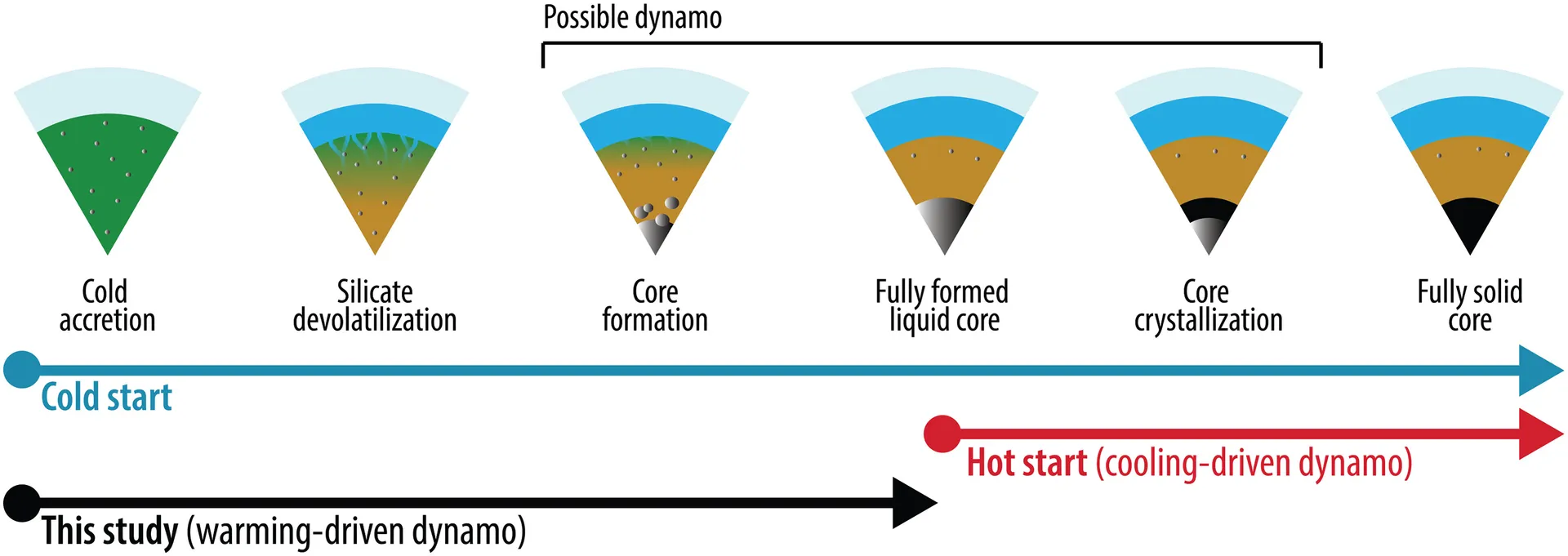
"Cold" and "hot" scenarios for the formation of a dynamo, such as within Ganymede, as modeled in this study.
In this model, molten metal blobs sink into Ganymede's innards to feed its core and whip up its magnetic field. They are warmed through two main mechanisms: radioactive heating and tidal heating.
First, as heavier radioactive isotopes decay into lighter elements, they release heat. Second, Jupiter's gigantic gravitational influence squeezes and stretches Ganymede as the moon whirls nearer and farther from its parent, as if "kneading" a planet-size piece of rocky, icy dough. The resulting inner friction generates heat. This heat powers the dynamo that gives Ganymede its magnetic field.
Altogether, this hypothesis does not preclude the possibility that Ganymede formed with a magnetic-field-producing core.
Alien implications?
But if "cold start" cores exist throughout the universe, it could present a previously unexplored process for magnetic fields to form and protect aging worlds, perhaps facilitating an intriguing implication in the search for extraterrestrial life.
Related stories
Magnetic fields are necessary to protect life from harmful solar and cosmic radiation, making them a prerequisite in most searches for habitable planets. But a little magnetism can go a long way: As is apparent on Earth, with a magnetic field significantly weaker than a fridge magnet, even a modest magnetosphere can transform the outlook of planetary bodies.
"There could be young rocky exoplanets or exoplanets with lower radioactive isotope abundances (i.e., slower heating) that would be favorable for a recent warming-driven dynamo," Trinh told Live Science in an email. "The challenge is that no one has detected an exoplanet dynamo so far."
Trinh, K. T., Petricca, F., Hemingway, D. J., & Vance, S. D. (2026). Powering Ganymede’s dynamo with protracted core formation. Science Advances, 12(19), eaed8021. https://doi.org/10.1126/sciadv.aed8021
Ivan is a long-time writer who loves learning about technology, history, culture, and just about every major “ology” from “anthro” to “zoo.” Ivan also dabbles in internet comedy, marketing materials, and industry insight articles. An exercise science major, when Ivan isn’t staring at a book or screen he’s probably out in nature or lifting progressively heftier things off the ground. Ivan was born in sunny Romania and now resides in even-sunnier California.
You must confirm your public display name before commenting
Please logout and then login again, you will then be prompted to enter your display name.