













Ramesses II's sarcophagus finally identified thanks to overlooked hieroglyphics
Archaeologists determined that a fragment of a sarcophagus hidden beneath a Coptic building's floor once belonged to Ramesses II.
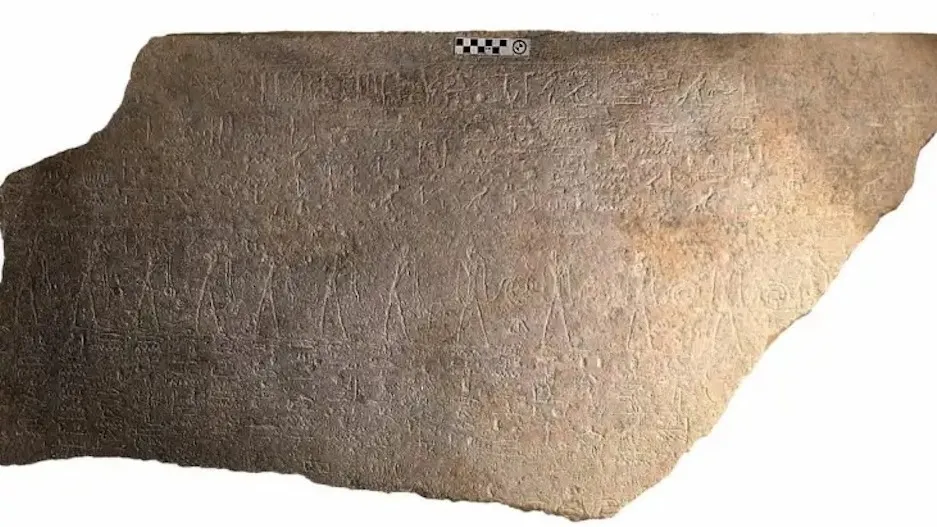
A sarcophagus fragment discovered beneath the floor of a religious center belongs to Ramesses II, one of the best-known ancient Egyptian pharaohs, according to a new study.
Archaeologists unearthed the granite artifact in 2009 inside a Coptic building in Abydos, an ancient city in east-central Egypt. The team, led by archaeologists Ayman Damrani and Kevin Cahail, had determined that the sarcophagus had carried two individuals at different times. However, they could identify only the latter — Menkheperre, a "high priest of the 21st dynasty," who lived in roughly 1000 B.C., according to a translated statement from France's National Center for Scientific Research.
The initial owner of the sarcophagus — a container that is covered in carved decorations and texts — had remained a mystery. But archaeologists knew it had belonged to a "very high-ranking figure of the Egyptian New Kingdom," according to the statement.
Further sleuthing enabled Egyptologist Frédéric Payraudeau, a teacher and researcher at Sorbonne University in France, to connect Ramesses II (also spelled Ramses II) to the sarcophagus. To do so, he deciphered an overlooked cartouche, an oval-shaped engraving that represents the name of a pharaoh, "of Ramses II himself," according to the statement.
Ramesses II was the third ruler of ancient Egypt's 19th dynasty and ruled from 1279 to 1213 B.C. He's known for expanding Egypt's empire to what is now modern-day Syria and for his building projects, including the expansion of Karnak Temple.
Related: Ancient Egyptian pharaoh Ramesses II's 'handsome' face revealed in striking reconstruction
In 1881, Ramesses II's mummy and coffin were found in a "secret" hiding place in Deir el-Bahari, a temple complex outside Luxor, that contained the remains of 50 other members of nobility, including his father, according to the Egypt Museum. His highly ornate coffin is considered "one of the most striking coffins from ancient Egypt," according to the American Research Center in Egypt.
Get the world’s most fascinating discoveries delivered straight to your inbox.
RELATED STORIES
Before being placed in the newly found sarcophagus, Ramesses II was buried in a now-lost gold coffin and was moved to an alabaster sarcophagus, which was found destroyed in his tomb by looters. He was later moved to the granite sarcophagus, which Menkheperre had transferred to Abydos to use for himself, La Brújula Verde reported.
"This discovery is new proof that at this time, the Valley of the Kings was the subject not only of looting but also of the reuse of funerary objects by subsequent sovereigns," according to the statement.
The study was published in the journal Revue D'Égyptologie.
Jennifer Nalewicki is former Live Science staff writer and Salt Lake City-based journalist whose work has been featured in The New York Times, Smithsonian Magazine, Scientific American, Popular Mechanics and more. She covers several science topics from planet Earth to paleontology and archaeology to health and culture. Prior to freelancing, Jennifer held an Editor role at Time Inc. Jennifer has a bachelor's degree in Journalism from The University of Texas at Austin.