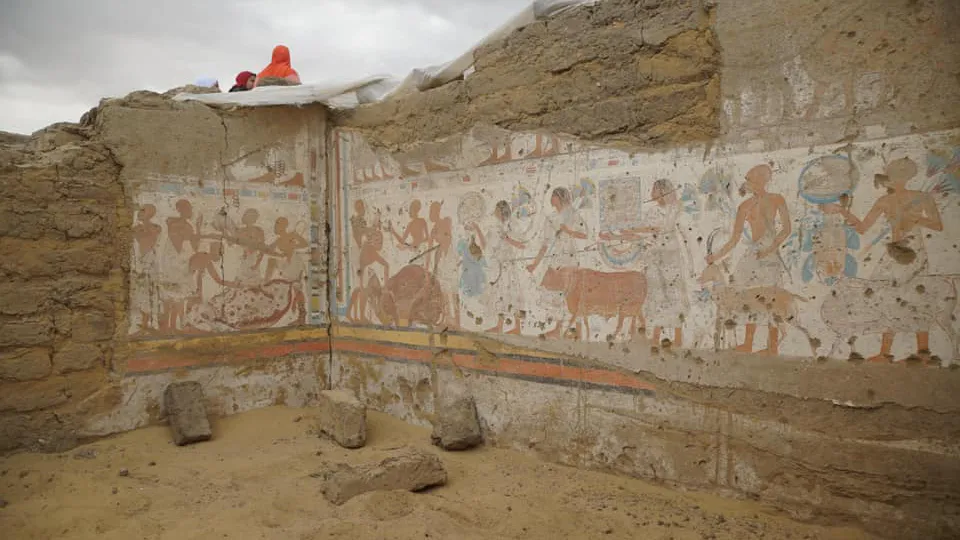
A tomb dating back over 3,200 years that was built for a senior official of one of Egypt's most powerful pharaohs has been discovered at Saqqara, the Egyptian Ministry of Tourism and Antiquities announced on Oct 30.
Inscriptions found in the tomb say that Ptah-M-Wia, the person buried there, held a number of positions including head of the treasury and chief supervisor of livestock during the reign of pharaoh Ramesses II (reign 1279–1213 B.C.), who expanded Egypt's empire as far as modern-day Syria. Ramesses II was also known for his building endeavors including the expansion of Karnak Temple, archaeologists said in a statement from the Egyptian ministry. Ptah-M-Wia was head of the treasury centuries before the invention of minted coins; at that time people made payments with goods, rations or precious metals.
In the remains of Ptah-M-Wia's tomb, archaeologists found a series of wall paintings showing people leading cattle and other animals to be slaughtered. This scene could be related to Ptah-M-Wia's position as livestock supervisor. It does not appear that any human remains were found in the tomb so far.
Several engravings in the tomb also depicted a man, possibly Ptah-M-Wia. In one engraving, he is shown sitting beside several jars and an object that looks like a horn.
Researchers are currently analyzing hieroglyphs found above the engraving that indicate, among other things, that in addition to his other duties Ptah-M-Wia was in charge of making "divine offerings" at one of the temples built by Ramesses II at Thebes (modern-day Luxor). The pharaoh built or expanded several temples at Thebes during his reign, and it's not clear which one Ptah-M-Wia made offerings at.
Ola Al-Ajizi, an archaeology professor at Cairo University, led the team that discovered the tomb. Archaeologists are continuing to excavate and analyze the tomb and nearby area. The discovery is in good company, as Saqqara holds a vast number of archaeological sites that include the 4,700-year-old Step Pyramid of Djoser.
Sign up for the Live Science daily newsletter now
Get the world’s most fascinating discoveries delivered straight to your inbox.
Owen Jarus is a regular contributor to Live Science who writes about archaeology and humans' past. He has also written for The Independent (UK), The Canadian Press (CP) and The Associated Press (AP), among others. Owen has a bachelor of arts degree from the University of Toronto and a journalism degree from Ryerson University.