











Barreleye fish: The deep-sea weirdo with rotating eyes and a see-through head
Thanks to a yellow pigment that filters out sunlight, barreleyes can't be fooled by a common deep-sea camouflage tactic.


Name: Barreleye fish (Macropinna microstoma)
Where it lives: The Bering Sea and the North Pacific Ocean, at depths between 2,000 and 2,600 feet (600 and 800 meters)
What it eats: Zooplankton and small crustaceans called copepods
Why it's awesome: As their name suggests, barreleye fish have really weird tubular eyes that they can rotate to gaze upward through their transparent foreheads. Although they appear green, the lenses are actually tinted with a yellow pigment that helps these bizarre fish distinguish between sunlight and bioluminescence.
The ocean's twilight zone — the layer of water from 650 to 3,300 feet (200 to 1,000 m) below the surface — receives just enough sunlight for creatures to cast a faint shadow. Their silhouettes are visible to predators lurking below, which is why some deep-sea critters have evolved light-producing organs on their undersides to match the downwelling light. But barreleyes' ocular trick, which works by filtering out sunlight, stops them being fooled by creatures trying to erase their shadows.
This barreleye fish has a transparent head! This fish can actually look up through their own head to see what’s above it. Its tubular eyes help barreleyes both see prey silhouetted against the lighted waters above and what’s in front of them! #FishyFriday pic.twitter.com/JM7bJvZrt8December 17, 2021
Barreleyes hover motionless in the dark until they spot a potential meal passing overhead. They then dart upward to snag it in their mouth and fix their eyes on their prey by rotating them into a forward-looking position.
In 2021, scientists captured footage of one of these rarely seen, deep-sea weirdos in Monterey Canyon, off the coast of California. They speculated that barreleye fish help themselves to a buffet of crustaceans and larvae that get caught in the tentacles of siphonophores — jellyfish-like organisms that form strings up to 130 feet (40 m) long, according to the Monterey Bay Aquarium.
Get the world’s most fascinating discoveries delivered straight to your inbox.
Barreleyes' transparent helmets may protect them from stinging cells on these tentacles — but this, as well as many other aspects of these creatures' lives, remains uncertain.
Scientists were treated to another barreleye fish sighting in fall 2026, five years after the last encounter. This time, researchers captured ultra-high-resolution footage of the creature to examine its body and behavior, and to keep a record of this rarely seen fish. The barreleye was floating about 1,970 feet (600 m) beneath the ocean's surface off the coast of California. The team spotted it by chance while pulling up a remotely operated vehicle (ROV) from deeper waters at the end of a working day.
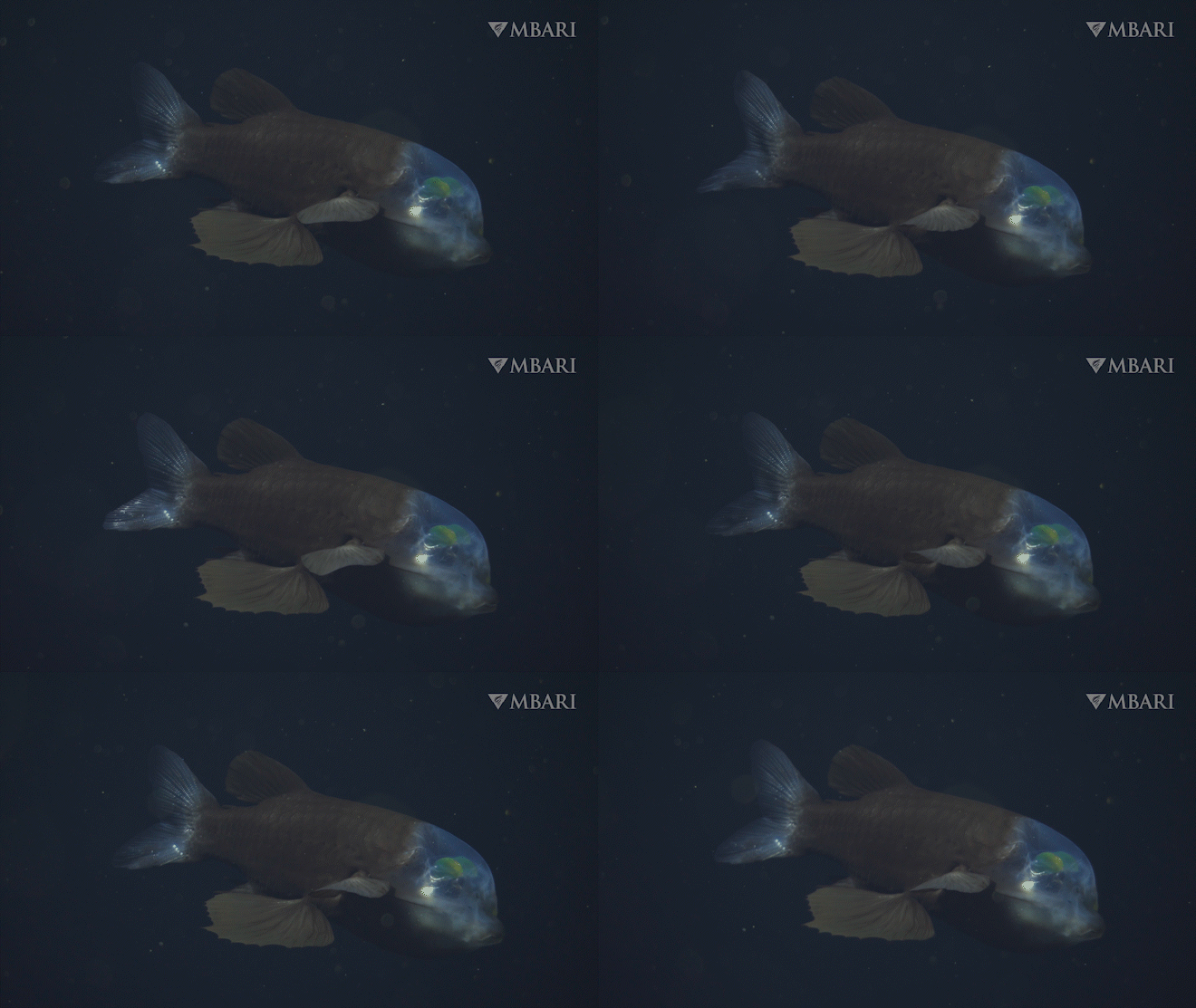
MBARI researchers spotted a deep-sea barreleye fish off the coast of California in fall 2026.
The researchers observed the barreleye fish in its natural habitat for 20 minutes, filming its strange eyes and capturing it in 3D stereo imagery — a technique that creates the illusion of 3D depth from 2D images. The team did not collect the fish, as the videos and photos will suffice to support further research, according to a statement from the Monterey Bay Aquarium Research Institute (MBARI).
Like most deep-sea fishes, barreleye fish are camera-shy and tend to swim away when they feel they are being observed, said Steven Haddock, a marine biologist and senior scientist at MBARI who was on the expedition. It is therefore remarkable that the team was able to film this specimen for so long, Haddock told Live Science in an email.
"Using advanced cameras on ROV Doc Ricketts, we were able to examine its features up close and even use a VR camera to observe the fish from all angles," he said. "I’ve been lucky enough to see this unique species a few times before, but my last encounter was nine years ago, before we had 4K cameras on the submersible, so this sighting was the most memorable one yet."
Editor's note: This article was originally published Aug. 5, 2023, and was updated Nov. 4, 2026, to include details about a new sighting of the barreleye fish.

Sascha is a U.K.-based staff writer at Live Science. She holds a bachelor’s degree in biology from the University of Southampton in England and a master’s degree in science communication from Imperial College London. Her work has appeared in The Guardian and the health website Zoe. Besides writing, she enjoys playing tennis, bread-making and browsing second-hand shops for hidden gems.
You must confirm your public display name before commenting
Please logout and then login again, you will then be prompted to enter your display name.