
















Carbon Dioxide Could Reach 410 PPM This Month
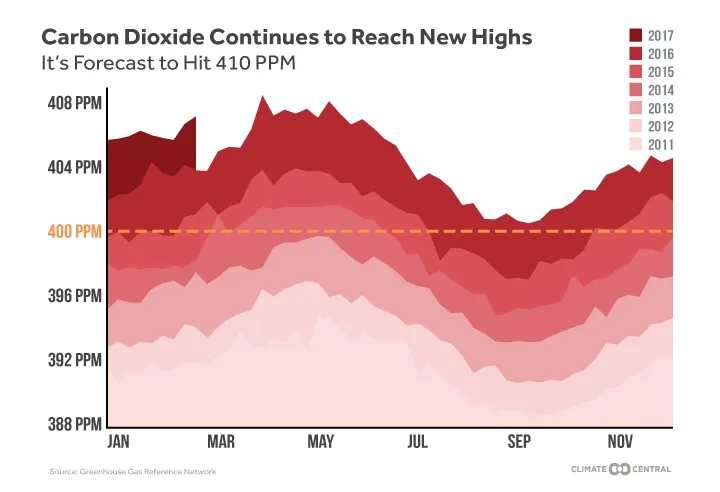
A never-ending stream of carbon pollution ensures that each year the world continues to break records for carbon dioxide in the atmosphere. This year will be no different.
Like a rite of spring, carbon dioxide is poised to cruise pass the previous mark set last year and reach heights unseen in human history. In the coming weeks, carbon dioxide will start to breach the 410 parts per million threshold on a daily basis at the Mauna Loa Observatory in Hawaii. The monthly average for May could come close to topping 410 ppm, too, according to the U.K. Met Office’s inaugural carbon dioxide forecast, released last week.
Richard Betts, a climate scientist who helped create the forecast, said we should pass last year’s record-setting monthly peak by April or even as soon as this month. It’s not a question of if but rather when depending on wind patterns and other factors that influence daily measurements.
This year’s new high-water mark comes a year after the planet passed the 400 ppm threshold permanently on the back of the greatest yearly rise in carbon dioxide on record. That dramatic rise was driven in part by last year’s super El Niño, but the underlying cause of the steady uptick is human activities that emit carbon pollution.
The World Passes 400 PPM Threshold. Permanently Flirting with the 1.5°C Threshold The Last Time CO2 Was This High, Humans Didn’t Exist
The string of carbon dioxide records is a running reminder that those activities are altering the basic chemistry of our atmosphere and destabilizing the climate that’s allowed civilization to flourish.
While 2017 is unlikely to see a rise as dramatic as 2016’s El Niño-fueled peak, the Met Office forecast said this year is still expected to see an above-average increase. Carbon dioxide is forecast to rise another 2.5 ppm this year.
Get the world’s most fascinating discoveries delivered straight to your inbox.
The forecast is based on research done by Met Office scientists last year that uses equatorial Pacific Ocean temperatures in the El Niño region coupled with carbon pollution data.
“Verifying the forecast against measurements gives us an extra reason to understand the processes behind the year-to-year variability in the rate of carbon dioxide rise — and that could be helpful in understanding the global carbon cycle and how it is affected by climate variability and change,” Betts said.
For decades, scientists have been monitoring the annual ebb and flow of carbon dioxide in the atmosphere at Mauna Loa. The ebb happens as plants inhale carbon dioxide out of the atmosphere in northern hemisphere summer. Their death and decomposition then sparks the flow of carbon dioxide.
Since the Industrial Revolution, human activities have added more carbon dioxide than plants can take up, altering the equation so that more and more carbon dioxide ends up in the atmosphere. As a result, temperatures have risen by roughly 1°C, sea levels have increased and a host of other impacts have been seen from more large wildfires, heat waves and extreme rainfall events.
If carbon pollution continues on its current trend, it’s likely to pass 450 ppm in the next two decades. That will send temperatures spiraling ever higher and further destabilize the climate.
Scientists and policymakers have agreed that to have the best chance to avoid catastrophic impacts, the global average temperature should rise no more than 2°C (3.6°F). The Paris Agreement signed in 2015 is an important step toward stemming the flow of carbon dioxide into the atmosphere, though more will have to be done to ensure the world kicks its carbon habit. Until then, the ritual of setting carbon dioxide records each year will continue.
You May Also Like: NOAA Cuts Could Stymie Research, Put Lives at Risk EPA Withdraws Request for Methane Data Trump Wants to ‘Zero Out’ EPA Programs The Vast Majority of the U.S. Had a Crazy Warm Winter
Originally published on Climate Central.