













2015 Already Setting Heat Records

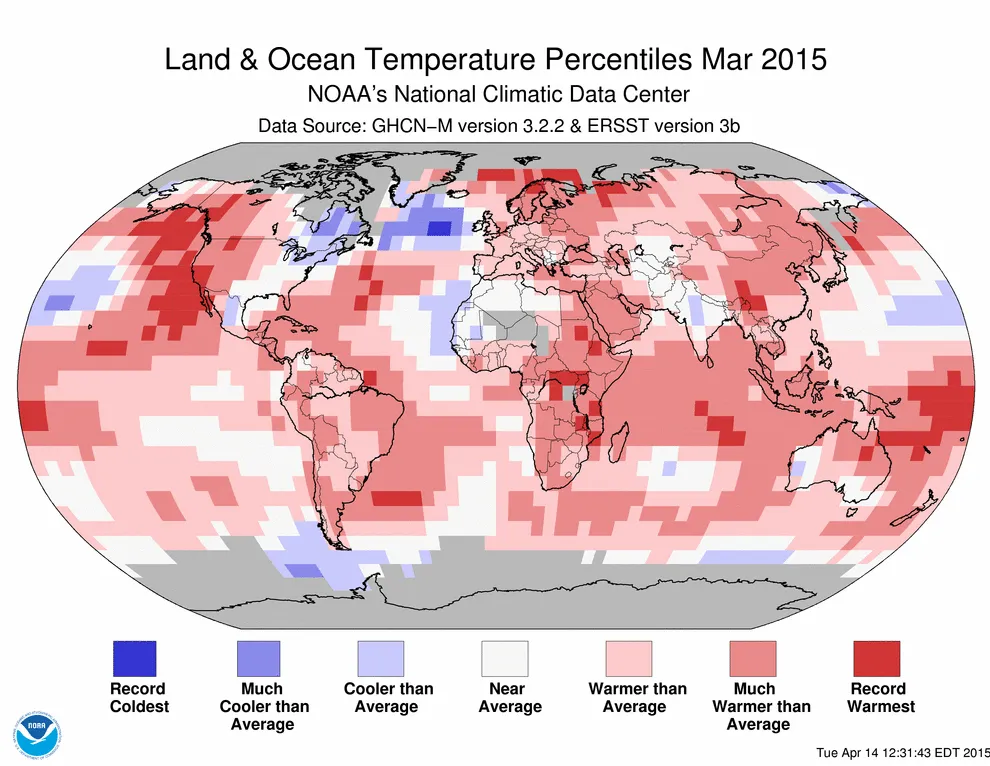
The first three months of 2015 set new global heat records, government officials announced today (April 17).
January, February and March set new high-temperature records, respectively; each month was warmer than any on the books since record keeping started 136 years ago. March also ended the hottest 12-month period on record, the National Oceanic and Atmospheric Administration (NOAA) reported. Seven of the past 11 months have tied or set new record-high monthly temperatures.
In March, Earth's average temperature was 56.4 degrees Fahrenheit (13.6 degrees Celsius), breaking the previous record set in 2010 by 0.09 F (0.05 C). The Japan Meteorological Agency also put March in first place, as the hottest month ever in its records, while NASA put it in third place, behind 2010 and 2002. Yet, all three agencies agree that the 12 months to date are the hottest ever. [Fishy Rain to Fire Whirlwinds: The World's Weirdest Weather]
Giant blobs of warm water in the tropical and northeast Pacific Ocean helped boost 2015 to the top of the rankings, according to the NOAA climate report. Like a pot of boiling water on a stove, the warm seawater radiates heat into the atmosphere and raises the planet's average temperature. The global average temperature includes measurements over land and ocean surfaces.
Because these warm-water pools are predicted to persist through year-end, more heat records could fall in the coming months. In the tropical Pacific, the warm water is linked to an ongoing El Niño, the cyclic phenomenon that shifts global weather. NOAA forecasts a 60 percent chance that the El Niño will last through fall.
March 2015's new record high was a bigger jump from the global average than records set during previous El Niño years, in February 1998 and January 2007, NOAA reported. The average March temperature over land surfaces across the globe was 2.86 F (1.59 C) above the 20th-century average.
During March, California saw record warmth, as did parts of the western United States and Canada, according to the report. Scandinavia, northwest Russia, south central China, northeast Australia and eastern Africa also baked under high temperatures, NOAA reported.
Get the world’s most fascinating discoveries delivered straight to your inbox.
The only place on Earth with notably cooler-than-average temperatures in March was northeastern Canada. Despite the record-breaking snow and chilly temperatures along the Atlantic Coast earlier this year, no state set a new cold record in the first three months of 2015, according to NOAA.
Follow Becky Oskin @beckyoskin. Follow Live Science @livescience, Facebook & Google+. Originally published on Live Science.
