














Will Your Next Phone Be Fair Trade? (Op-Ed)
This article was originally published at The Conversation. The publication contributed the article to LiveScience's Expert Voices: Op-Ed & Insights.
Organic, cage-free or home-grown? We think about our purchasing ethics in many areas of daily life, but not often about technology.
As with any product, though, we should think about the effects of our actions on workers and the environment. The idea of cage-free phones may sound silly, but for certain types of workers it’s a stark reality.
A mobile phone contains rare minerals that are often linked with violent conflicts. It is produced in difficult conditions by low-paid factory workers. (And if you’d like to play a game showing the production story of an iPhone, have a look at PhoneStory.)
A phone is also difficult to recycle safely at the end of its lifespan.

Technologies like mobile phones are often, by nature, small objects purchased infrequently. It’s difficult to put our ethics on the line when the object seems so meagre in size and when you don’t buy one that often.
And it often feels like we don’t have a lot of choice in the ethics of the phones we buy. All mobile phones are produced using the same materials, and some of these come from warzones. So choosing between Samsung and HTC can feel like choosing between a punch in the face and a kick in the guts.
Get the world’s most fascinating discoveries delivered straight to your inbox.
Part of the problem is that we really feel like we have no choice but to buy a phone. Can we realistically expect to “go without” a phone, when our work, family and friends expect us to be available at all times? And when our carrier invites us to upgrade our phone for next to nothing every two years, what incentive do we have to slow down?
Introducing the Fairphone and Ara
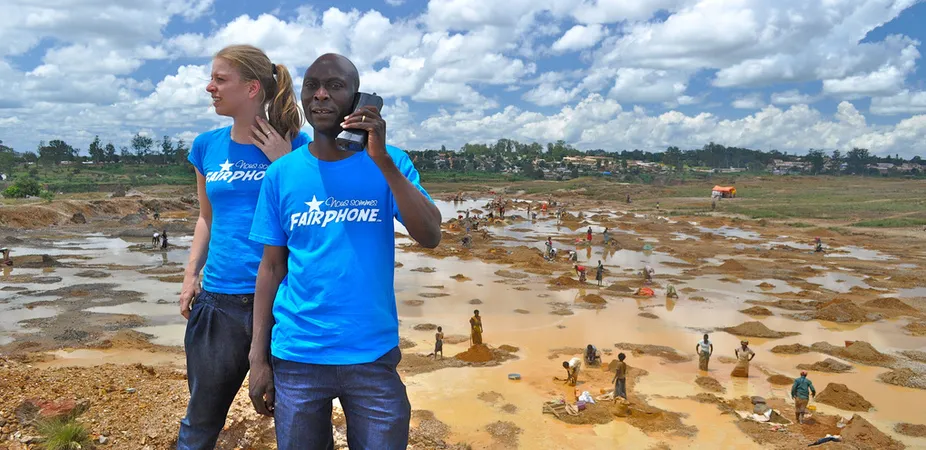
The Fairphone is one solution that has already sold out on its first production run. The sole marketing strategy for the Fairphone has been a detailed examination of the production process.
Their website provides photos and other evidence of attempts at ethical sourcing. Using those, you can make up your own mind about the ethics.
The 25,000 devices sold represent a very small proportion of the roughly 1.7 billion phones sold last year. And the Fairphone is not available at all in some markets, including Australia and the United States (though if you have a friend in Europe you can have them pick one up for you).

Nonetheless, the sales figures so far suggest consumers are getting interested in finding ethical technologies.
Will this act as a trigger for other producers to become more ethical?
Motorola has announced “Ara”, their attempt to provide a less destructive alternative. The Ara phone is modular, meaning that people can use 3D printers from their homes to replace core technological components as needed and switch aesthetic parts such as the housing at leisure.
Motorola is bargaining that this will reduce the overall impact of our love of mobile phones.
But at the same time, Ara encourages us to throw away phones in dribs and drabs. Because the phone is based on the idea that we can replace any part at any time, it may still generate more waste over time than other gadgets.
As consumers raise concerns about the ethics of their devices, producers are gradually raising their production standards. Apple, Microsoft and Nokia have joined the Public-Private Alliance for Responsible Minerals Trade, which is working to monitor, reform and document the extraction and trade of minerals such as coltan.
While the effects of the Alliance to date are unclear, it at least suggests that progress is possible.
The Fairphone and Ara are small examples, but hopefully they are the start of a growing change in the way we make and use mobile phones. They give us an opportunity to be more ethical in an area in which our choices are often limited.
Robbie Fordyce owns a Nokia phone from about three years ago. It has no smartphone features.
Luke van Ryn is an ambivalent owner of an iPhone 5.
This article was originally published at The Conversation. Read the original article. The views expressed are those of the author and do not necessarily reflect the views of the publisher. This version of the article was originally published on LiveScience.