It's quick and easy to access Live Science Plus, simply enter your email below. We'll send you a confirmation and sign you up for our daily newsletter, keeping you up to date with the latest science news.
Are you tired of keeping track of all those little chargers for your phone, your music player and your other little electronic gadgets? Professor Zhong Lin Wang of the Georgia Institute of Technology may have the answer.
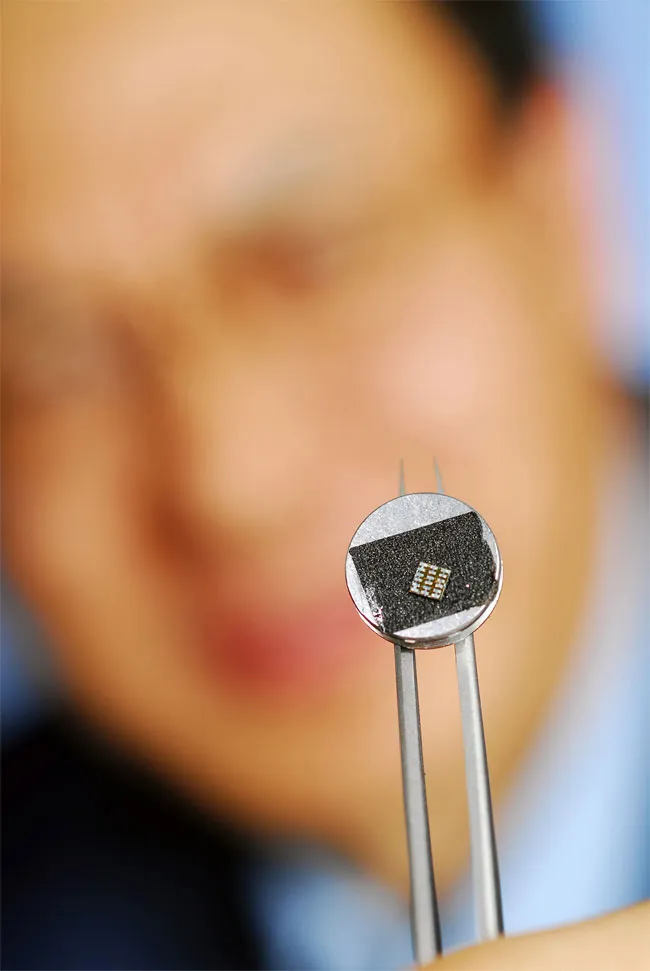
Wang has created a tiny nanogenerator that produces a continuous flow of electricity by harvesting mechanical energy from its surroundings. It can produce energy from ultrasonic waves, mechanical movement or even blood flow.
"This is a major step toward a portable, adaptable and cost-effective technology for powering nanoscale devices. There has been a lot of interest in making nanodevices, but we have tended not to think about how to power them. Our nanogenerator allows us to harvest or recycle energy from many sources to power these devices."
The prototype nanogenerator is made up of tiny wires that are free to flex just slightly. When moved by mechanical energy, they flex and make contact with a collection plate. The wires have piezoelectric qualities, meaning that they provide a tiny voltage when mechanical stress is applied. By capturing the output of large numbers of nanowires in motion, the prototype nanogenerator produces a miniscule direct current output.
Wang and his group believe that the nanowires could produce as much as 4 watts per cubic centimeter. "If you had a device like this in your shoes when you walked, you would be able to generate your own small current to power small electronics," Wang noted. "Anything that makes the nanowires move within the generator can be used for generating power. Very little force is required to move them."
Science fiction fans are always looking for ways to enable the creation of their own favorite devices. For example, the stillsuit from Frank Herbert's 1965 novel Dune made use of the body's own mechanical energy to provide power for the suit, which captured perspiration and other body moisture and processed it for reuse.
It's basically a micro-sandwich; a high-efficiency filter and heat-exchange system. The skin-contact layer is porous. Perspiration passes through it, having cooled the body. Motions of the body, especially breathing, and [heel-powered pumps] provide the pumping force. With a ... suit in good working order, you won't lose more than a thimbleful of moisture a day... (Read more about the Dune stillsuit)
Read more stories about other attempts at harvesting power from mechanical motion:
Sign up for the Live Science daily newsletter now
Get the world’s most fascinating discoveries delivered straight to your inbox.
Bill Christensen catalogues the inventions, technology and ideas of science fiction writers at his website, Technovelgy. He is a contributor to Live Science.