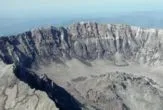
Long before Mount Vesuvius buried Pompeii in rock and ash, the volcano erupted in an even more powerful explosion that affected the area occupied by present-day Naples. It left the region a desert wasteland for centuries afterwards, a new study reports.
The so-called Avellino eruption occurred about 3,780 years ago during the Bronze Age and was at least twice as powerful as the one that smothered Pompeii and the nearby town of Herculaneum in 79 AD.
If a similar-sized eruption occurred today, it would destroy the entire Italian port-city of Naples and displace millions of people, experts say.
The findings are detailed in the March 7 issue of the journal for the Proceedings of the National Academy of Sciences.
Far flung destruction
Scientists have known about the Avellino eruption since the 1980s but didn't know that its destructive influences extended so far.
"We didn't know that the city of Naples would be so threatened," said study leader Michael Sheridan of the University of Buffalo in New York. "We never had evidence for a blast extending into the Neapolitan area and beyond it."
Sign up for the Live Science daily newsletter now
Get the world’s most fascinating discoveries delivered straight to your inbox.
Based on recent geological and archaeological evidence, scientists now think that the Avellino eruption rained more than a meter of hot ash and pumice— a light, sponge-like rock that forms when ejected magma solidifies in air— as far as 9 miles away. Naples is located about 6 miles away from Vesuvius.
Scientists think that the Avellino eruption shot a column of superheated rock and dust more than 20 miles high, darkening skies for miles around. In areas close to the volcano, scorched rocks rained down at more than 150 mph.
Driven by westerly winds, the ejected debris blanketed thousands of square miles northeast of the volcano, creating a bleak landscape of uninhabitable desert that lasted for more than 200 years.
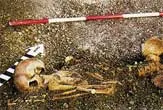
In the prehistoric village of Nola 9 miles away, archeologists discovered skeletons of dogs and nine pregnant goats. A little east of the village, they uncovered the skeletons of a man and a woman buried beneath more than 3 feet of debris; the pair probably died of asphyxiation as they tried to escape.
Scientists think most people survived the eruption, however. Thousands of human and animal footprints have been found around Vesuvius, embedded in wet volcanic ash and leading away from the volcano. Based on estimates of the sustainability of the land during the time, scientists estimate that more than 10,000 people were living in the region when the volcano erupted.
Naples not prepared
Scientists think that Vesuvius formed some 25,000 years ago and that it experiences one major eruption every 2,000 years or so. There are dozens of smaller eruptions between the major events, however. Some 30 minor eruptions are thought to have occurred since the 79 AD catastrophe that destroyed Pompei. The last eruption was in 1944.
Sheridan estimates that there is more than a 50 percent chance of an eruption occurring within the next year.
"With each year that goes by, the statistical probability increases," he said.
And while Naples has emergency plans to deal with smaller eruptions, Sheridan doesn't think it's prepared for a major one. He said an eruption the size of Avellino today would destroy Naples and displace more than 3 million people.
"This eruption is much larger than the ones that are currently anticipated at Vesuvius," Sheridan said. "What would you do with the evacuation of 3 million people? They're not coming back. There won't be anything to come back to."