













How Global Warming Can Chill the Planet
Scientists hope new evidence of an ancient rise in sea level from a fresh water flood will tell them how global warming can lead to global cooling.
A global cooling event was caused by global warming? Sounds strange. But that is exactly what scientists say happened.
The Earth was emerging from an ice age 8,200 years ago. Seas were warming and life was heating up. Then quite abruptly and for a relatively short period of time -- about 100 years -- the entire globe chilled down again, by almost 10.8 degrees Fahrenheit (6 Centigrade).
One widely held theory for the chill was the sudden release of a substantial amount of fresh water into the northern Atlantic.
A lake twice the size of the Caspian Sea broke through an ice sheet that contained it over current day Minnesota and Canada, the evidence shows. It poured its fresh water into the salty Atlantic and changed the density of the ocean water.
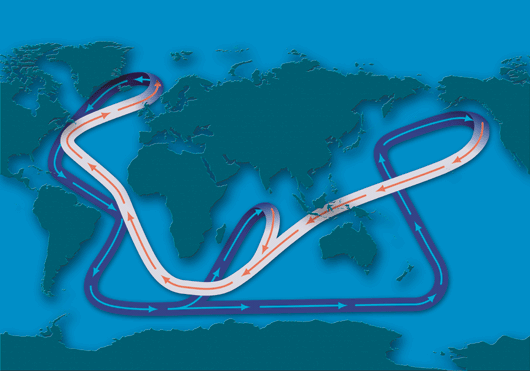
The oceans work on a sort of conveyor belt method to circulate cold and warm waters, thereby helping control cold, moderate, and warm areas of the globe. (Earth's climate is only partly affected by land temperatures and sunlight. Oceans, which store vast amounts of energy and are slow to warm up and cool down, contribute greatly to climate.)
But what happens if that conveyor belt stops or slows down?
Get the world’s most fascinating discoveries delivered straight to your inbox.
Cold, fresh water sinks, and warm salty water rises. The influx of fresh water into the Hudson Bay from Lake Agassiz provided a barrier against the warm, salty water struggling to move north on the conveyor belt. This effectively shut down the circulation of warm water in the Northern Atlantic.
With warm waters unable to move as far north the world became cooler. The amount of water Lake Agassiz dumped into the ocean is equivalent to how much the seas rose. Knowing these amounts will tell scientists how much fresh water could create this type of climate change nowadays, were a bunch of it to suddenly find its way into the ocean.
The oceans were able to find their balance relatively quickly in that ancient event, and the effects wore off in about a century, but a century of that kind of change today would create widespread havoc.
"There is nothing like Lake Agassiz today, but there are things that could have a comparable effect," said Torbjorn E. Tornqvist, an geologist at the University of Illinois at Chicago. "Places like the Greenland ice sheet are very sensitive to warming and a lot of fresh water could enter the northern oceans and mess up circulation."
Scenarios such as this are exactly why Törnqvist says investigations into past climate are vital to understanding current and future climate.
"What if patterns of precipitation change from global warming? Having more precipitation in one place than in another could freshen ocean waters and play a role in climate cooling," Tornqvist told LiveScience.
The research of Tornqvist and his students centered on peat deposits in the Gulf of Mexico, where they found samples that were 8,200 years old.
Tornqvist explained that peat is formed between sea level and high tide, and since there is very little influence from tides in the Gulf of Mexico, it is the perfect place to study changes in sea level accurately. The results of the research, which are detailed in the Dec. 11 online version of Geophysical Research Letters, showed a rise in sea level of less than about 4 feet (1.2 meters).
The rise might be even less, according to Tornqvist, and determining exactly how much less will provide a better picture of how fresh water influx affects the ocean conveyor belt and global climate.
With this new data, and previous evidence from ice cores in Greenland that also showed a rise in sea level at the same time, scientists hope they can narrow down how much the seas rose. Then they can calculate how much water flowed into the ocean.
Understanding these past climate changes will give scientists a better sense of what could happen today if similar events occurred.
"Climatologists urgently need this type of information to run their climate models in order to understand the conditions that can produce such an abrupt climate change," Tornqvist said.