LiveScience Blogs Home / Science of Fiction Archive

Deep Space Potato Chips

January 9th, 2008
Author Tariq Malik

Life imitated art this week aboard the International Space Station, where weightless astronauts munched on free-flying potato chips a la Homer Simpson.

During a break from the serious work of space station maintenance and research, Expedition 16 commander Peggy Whitson and flight engineers Yuri Malenchenko and Dan Tani snacked on the crunchy chips, sometimes as they floated on their own in the station’s orbital galley.

The scene, caught on home video and beamed down from orbit Tuesday, was oddly reminiscent of Homer Simpson’s potato chip hunt aboard a NASA space shuttle in the Simpsons episode “Deep Space Homer.” Unlike Homer, who ran into an ill-placed ant farm while chasing down chips, Whitson and her crew merely discussed potential science experiments and playfully tossed chips to one another before resuming work aboard their orbital laboratory.

Space Station Commander Peggy Whitson snacks on potato chips. Credit: NASA TV
Top: Space station commander Peggy Whitson snacks on potato chips in orbit.
Bottom: A free-flying chip floats toward hungry spaceflyers. Credit: NASA TV.
NASA’s beams down live video from inside (and outside) the space station every weekday (barring holidays) at about 11 a.m. EST, and gems like Tuesday’s potato chip moment - not the mention the stunning views - make tuning in worthwhile. But don’t worry if you end up missing it. NASA replays commentary at 3 p.m. and 11 p.m. EST every day.

You can check it out via SPACE.com’s NASA TV feed, which is available on our Space Station Expedition Page.

Homer Simpson hunts space potato chips. Credit and Copyright: Fox
Mmmm…space potato chips. Credit and copyright: 20th Century Fox
Homer Simpson, eat your heart out.

Leave a Reply »
  • Add to delicious
  • Digg It!
  • Save to Newsvine
  • Add to reddit
  • Add to Netscape
  • Email to Friend Email
  • Subscribe Subscribe

Arthur Clarke’s “Banyan Trees” on Mars Chopped Down

December 12th, 2007
Author Leonard David

Those weird features on Mars recently surveyed by NASA’s super-powerful Mars Reconnaissance Orbiter have uprooted Arthur C. Clarke’s view that vegetation might be at work on the red planet.

Back in 2001, I reported that Clarke saw in Mars Global Surveyor snapshots “extraordinary features” that couldn’t be explained. The noted science fact/fiction writer said signs of vegetation seem apparent. One image even showed what appeared to him looking like Banyan trees, he said.

In a bit of added humor, Clarke decided that Mars must be inhabited “by a race of demented landscape gardeners.”

Here are those stories:

http://www.space.com/peopleinterviews/clarke_mars_010601.html

http://www.space.com/scienceastronomy/solarsystem/clarke_mars_banyon_010709-1.html

But now MRO imagery has found that channels carved out by escaping gas form a “starburst” pattern, radiating out into feathery extensions.

At this week’s American Geophysical Union meeting in San Francisco, Candice Hansen of NASA’s Jet Propulsion Laboratory detailed new looks at Mars morphology, reporting on “lace” and “lizard skin” and branching patterns called “spiders”.

Check out: http://hirise.lpl.arizona.edu/PSP_003443_0980

Turns out that those Clarke Banyan tree-like features are similar channels carved into the ground, Hansen has advised me, adding: “Arthur C. Clarke writes great science fiction.”

Leave a Reply »
  • Add to delicious
  • Digg It!
  • Save to Newsvine
  • Add to reddit
  • Add to Netscape
  • Email to Friend Email
  • Subscribe Subscribe

The Overview Effect Goes Viral

July 19th, 2007
Author Dave Brody

Back on February 7th 1971 (Earth time), Ed Mitchell was speeding much faster than a rifle bullet, on a trajectory between the Moon and the Earth. That’s when the strangest thing happened…

Mitchell had piloted Apollo 14’s Lunar Module down to the Fra Mauro region of the Moon, become the sixth human to do science in the dust, and gotten himself and Cdr. Alan Shepard back off the regolith and onto their bus ride back home.

Now he was bored: “We were just systems engineers on a perfectly functioning spacecraft.” So he looked out the window. The Command Module was pointing “up” – which is to say perpendicular to the plane of the Solar System – and spinning slowly, about once every two minutes. “Barbecue Mode”, it’s called; to evenly heat the vehicle. Ed was floating, watching the Earth, Moon, Sun and starfield pan by.

And then, without warning: an overwhelming feeing of bliss, timelessness, connected-ness… He suddenly and deeply felt the understanding of his constituent atoms as having been born in the fires of ancient supernovas. He saw Earth and it’s people and all it’s other species and systems as a unified integrated synergistic whole. He felt good; ecstatic actually…

He was not the first – nor the last – to have this specific epiphany.

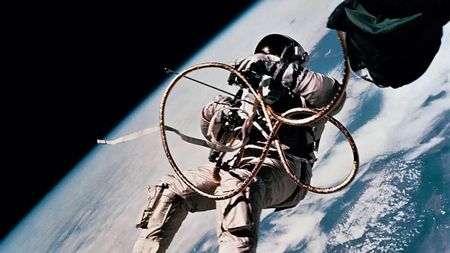
Rusty Schweikart had felt it back on March 6th 1969 during a spacewalk outside his Apollo 9 vehicle: “When you go around the Earth in an hour and a half, you begin to recognize that your identity is with that whole thing. That makes a change…it comes through to you so powerfully that you’re the sensing element for Man.”

20 years ago, author Frank White collected, sifted, polished and curated the observations of 30 astronauts and cosmonauts. But these weren’t science observations or notes about the spacecraft hardware. They were reports of this specific, marked psychological shift – common to all these space travelers – immediately and profoundly broadening these hard-boiled guys’ perspectives.

This morning, in a hotel across the street from the Pentagon in Washington, DC, Frank White addressed proponents of proselytizing this Overview Effect. Cognitive scientist David Beaver had called us here. A core group of about 40 authors, astronauts, special; effects designers, ex-magicians, musicians, scientists, technologists, producers, journalists, capitalists, space-tourist adventurers, humanists, assorted geeks, hippie-survivors (and, yes, this reporter) quickly decided upon a loose strategy of collaboration and mutual support. Intended mission: maximize opportunities for Earth-dwellers to have individual Overview experiences. Strategy: use art, science, mass media, music, environmental awareness, personal networking and, oh yeah: the Web to spread the opportunity for non-space travelers to understand and possibly experience the Effect.

After decades of studying this, Ed Mitchell is pretty certain that the feeling of interconnectedness / oneness with the Universe is a consequence of quantum physics. Now Mitchell and the others assembled here want, specifically to induce or produce the Overview Effect in as many of Earth’s citizens as possible.

If this feels a little religiously fervent to you, you’re not wrong. And that’s a danger: It tends to turn critical thinkers off before they start thinking truly critically about the possibilities.

But, to the good, the Overview Effect is - by definition - simultaneously ecumenical and agnostic. And it’s nothing if not a thrill ride:

40 years ago, Doug Trumbull instantiated Overview Effects in moviegoers as the special effects designer of Kubrick and Clarke’s 2001 a Space Odyssey. Since then Trumbull’s technical-artistic touched has graced many pivotal motions pictures. He, more than anyone, invented the motion-based movie-driven theme park ride. That little thing at Universal called Back to the Future, for instance; Trumbull made it fly.

Today, at the conference, Doug foresaw a time perhaps 5-6 years out when a video iPod-like device would deliver an Overview Effect-producing dose of media content directly to users’ retinas. Oh, and it looks like Trumbull will own or co-own the patent…

Andy Newberg, a neuroscientist/physician with a background in space medicine, is learning how to spot the markers: “You can often tell when you’re with someone who has flown in space,” he says, “It’s palpable.” Andy scans brains for a living: praying nuns, transcendental meditators, others in the act of focused states. He can pinpoint regions in subjects’ gray matter that correlate to these circumstances. Newberg is seriously looking at how to fly equipment that could study, in-situ, the brain functions of space travelers. If this Overview Effect is physiologically real, Andy could watch it happen.

Interestingly, Newberg’s first test subject will not be a paid astronaut, but rather a paying space tourist: Reda Andersen slated to fly with Rocketplane Kistler says “It would be criminal NOT to study the first of us (space adventure travelers).”

Barbara Marx Hubbard is convinced this is evolution in action: “The sleep of the womb is over,” she says, “We are growing up; becoming fully human.” Hubbard has worn many hats: disciple of Bucky Fuller, Democratic Vice-Presidential nominee, international space advocate, and importantly a mother of five. As we’re born, Barbara says: “we pass from the Inner Space of our mothers into Outer Space”

So, keep the term “Overview Effect” in the top list of your search engine. In the next few years, you’ll see it connected to some awfully smart, entertaining, pithy, profound, soulful, and, yeah probably some way-too-silly and hopelessly doomed-to-fail stuff, as well.

But such is the messy, non-directed, unintended, viral-memetic way of evolution.

Leave a Reply »
  • Add to delicious
  • Digg It!
  • Save to Newsvine
  • Add to reddit
  • Add to Netscape
  • Email to Friend Email
  • Subscribe Subscribe

Star Trek Beams Down from ISS

June 16th, 2007
Author Tariq Malik

So the question is, ‘Who are Spock’s parents?’

That call, heard on NASA TV, came from NASA astronaut Clayton Anderson aboard the International Space Station last night as he radioed down to Mission Control here in Houston late last night.

If you know the answer - like this sci-fi addicted space reporter - then don’t go blabbing. The query from space is apparently Anderson’s way of carrying on a pop-culture tradition set by NASA astronaut and all-time U.S. spaceflyer Michael Lopez-Alegria.

During his seven-month stint as commander of the station’s Expedition 14 mission, Lopez-Alegria routinely called down movie lines (he said he’d make use of the station’s video editing equipment as a hobby) to flight controllers and challenged them to match the lines to their respective films.

Near the end of the mission, with his well of movie lines running dry, Lopez-Alegria switched to rock song trivia, playing part of a song and then challenging flight controllers to come up with the next line. It may sound like good fun, and apparently that’s the point. 

The brief exchanges are meant to add some levity to the busy, stressful schedules of astronauts in orbit and the flight controllers who watch over them.

Returning astronaut Sunita Williams, who served with Lopez-Alegria and then stayed on for the start of Expedition 15 to hand over to Anderson, has a tradition of her own. She and her crewmates have been playing ultra-long distance dedications from space for folks back on Earth.

Last night, Anderson jibed flight controllers when they’re answer to the previous day’s question - involving Abbott and Costello’s ‘Who’s on First?’ routine - didn’t quite meet his specs.

Then he threw down the Spock lineage inquiry for today. If you listen close, you might hear flight controllers beam up the answer later tonight.

So, who are Spock’s parent’s?

Don’t worry, Clay. I won’t spoil the fun.

P.S. - Remember that time when they saved Spock’s brain? Classic.

Leave a Reply »
  • Add to delicious
  • Digg It!
  • Save to Newsvine
  • Add to reddit
  • Add to Netscape
  • Email to Friend Email
  • Subscribe Subscribe

Board Game, Sci-Fi to Ride Shuttle Atlantis to ISS

June 7th, 2007
Author Tariq Malik

Seven U.S. astronauts and new girders and solar arrays are not the only riders for NASA’s space shuttle Atlantis set to launch late Friday.

Tokens for the family board game Monopoly and the science fiction film Serenity (not to mention its television show root Firefly) will catch a ride to the ISS aboard Atlantis during NASA’s STS-117 mission when it rockets spaceward at 7:38 p.m.  EDT tomorrow night.

The Monopoly tokens are the little mover pieces for the Hasbro game’s Here & Now edition, which just happens to have NASA’s Johnson Space Center — the Houston training site for U.S. astronauts — as an available,  according to the folks at Hasbro. Tucked away inside the 100-ton Atlantis are tiny versions of the Toyota Prius, New Balance Shoe, Labradoodle, Motorola Razr cell phone, Laptop Computer, McDonald’s French Fries and an airplane that serve as player pieces for the game, they added.

Whedon’s Serenity and Firely, certainly a favorite for this space reporter, are apparently being carried in DVD form to take a permanent place on the ISS by an Atlantis crewmember.

For those of you under a sci-fi rock, Serenity is the name of the beloved Firefly spaceship helmed by Capt. Malcolm Reynolds.

Fans (called Browncoats) apparently gave the DVDs to the STS-117 astronaut in question and are tracking the sci-fi film/series’ launch at: http://www.breakingatmo.com/, where you’ll find an oh-so-cool image of Serenity flying past the ISS. Shiny!

Thanks to CaptainCoupi, whoever you are, out there for sending this bit along.

If Monopoly and Serenity aren’t enough for you, don’t worry. The space memorabilia experts over at collectSPACE.com will have a full workup on the personal effects to be carried spaceward by the STS-117 during their 11-day mission.

NASA’s STS-117 crew will deliver new trusses and solar arrays to the space station, as well a new crewmember. You can follow SPACE.com’s mission coverage here.    

Leave a Reply »
  • Add to delicious
  • Digg It!
  • Save to Newsvine
  • Add to reddit
  • Add to Netscape
  • Email to Friend Email
  • Subscribe Subscribe

Russia Could Counter Space Rock Menace

October 24th, 2006
Author Tariq Malik

Russia may not have Bruce Willis or Sean Connery, but the nation’s Federal Space Agency says it could rise to the occasion should an asteroid threaten to impact Earth.
 
According to wire reports from the Interfax News Agency, ITAR-TASS and AFP, a high ranking Federal Space Agency official told reporters that Russia would step up to save the planet, but that the effort had to be an international endeavor.

“If necessary, Russia’s rocket-manufacturing complex can create the means in space to repulse asteroids threatening Earth,” Viktor Remishevksy, deputy head of the Federal Space Agency, told AFP, which cited the wire service ITAR-TASS.

Remishevsky told Interfax that defending the Earth from the asteroid menace does not rank high on the Federal Space Agency’s agenda, but could jump up a few notches if need be.

“But if a method of dealing with asteroid with space means is devised, we will create such means,” he told Interfax. “In any case, the rocket industry’s potential is adequate to the task.”

So we can all breathe a little bit easier, I think. Because in all honesty, I don’t think Bruce Willis (remember Armageddon?) or Sean Connery (how about Meteor) will be on the short list of who to call if and when that space rock comes calling.

Now if only we can get someone who can jumpstart the Earth’s core

Leave a Reply »
  • Add to delicious
  • Digg It!
  • Save to Newsvine
  • Add to reddit
  • Add to Netscape
  • Email to Friend Email
  • Subscribe Subscribe

SciFi Channel Gets Active for Your Future

September 29th, 2006
Author Tariq Malik

The SciFi Channel is taking charge of your future with a new campaign to offer a positive view of tomorrow and encourage top thinkers and the community-at-large to tackle the problems of today.

The cable channel unveiled its Visions for Tomorrow campaign Thursday here at the Wired NextFest forum in New York City. The effort includes: an 18-member advisory board of scientists, futurists, artists, writers, political activists and business leaders to examine energy, environment and other issues; an educational outreach endeavour to reach today’s youth and educators view SciFi’s Visions for Tomorrow website

“I think it’s taking a step beyond entertainment for sure,” actress Mary McDonnell, who portrays President Laura Roslin on SciFi’s Battlestar Galactica, told me here at NextFest.

McDonnell is an advisory board member and SciFi Channel’s ad hoc spokesperson for Visions for Tomorrow.

In a Thursday panel, advisory board members credited past science fiction works such as television’s Star Trek and Flash Gordon, the stories of H.G. Wells and Jules Verne – not to mention NASA’s televised Apollo Moon missions – among others for inspiring a generation of people to take charge of technology and shape their future.

“It’s about taking the future in our hands and trying to envision something that’s better and brighter,” said McDonnell.

Leave a Reply »
  • Add to delicious
  • Digg It!
  • Save to Newsvine
  • Add to reddit
  • Add to Netscape
  • Email to Friend Email
  • Subscribe Subscribe

Where Are All the Hurricanes?

July 31st, 2006
Author Jason Hoch

Blistering heat, oppressive humidity, and frequent power outages… summer really is here, and it’s going full bore with most of the United States blanketed in 100 degree temperatures.

With so much heat and humidity, is it surprising that we haven’t seen more activity from Atlantic hurricanes this year? And wasn’t last year at least a little milder in terms of temperatures? What should we believe?

According to data from the Tropical Prediction Center, we had already experienced 7 Atlantic storms, 3 of which were named hurricanes, the other 4 being tropical storms by the end of July 2005. By comparison, this year, we’ve narey had a rumble, with Alberto and Beryl being the only 2 named Tropical Storms this year and no named hurricanes to-date.

So what’s normal? Looking back at stats for the last 10 years, 5 out of the last 10 years had exactly zero named Hurricanes by the end of July and only 3 of the last 10 years had more than one tropical storm or hurricane occur by that same time.

While hurricanes certainly feel like a summer-time activity, they are more commonly found to be late summer to early fall activities. The kids are back to school in some areas of the country in another week - and not a whisper from the Atlantic.

History shows us that as quiet as June and July have commonly been for major hurricane activity, August and September tell a completely different story. Stay tuned.

Leave a Reply »
  • Add to delicious
  • Digg It!
  • Save to Newsvine
  • Add to reddit
  • Add to Netscape
  • Email to Friend Email
  • Subscribe Subscribe

ISS Expedition 6: From Orbit to the Stage

July 26th, 2006
Author Tariq Malik


Actors rehearse on trapezes for Bill Pullman’s play about the ISS Expedition 6 mission. Credit: Bill Pullman.org.

The three astronauts who served aboard the International Space Station (ISS) during the sixth mission to the orbital laboratory – and a particularly trying time for NASA and the U.S. – may not be in space anymore, but their story lives on in a Baltimore play this weekend.

Expedition 6, a play written and directed by actor Bill Pullman, chronicles the experience of American astronauts Ken Bowersox, Don Pettit and Russian cosmonaut Nikolai Budarin in 2003 as the three men watched Earth from space while NASA faced its Columbia disaster and the U.S. invaded of Iraq. Full-length rehearsals of the play – which features trapezes and toy tanks – are open to the public on July 28-29 at the Theatre Project in Baltimore, Maryland. [Click here for more info. A trailer for the play can be found here.]

“2003 was unlike any year that came before,” Pullman told the Baltimore Sun’s Mary Carole McCauley. “It changed everything that will come after for at least a decade. When the Columbia space shuttle exploded, there were 600,000 people cheering in the streets of the Middle East. They saw it as a sign, an omen, that we [the United States] were not invincible.”

The space station astronauts’ story, Pullman tells the Sun, never quite got the attention they deserved.

The Expedition 6 crew launched toward the ISS in November 2002 aboard NASA’s space shuttle Endeavour and were expected to return aboard the Atlantis orbiter in March 2003.

But NASA’s loss of the space shuttle Columbia and its seven-astronaut crew on Feb. 1, 2003 grounded the U.S. space agency’s orbiter fleet and forced a two-month mission extension for the Expedition 6 team, during which time U.S. armed forces surged into Iraq in a conflict that continues still.

Bowersox, who commanded the mission, and his fellow crewmates later rode a Russian-built Soyuz spacecraft back to Earth on May 3, 2003, but a computer glitch sent the astronauts hundreds of miles off course after a rough landing that subjected them to more than twice the G-forces typically experienced during reentry.

So, a dramatic reentry after a dramatic orbital mission to be sure.

The melding of spaceflight and exploration with art and culture here on Earth seems to be on the upswing in recent months.

In September, NASA plans to highlight that synergy with the Societal Impact of Spaceflight Conference.

Leave a Reply »
  • Add to delicious
  • Digg It!
  • Save to Newsvine
  • Add to reddit
  • Add to Netscape
  • Email to Friend Email
  • Subscribe Subscribe

Let That Be Your Last Battlefield

July 16th, 2006
Author Dan Stone

A few weeks ago I would have thought that my TV viewing this weekend would be focused on the wonders of Return to Flight 2006 with STS-121 completing a successful mission. Instead the TV is filled with death, destruction, violence, and hatred. The wonders of technology that have allowed humans to travel in space and the payoff of international cooperation embodied in the ISS are overshadowed by the international proliferation of weapons technology. The money which could otherwise be used in support of peaceful uses of nuclear power, such as Project Prometheus which will allow us to use nuclear power to go further and faster into space, is instead being focused on keeping nuclear weapons technology out of the hands of radical governments.

This weekend reminded me of one of my favorite Star Trek episodes starring Frank Gorshin called “Let That Be Your Last Battlefield” in which two men chase each other around the universe for eternity trying to kill each other. Captain Kirk can’t understand why until the combatants point out to him the one is black on the left and white on the right while the other is white on the left and black on the right. Kirk tries unsuccessfully to point out the absolute absurdity of the situation.

Now we know that many of the original Star Trek episodes were rife with social commentary that was fertile ground in the 60s when the episodes first aired– in this case, the episode pointed out the absurdity of judging people by the color of their skin. But I wonder if Gene Roddenberry was foreshadowing another message? That is, despite the technological advances embodied in the Star Trek world of the future, old fashioned, low-tech bigotry, hatred and killing will be as ubiquitous as ever. Whether or not that was his intent, it has unfortunately turned out to be true.

Leave a Reply »
  • Add to delicious
  • Digg It!
  • Save to Newsvine
  • Add to reddit
  • Add to Netscape
  • Email to Friend Email
  • Subscribe Subscribe