













Monkeys Go Bananas Over Flying Squirrels

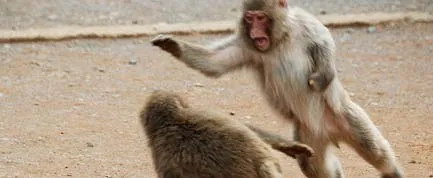
Researchers have observed small monkeys called Japanese macaques going bananas at the sight of a flying squirrel.
This riled-up response is probably just a false alarm, with the monkeys mistaking the squirrel for a predatory bird. On the other hand, male macaques – some of whom give chase and even attack a harmless rodent – might be trying to impress females in their troop.
Although this tough-guy motive was not proved in a new study, "it is possible that adult or sub-adult male monkeys may be 'showing off' their fitness" as potential mates, said Kenji Onishi, an assistant professor of behavioral sciences at Osaka University and lead author of the paper being published in the current issue of the journal Primate Research.
Biologists and psychologists have long studied macaques' complex social interactions for insights into human evolution and behavior.
However, much remains unknown about how macaques get along (or not) with other creatures. Better documentation of such encounters could reveal more about macaque societies as well as that of our shared primate forbearers.
"Human evolution occurred alongside primate evolution from a common mammalian ancestor," Onishi told LiveScience. "Therefore, it is important to learn the evolution of primates in understanding the previous steps in human evolution."
Intruder alert!
Get the world’s most fascinating discoveries delivered straight to your inbox.
When Japanese giant flying squirrels glided over to a tree in the monkeys' vicinity, adults and adolescent macaques started hollering at it threateningly, the researchers report. Young macaques screamed and mothers scooped up their infants, while adults and high-ranking males in particular went and physically harassed the offending squirrel.
Onishi said other researchers have observed macaques responding in a similarly aggressive manner to birds that prey on the monkeys, such as the golden eagle and mountain hawk eagle. These raptors glide and swoop much like the flying squirrels.
Upon closer inspection up in a tree or on the ground, however, the squirrel is clearly no bird of prey. Yet the animal still raises the hackles of the macaques.
Other woodland creatures, including hares, deer and wild boars, barely elicit a response from macaque groups, said Onishi, though dogs and people will sometimes instigate alarm calls and a fleeing from the immediate area.
{{ video="LS_100730_japanese-monkey" title="Monkeys Gang Up on Flying Squirrel" caption="Japanese macaques went bananas when they spotted a flying squirrel, suggesting they either mistook the squirrel for a predator or were trying to impress females in the troop. Credit: Primate Research/Kenji Onishi." }}
Meet the macaques
After humans, macaques are the most geographically dispersed primate on the planet, living across southern Asia and into North Africa. The rhesus macaque is also perhaps the most familiar monkey to Westerners, common both in zoos and as lab animals.
The Japanese macaques in the study are well-known for a group of them that hang out every winter in the Jacuzzi-like Jigokudani hot springs when it gets too cold and snowy outside (no wonder the species is also nicknamed "snow monkey").
The adult male Japanese macaques range in size from about 20 to 24 inches (50 to 60 centimeters) tall and females about 19 to 22 inches (48 to 55 centimeters).
This gives the monkeys a clear size advantage over their flying squirrel antagonists, if one does not count the squirrels' tails. The squirrels documented in the study were typical for their kind, about 12 to 15 inches (30 to 40 cm) long and with a bushy tail of about equal length.
Show of (non)force?
When chasing macaques did succeed in getting close to these infringing squirrels, the monkeys tended to look on "in fear and hesitated to attack," Onishi said.
In rare instances when the bolder monkeys did physically assault their quarry, Onishi said the squirrels were neither harmed nor eaten and eventually escaped.
Though clearly not interested in eating each other, the diets of the animals do cross when it comes to fruits, nuts and other delectables. But a territorial defense of food resources is not the motive of these militant monkeys, as there are "low levels of food competition between macaques and the squirrels," Onishi noted
It is more likely that a simple misunderstanding about the squirrels' nature underpins the melee.
Mewa Singh, a professor of psychology at the University of Mysore in India who has studied macaques, pointed out that the flying squirrels are generally nocturnal, whereas the monkeys are active during the day.
"The interactions between monkeys and a flying squirrel, therefore, are not expected to be frequent and the monkeys may not "know" whether the squirrel is a predator or not," said Singh, who was not involved in the study.
All in the game
Nevertheless, the fact that adult males had a greater tendency to be the ones beleaguering the flying squirrels led Onishi and his co-authors to speculate that a measure of flaunting biological fitness to the females is in play.
At the same time, a generic "battle stations!" response to raptor-like behaviors from any sort of animal, whether feathered like a bird or not, might prime the macaques for when real danger glides into town.
This hair-trigger might increase the possibility that macaques in the troop "survive when true predatory threats emerge," Onishi said.
- Video - Watch the Monkeys Gang Up on a Flying Squirrel
- Real of Fake? 8 Bizarre Hybrid Animals
- World's Cutest Baby Animals
