Fossilized Bird Brains May Yield Secret of First Flights

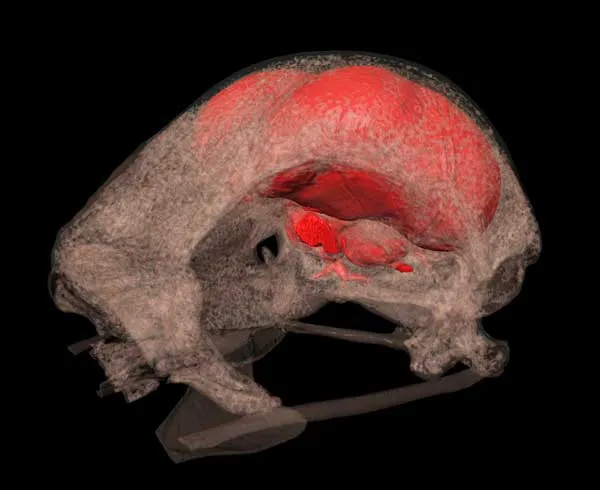
By reconstructing the brains of extinct birds, researchers could shed light on when birds evolved into creatures of flight.
Overwhelming evidence suggests birds evolved from dinosaurs some 150 million years ago, but one of the missing pieces to the evolutionary puzzle is how such birds took to the air.
Scientists in Scotland are focusing on changes in the size of a part of the rear of the brain. This part of the cerebellum, known as the flocculus, is responsible for integrating visual and balance signals during flight, allowing birds to judge the position of other objects in midflight.
"We believe we can discover how the flocculus has evolved to deal with different flying abilities, giving us new information about when birds first evolved the power of flight," said project leader Stig Walsh, senior curator of vertebrate palaeobiology at National Museums Scotland.
In collaboration with the University of Abertay Dundee, investigators are scanning fossils of at least a half-dozen extinct species and the skulls of roughly 100 modern birds in unusual detail. "Unlike medical scanners, which take a series of slice images through an object that may be up to 1.5 millimeters apart, the 3-D scanner at Abertay University can be accurate up to 6 microns," Walsh said. (The width of a strand of hair is about 100 microns.)
When it comes to the modern birds, "we are particularly interested in species that are closely related where there are flying and flightless examples, such as cormorants, pigeons, parrots and ducks," Walsh told LiveScience.
This could reveal whether the flocculus became smaller with the loss of flight.
Get the world’s most fascinating discoveries delivered straight to your inbox.
In addition, the researchers are investigating birds that are particularly fast fliers, such as peregrine falcons; those with acrobatic talents, such as swifts and house martins; those that can hover through powered flight, such as kingfishers; and birds that can fly backward, such as hummingbirds.
The extinct birds the researchers are scanning include recently vanished species such as the dodo, which died out in the late 17th century, as well as fossils of three species from the lower Eocene roughly 55 million years ago, a flightless sea bird from the Cretaceous Period around 100 million years ago, and the oldest known flying bird, Archaeopteryx. Those prehistoric fossils, which retain their original shape, are extraordinarily rare, since most bird fossils are flattened by the earth under which they are buried.
The researchers are looking for a link between a larger flocculus and a greater ability to process the visual and balance signals during flight. If the relationship is proven, it could mark a major step forward in understanding bird evolution, and even might help resolve the controversy over whether some ancient bird-like fossils were truly those of dinosaurs or simply of birds that lost the power of flight.
"With the heated debate about these animals, this would be an excellent finding, though I'm sure the debate won't end there," Walsh said.
The project is scheduled to run until early 2012.