















Oldest Horseshoe Crab Fossil Discovered
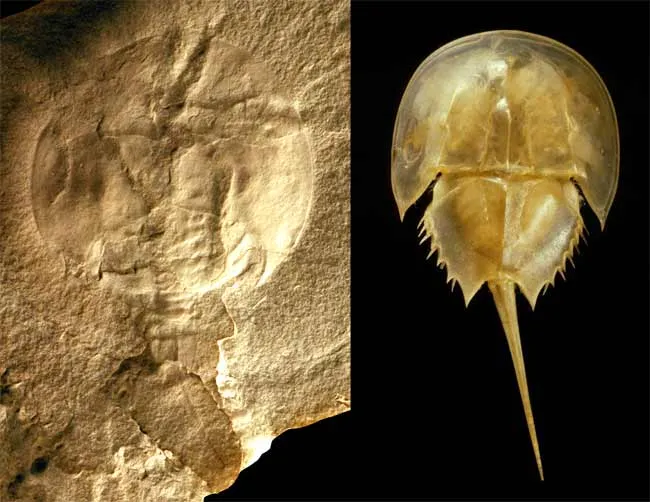
Nearly a half a billion years ago, tiny horseshoe crabs crept along the shorelines much like today's larger versions do, new fossil evidence suggests.
Two nearly complete fossil specimens discovered in Canada reveal a new genus of horseshoe crab, pushing their origins back at least 100 million years earlier than previously thought.
Dubbed Lunataspis aurora, the ancient horseshoe crab is estimated to have been just 1.5 inches (4 centimeters) from head to tail-tip. That's much smaller than its modern-day relatives that can span nearly 20 inches (50 centimeters).
"We do not know if the fossils were small because they were simply young animals or because Lunataspis just didn't grow any bigger," said researcher David Rudkin of the Royal Ontario Museum in Canada.
Crabby find
Rudkin and his colleagues, including Graham Young of the Manitoba Museum, spotted the fossils buried in 445-million-year-old rocks from the Ordovician period in central and northern Manitoba. They describe the discovery in the January issue of the journal Paleontology.
The specimens included patches of the animals' outer-covering and even evidence of their compound eyes.
Get the world’s most fascinating discoveries delivered straight to your inbox.
Horseshoe crabs are not true crabs and are instead more closely related to spiders and scorpions. And like their eight-legged relatives, horseshoe crabs sport a flexible exoskeleton made of chitin rather than the hard-shell armoring worn by crabs.
Chitin degrades over time. For that reason, ancient specimens of horseshoe crabs have been sparse. Until now, the oldest fossils dated back 350 million years ago, from the Carboniferous period. Fossils have also been found in rocks from the Jurassic Period, suggesting the animals were crawling around beneath dinosaurs. Both the Carboniferous and the Jurassic fossil discoveries indicate the ancient horseshoe crabs greatly resembled their modern-day counterparts.
Primitive looks
Analysis of the recent finds also indicates the ocean creatures haven’t changed much over the eons.
"We wouldn't necessarily have expected horseshoe crabs to look very much like the modern ones, but that's exactly what they look like," Rudkin said.
"This body plan that they've invented, they've stayed with it for almost a half a billion years. It's a good plan," Rudkin told LiveScience. "They've survived almost unchanged up until the present day, whereas lots of other animals haven't."
And whereas major extinction events have wiped even the mightiest, non-avian dinosaurs from our planet, this primitive-looking organism has come out unscathed.
"The horseshoe crab, the lowly little animal that crawls out of the sea every once in a while to mate, it's survived for at least 445 million years in more or less the same form," Rudkin said.
He added that understanding how horseshoe crabs adapted to their ecological niche so early and then weathered natural crises will give scientists broader insights about how ocean ecosystems changed over time.
- Rumor or Reality: The Creatures of Cryptozoology
- Image Gallery: Sea Creatures
- 10 Amazing Things You Didn't Know About Animals
Jeanna Bryner is managing editor of Scientific American. Previously she was editor in chief of Live Science and, prior to that, an editor at Scholastic's Science World magazine. Bryner has an English degree from Salisbury University, a master's degree in biogeochemistry and environmental sciences from the University of Maryland and a graduate science journalism degree from New York University. She has worked as a biologist in Florida, where she monitored wetlands and did field surveys for endangered species, including the gorgeous Florida Scrub Jay. She also received an ocean sciences journalism fellowship from the Woods Hole Oceanographic Institution. She is a firm believer that science is for everyone and that just about everything can be viewed through the lens of science.