 Live Science Plus






Monitor Lizard Discovered with Flame-Colored Head
You are now subscribed
Your newsletter sign-up was successful
Want to add more newsletters?

Delivered Daily
Daily Newsletter
Sign up for the latest discoveries, groundbreaking research and fascinating breakthroughs that impact you and the wider world direct to your inbox.

Once a week
Life's Little Mysteries
Feed your curiosity with an exclusive mystery every week, solved with science and delivered direct to your inbox before it's seen anywhere else.

Once a week
How It Works
Sign up to our free science & technology newsletter for your weekly fix of fascinating articles, quick quizzes, amazing images, and more

Delivered daily
Space.com Newsletter
Breaking space news, the latest updates on rocket launches, skywatching events and more!

Once a month
Watch This Space
Sign up to our monthly entertainment newsletter to keep up with all our coverage of the latest sci-fi and space movies, tv shows, games and books.

Once a week
Night Sky This Week
Discover this week's must-see night sky events, moon phases, and stunning astrophotos. Sign up for our skywatching newsletter and explore the universe with us!
Join the club
Get full access to premium articles, exclusive features and a growing list of member rewards.
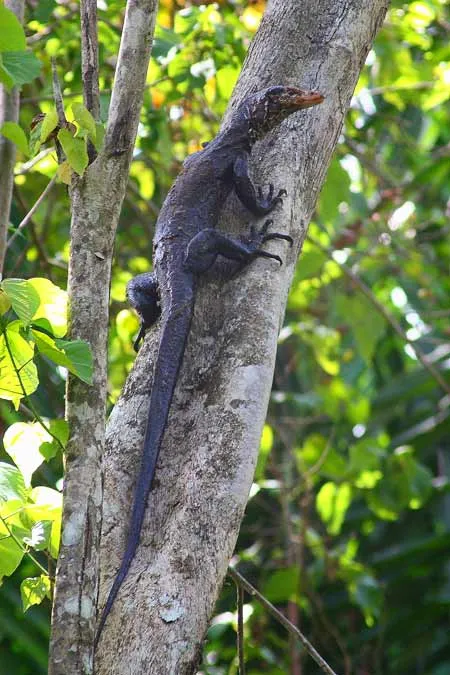
A distinctly colored species of monitor lizard, a close relative of the Komodo dragon, has been discovered in Indonesia.
The lizard, whose scientific name is Varanus obor, is also called by its popular names, Torch monitor and Sago monitor. It's called Torch monitor because of its bright orange head with a glossy black body. "Obor" means torch in Indonesian.
The Torch monitor can grow to nearly 4 feet (1.2 meters) in length and 3.5 pounds (1.5 kilograms) in weight, and thrives on a diet of small animals and carrion.
The Torch monitor exists only on the small island of Sanana in the western Moluccan islands of Indonesia. A unique aspect of this geographical region is the lack of mammalian predators, which may have given reptiles the space to evolve as the top terrestrial predators and scavengers.
Several million years ago, this island was situated near New Guinea, and it is possible that the lizard lives on as a relic from that period. It is the only black monitor in its lineage, and the only monitor species anywhere that has evolved red pigmentation.
The newly discovered species was described by Sam Sweet, an ecologist at the University of California, Santa Barbara, and Valter Weijola, a graduate student at Abo Akademi University in Turku, Finland, on April 23 in an online issue of the journal Zootaxa.
Sweet, an authority on monitor lizards describes the discovery's important biological context in the area in which it was found: "East of Wallace's Line –– the boundary between Asian and Australian domains –– there are no native carnivorous mammals, and monitor lizards fill that role. There are more species there, doing more different things ecologically than in Africa or South and Southeast Asia, where competition and predation by mammals tend to keep monitor lizards down," Sweet said.
"East of Wallace's Line in Indonesia, New Guinea, and Australia, monitor lizards are on the top of the heap. It emphasizes again how little we know about some tropical regions, to find an animal so strikingly colored and so large only last year."
Weijola discovered the lizard last spring, and returned with Sweet in late 2009 for five weeks to do studies and take photographs of the animal. The Torch monitor is most common in the coastal sago palm swamps and belongs to the mangrove monitor group.
- Images: Snakes, Frogs and Lizards
- Giant Lizard Eluded Science, Until Now
- Lizard News, Images and Information

