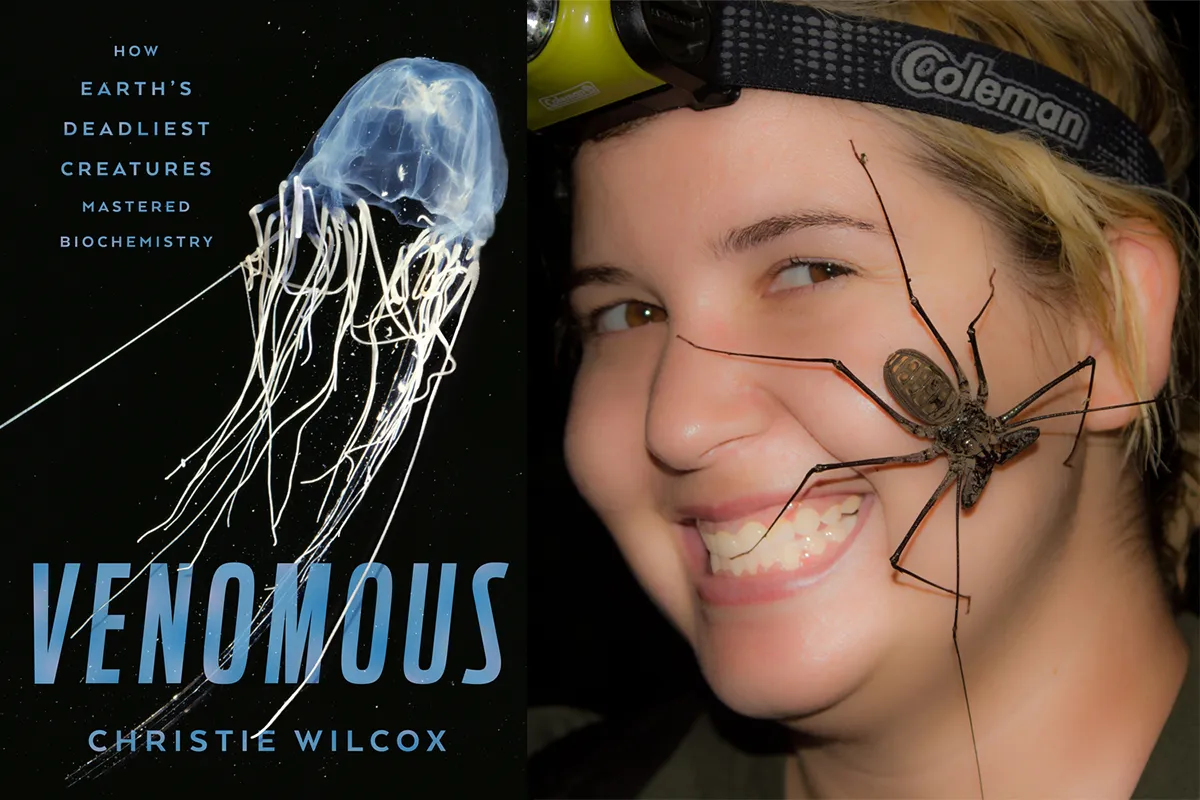
A scorpion, a jellyfish, and a viper don't share much of a physical resemblance, but they have one very important thing in common — they are venomous, producing a chemical compound containing neurotoxins that can incapacitate or even kill, and they inject this dangerous brew using highly specialized stingers or fangs. Nearly every group of animal life includes venomous species, and they produce a wide variety of toxins that can cause excruciating pain, delirium, partial or complete paralysis, and organ failure. Biologist and writer Christie Wilcox has encountered many venomous animals — some that live in remote corners of the planet and others that can be found in suburban backyards. In her new book, Wilcox introduces readers to many of these deadly creatures, and investigates how evolution shaped diverse types of chemical attacks — or defenses — and what makes each weapon unique to the species that wield them. Below is an excerpt from "Venomous: How Earth's Deadliest Creatures Mastered Biochemisty" (Scientific American/Farrar, Straus and Giroux, 2016).
If you decided to create a list of the most improbable animals on the planet, the platypus is an easy first pick. The platypus is so peculiar that even the great naturalist George Shaw, who provided the first scientific description of the animal in 1799, could hardly believe it was real. “A degree of skepticism is not only pardonable, but laudable,” he wrote in the tenth volume of his Naturalist’s Miscellany, “and I ought perhaps to acknowledge that I almost doubt the testimony of my own eyes.” It is a sentiment I understand. As I sat staring at a large male platypus at the Lone Pine Koala Sanctuary in Melbourne, Australia, I could hardly believe the creature in front of me was real. Even up close, it looked like some kind of masterful puppet, Jim Henson’s greatest feat.
Rebecca Bain, known as Beck, the head mammal keeper and one of the people responsible for Lone Pine’s two male platypuses, was kind enough to let me in behind the scenes to indulge my interest in the animal. As Beck wrestled the older male from his nest box, I was surprised by his beaveresque tail, duck-like bill, and ottery feet. But while these traits are all fantastically unthinkable, there is one feature of the platypus that stands out among these oddities. It was the feature that drew me to Australia, the reason I came to see the bizarre creatures in person. Beware the male platypus: of the 5,416 currently recognized species of mammals, he alone possesses a venomous sting, using toxic ankle spurs to fight over females.
Latest Videos From
We know of twelve venomous mammals; all except for the platypus deliver a venomous bite. There are four species of shrew, three vampire bats, two solenodons (long-snouted, rodent-like burrowing mammals), one mole, the slow loris, and the platypus. There’s some evidence that the slow loris may actually be four species of slow lorises, which would bump the total to fifteen, but even so, that’s still just three handfuls of venomous mammals.
Of the animal lineages, there are venomous representatives in the phyla Cnidaria, Echinodermata, Annelida, Arthropoda, Mollusca, and Chordata—the phylum that includes humans. Compared with other groups of animals, the mammals boast very few venomous members; the Cnidaria, including jellyfishes, anemones, and corals, are an entire phylum—more than nine thousand species—of venomous animals, though if we want to talk sheer numbers, the venomous arthropods, including spiders, bees and wasps, centipedes, and scorpions, undoubtedly reign supreme. There are venomous snails, venomous worms, and venomous urchins. And that’s not even including the rest of the venomous vertebrates in the Chordata. There are venomous fishes, frogs, snakes, and lizards.
The term venomous carries with it an explicit set of requirements. Many species are toxic: they possess substances that cause a substantial degree of harm in small doses (a toxin). We used to think of the terms toxic, poisonous, and venomous as interchangeable; now modern scientists distinguish between them. Both poisonous and venomous species are indeed toxic, for they produce or store toxins in their tissues. You may have heard that everything is a toxin in the right dose, but that’s not quite true. A large enough dose can make something toxic, but if it takes a lot to kill you, then a substance isn’t a toxin. Sure, you can drink enough cans of Coke for it to be fatal, but sodas are not considered toxins because the amount it takes for them to be toxic is huge (you’d have to chug liters at a time). The secretion of the anthrax bacterium, on the other hand, is a toxin because even a teeny bit can be deadly.
We can further classify species that are toxic based on how those toxins arrive in a victim. Any toxin that causes harm through ingestion, inhalation, or absorption is considered a poison. Poisonous species, like dart frogs or pufferfishes, must wait for other species to make a mistake before inflicting their toxins. Some scientists would argue there is a third subcategory of toxic, in addition to poisonous and venomous—the toxungenous animals—which are essentially poisonous with purpose: toxungenous animals are equipped with poisons, but they’re more impatient. Animals like the poison-squirting cane toads or the spitting cobras actively aim their poisons at offenders when they’re annoyed, refusing to wait to be touched or bitten, like other poisonous animals, to transmit their toxins.
To earn the prestigious descriptor of “venomous,” an organism must be more than just toxic; it must also have a specific means of delivering its dangerous goods into another animal. It has to be proactive about its toxicity. Snakes have fangs. Lionfish have spines. Jellyfish have stinging cells. Male platypuses have spurs.
The venomous spurs on the platypus aren’t hard to spot. As Beck described the animals and their care at Lone Pine, I stared at the yellow toothlike points jutting from the hind legs. At about an inch long, they are much larger than I had expected. There’s no doubt that any wound created by such impressive spurs would be terribly painful even without the venom. As I placed my hands within inches of the spurs to get a close-up photograph, I shuddered at the thought of how much it would hurt to be stung by the animal in front of me.
Platypuses are really awfully, terribly venomous. From what I’ve heard, being stung by a platypus is a life-changing experience, as any deeply traumatic event shapes who you are. Their venom causes excruciating pain for several hours, even days. In one recorded case, a fifty-seven-year-old war veteran was stung in his right hand when he stumbled on what seemed like a wounded or sick platypus while he was out hunting and, concerned for the little guy, picked it up. For his kindness, he was hospitalized for six days in excruciating agony. Over the first half hour of his treatment, doctors administered a total of 30 milligrams of morphine (the standard for patients in pain is usually 1 milligram per hour), but it had almost no effect. The veteran said the pain was far worse than the pain from the shrapnel wounds he’d gotten as a soldier. Only when the medics numbed all feeling in his hand with a nerve-blocking agent did he finally feel relief.
Even more bizarre is that the venom the platypus delivers is very different from the venoms of its mammalian relatives. Similar to the animal’s outward appearance, with its collection of body parts seemingly taken from other species, it is as if the platypus’s venom is composed of a random spattering of proteins stolen from other animals. There are eighty-three different toxin genes expressed in the platypus venom gland, some of whose products closely resemble proteins from spiders, sea stars, anemones, snakes, fish, and lizards, as if someone cut and pasted genes from the entire diversity of venomous life into the platypus’s genome. Both externally and internally, the platypus is a testament to the power of convergent evolution, the phenomenon in which similar selective pressures can lead to strikingly similar results in very different lineages. Yet they are also wonderfully unique animals, the only ones we know of that use venom primarily for masculine combat rather than for feeding or defense.
Before she placed him back in his nest box, Beck allowed the platypus to release his rage. She pulled out a towel and dangled it behind him. The animal quickly and gleefully grabbed the towel with his hind legs and began writhing vigorously. The fervor with which he envenomated the cloth was adorable and terrifying. I silently thanked the awkward animal for accommodating my presence, however unwillingly. I’m pretty sure he imagined it was my arm and not the towel he clung to.
Copyright 2016, Christie Wilcox. Reprinted with permission of Farrar, Straus and Giroux.

 Live Science Plus