Live Science Plus




You are now subscribed
Your newsletter sign-up was successful
Want to add more newsletters?

Delivered Daily
Daily Newsletter
Sign up for the latest discoveries, groundbreaking research and fascinating breakthroughs that impact you and the wider world direct to your inbox.

Once a week
Life's Little Mysteries
Feed your curiosity with an exclusive mystery every week, solved with science and delivered direct to your inbox before it's seen anywhere else.

Once a week
How It Works
Sign up to our free science & technology newsletter for your weekly fix of fascinating articles, quick quizzes, amazing images, and more
Delivered daily
Space.com Newsletter
Breaking space news, the latest updates on rocket launches, skywatching events and more!

Once a month
Watch This Space
Sign up to our monthly entertainment newsletter to keep up with all our coverage of the latest sci-fi and space movies, tv shows, games and books.

Once a week
Night Sky This Week
Discover this week's must-see night sky events, moon phases, and stunning astrophotos. Sign up for our skywatching newsletter and explore the universe with us!
Join the club
Get full access to premium articles, exclusive features and a growing list of member rewards.
Tiny temblors are shaking Mount St. Helens, indicating that the magma beneath the volcano is on the move, the U.S. Geological Survey (USGS) reports.
These mini earthquakes, along with the fact that the ground around the volcano is moving ever so slightly away from it, suggest that Mount St. Helens will one day erupt again, said Seth Moran, the scientist in charge at the USGS Cascades Volcano Observatory in Vancouver, Washington.
However, this upcoming eruption is likely "years to decades down the road,"Moran told Live Science.
Mount St. Helens, located in the Cascade Mountain range in southern Washington, is known for its enormous eruption on May 18, 1980. The eruption, which was preceded by more than 10,000 earthquakes, killed 57 people, according to USGS. [In Photos: The Incredible 1980 Eruption of Mount St. Helens]

These earthquakes started small, but grew into the 4-magnitude range as the volcano neared its eruption, finally reaching a magnitude 5.1 the morning of May 18, USGS reported.
"What we're looking at [now] is way smaller," Moran said.
Mount St. Helens had a much smaller eruption lasting from 2004 to 2008, USGS said.
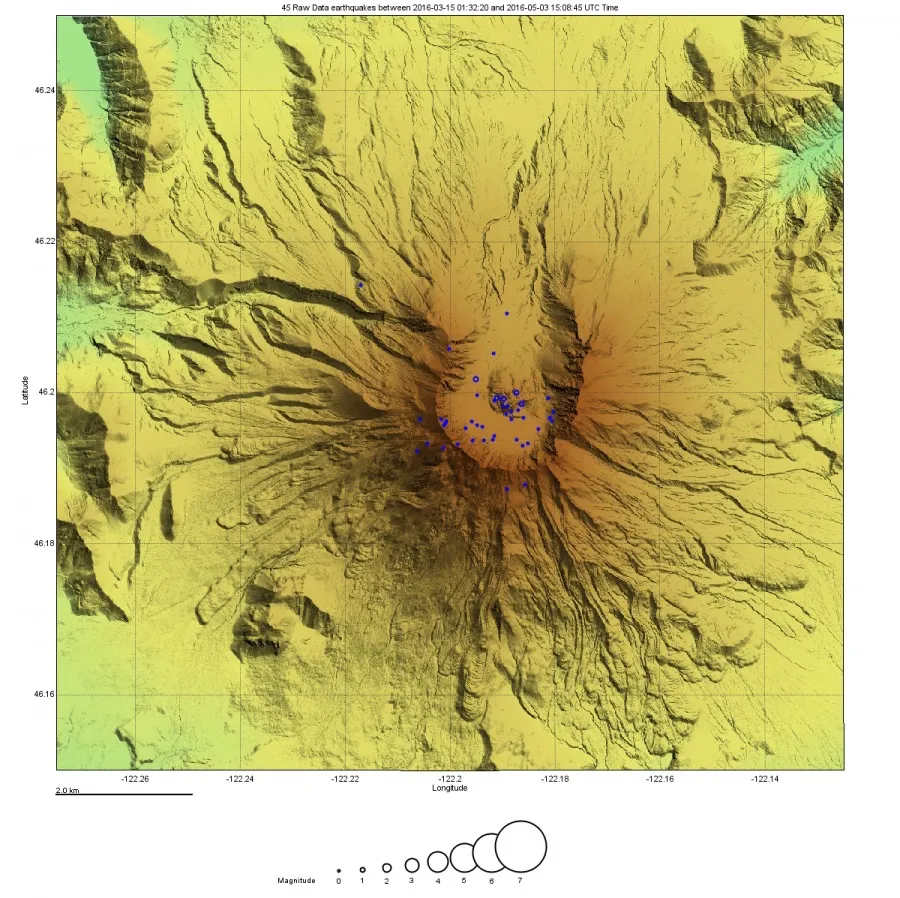
The latest earthquakes — most registering a magnitude of 0.5 or less, with the largest reaching a magnitude 1.3 — started March 14, 2016, at a depth between 1.2 miles and 4 miles (2 and 7 kilometers), USGS said.
During the past eight weeks, researchers have recorded more than 130 of these tiny earthquakes. The rate of the temblors has been increasing since March, reaching almost 40 earthquakes a week, the USGS said.
Moreover, global positioning system (GPS) instruments placed around the volcano show a slight ground movement. Over the past eight years, the ground has moved between 0.4 inches to 0.8 inches (1 to 2 centimeters) away from the volcano, Moran said.
Both of these signs — the earthquakes and the movement — are volcano-tectonic in nature, the USGS said. These signs are probably happening because of a slip on a small fault, the agency said.
"Such events are commonly seen in active hydrothermal and magmatic systems," the USGS said. "The magma chamber is likely imparting its own stresses on the crust around and above it, as the system slowly recharges. The stress drives fluids through cracks, producing the small quakes."
Similar events happened in 2013 and 2014, and in the 1990s a swarm of earthquakes were even more frequent and released more energy, USGS said.
However, the USGS hasn't detected any anomalous gases coming from the volcano, which would suggest magma is pushing up toward the surface. "As was observed at Mount St. Helens between 1987 [and] 2004, recharge can continue for many years beneath a volcano without an eruption," USGS said.
What's more, Mount St. Helens is hardly the only active volcano in the United States. For instance, the Pavlof volcano in Alaska spewed ash 20,000 feet (6,000 meters) into the air in late March, and Hawaii's Kilauea volcano has been continuously erupting since 1983, Moran said.
Follow Laura Geggel on Twitter @LauraGeggel. Follow Live Science @livescience, Facebook & Google+. Original article on Live Science.