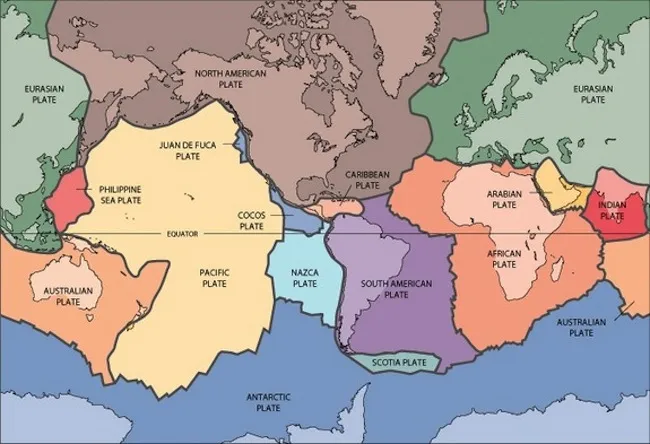
A cold, crusty shell of a planet that regularly kills off its occupants with violent earthquakes and massive volcanic eruptions doesn't sound like ideal habitat. But Earth's grinding plates, the source of its deadly tectonics, are actually one of the key ingredients that make it only planet with life in the solar system (found so far).
Now, a new model seeks to explain why Earth's plate tectonics is unique among the sun's rocky planets. It all comes down to tiny minerals in rocks.
"What goes on in rocks has helped us understand how plate boundaries evolve," said David Bercovici, a geophysicist at Yale University and lead author of the new study.
Plate tectonics is a widely-accepted theory that says the Earth's outer surface, or crust, in divided into rigid plates. These plates move around the planet on top of convection currents in the mantle, the hotter rock layer between the crust and Earth's core. The crust is recycled back into the mantle at subduction zones, where one plate bends down under another. [Related: What is Plate Tectonics?]
There are hints that the plates emerged 4 billion years ago, only 500 million years after Earth formed. But many researchers think the full system of plate tectonics we see today — with the entire Earth's surface covered in rigid plates that crash, slide and subduct — didn't really get set up until about 3 billion years ago. For example, instead of subduction zones, pieces of crust "dripped" into the mantle like a sinking blob in a lava lamp, some researchers think.
A simulation showing how plate-tectonic boundaries emerge because of inherited damage following a shift in plate-tectonic driving forces.
(Image credit: David Bercovici)
Bercovici and co-author Yanick Ricard, of the University of Lyon in France, set out to solve the billion-year gap. Their model builds on experimental evidence of how the minerals within rocks behave at certain temperatures and pressures, as well as geologic evidence, such as rocks called mylonite, brought from deep in the Earth to the surface through movement along faults. The study was published today (April 6) in the journal Nature.
Starting at the microscopic level with minerals, or grains, in rocks, the researchers investigated how rocks weaken when they are damaged. Bercovici and Ricard discovered a feedback loop. First, mineral grains get smaller when rocks grow weaker. Then, in the researchers' model, flowing zones of rock deformation tend to hone in on the weak rocks, and add to the damage of the minerals — which made the grains grow even smaller, even faster.
Sign up for the Live Science daily newsletter now
Get the world’s most fascinating discoveries delivered straight to your inbox.
"Because of the feedback, a deformed zone gets narrower and more focused, and ends up looking like a plate boundary," Bercovici told Live Science's Our Amazing Planet.
On the early Earth, the first weak zones were proto-subduction zones, where blobs of crust dripped down into the mantle, the researchers suggest. Here, rocks were deformed and mineral grains grew smaller, according to the model. Over a billion years, these weak zones grew and connected into actual plate boundaries, the researchers showed.
"They're like scars," Bercovici said. "Eventually you get enough of them to form a contiguous plate boundary."
The researchers also compared their Earth plate tectonics model to Venus, finding that the surface of Venus was too hot for plate tectonics to develop. "Because it's hotter, the damage heals faster and the [rock] grains grow strong again," Bercovici said.
Becky Oskin covers Earth science, climate change and space, as well as general science topics. Becky was a science reporter at Live Science and The Pasadena Star-News; she has freelanced for New Scientist and the American Institute of Physics. She earned a master's degree in geology from Caltech, a bachelor's degree from Washington State University, and a graduate certificate in science writing from the University of California, Santa Cruz.