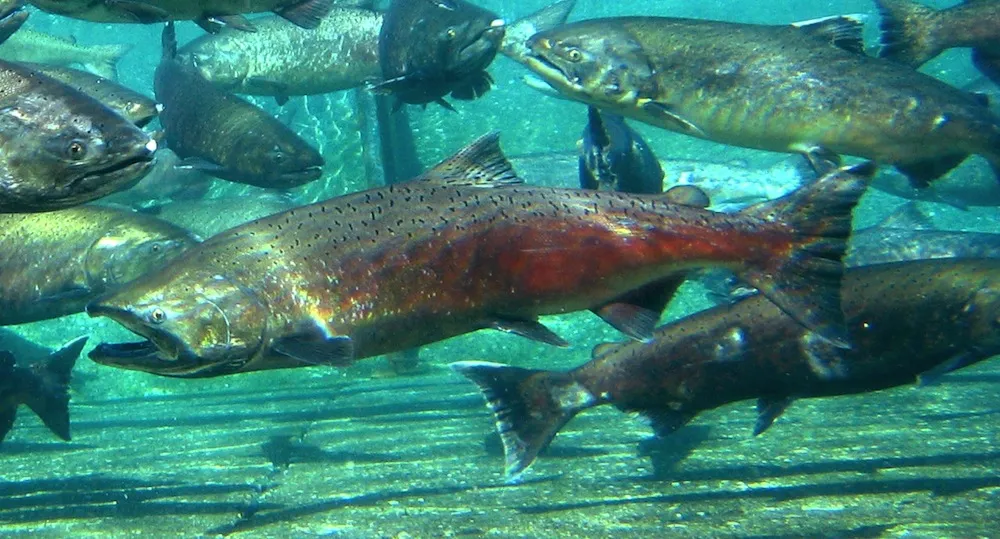
Without any prior migration experience, juvenile Chinook salmon can find their way to ancestral feeding grounds by using the Earth's magnetic field and an inherited internal map, according to a new study.
Lots of migratory animals use the Earth's magnetic field to orient themselves during migrations. But in most known cases, young animals learn routes from more experienced individuals, and then internalize the magnetic fields associated with those routes for subsequent trips.
Until now, loggerhead sea turtles have been the only animals confirmed to know ancestral migration routes from the moment they hatch. But now, researchers based at Oregon State University have found that juvenile Chinook salmon — which hatch in freshwater streams and then swim to the ocean to feed within the first year of their lives — also inherit a sense of direction to their families' migration routes. [Quest for Survival: Incredible Animal Migrations]
Latest Videos From
The researchers tested the internal maps of hundreds of juvenile salmon by placing individuals in test tanks, letting the fish acclimate for about 10 minutes and then manipulating the magnetic field around the tank using coils with electric currents running through them.
The team found that a significant number of salmon oriented themselves toward the magnetic fields that exist in their oceanic feeding grounds.
"Everybody was pretty surprised that the fish already had that ability," study co-author Nathan Putman, a researcher at Oregon State University, told Live Science. "Before the fish even hit saltwater, they already have a sense of what they should be doing if and when they should find themselves in a certain magnetic field."
Since salmon and sea turtles are so far apart on the evolutionary tree, the new findings suggest that other migratory marine animals likely have this ability as well. Two distantly related species rarely share evolutionary traits that other closer relatives don't share as well, said Putman.
Whereas many migratory bird species have the chance to learn their migratory routes from more experienced birds, young Chinook salmon don't generally have this option, because adults abandon them soon after they hatch. The inheritance of a magnetic map is, therefore, more crucial to salmon's survival than to that of other species with more adult support early in life, Putman said.
The researchers are now trying to determine exactly how precise the salmon's internal GPS is — whether the fish come within feet or miles of their feeding grounds.
"My guess is that they will have a very coarse resolution at this young age, but as they get older and do get experience with the magnetic field, that resolution will continue to get better until they are adults," Putman said.
The study findings are detailed today (Feb. 6) in the journal Current Biology.
Follow Laura Poppick on Twitter. Follow us @livescience, Facebook & Google+. Original article on Live Science.

 Live Science Plus