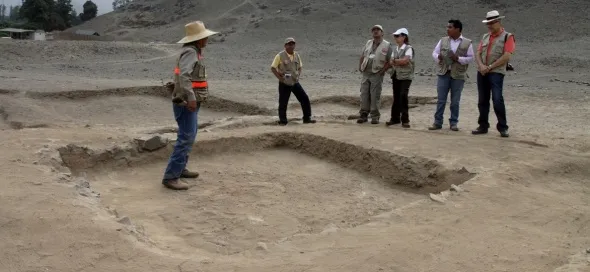
Archaeologists in Peru have uncovered what they believe is a temple, estimated to be up to 5,000 years old, at the site of El Paraíso, north of Lima.
Inside the ruins of the ancient room, which measures about 23 feet by 26 feet (7 meters by 8 meters), there's evidence of a ceremonial hearth, where offerings may have been burned, archaeologists say. The temple also had a narrow entrance and stone walls covered with yellow clay, on which traces of red paint were found, according to a statement from Peru's Ministry of Culture.
El Paraíso, located on the central coast of Peru, just north of Lima, is a site made up of 10 buildings stretching over 123 acres (50 hectares). It's one of the earliest known examples of monumental stone architecture in the Americas, dating back to the Late Preceramic period (3500-1800 B.C.). The newly found building is thought to date back to 3000 B.C., which should be confirmed with a radiocarbon analysis.
Rafael Varón, Peru's deputy minister for culture, said in a statement that the discovery of the temple "has particular importance because it is the first structure of this type found on the central coast." It suggests that the Lima region had more religious, economic and political importance during this early period than previously thought, Varón added.
Previously, man-made mounds shaped like orcas, condors and even a duck were discovered in Peru's coastal valleys, including at El Paraíso, by anthropologist Robert Benfer, professor emeritus of the University of Missouri, who spotted the mounds in satellite photos. One curious mound found in El Paraíso in the Chillón Valley was of a condor head whose burned-charcoal eye was likely the place where offerings were once burned. The condor was also positioned to line up with the most extreme orientation of the Milky Way as seen from the Chillón Valley. [See Photos of the Animal Mounds]
A second mound, right next to the condor, looked like a combination of a puma and alligatorlike cayman, Benfer said. That one was oriented toward the spot where the sun rises on the day of the June solstice, the start of summer.
Dating to more than 4,000 years ago, the structures may be the oldest evidence of animal mounds outside of North America, Benfer said last year. The previous oldest animal structures date to about 2,000 years ago, part of the Nazca Lines. These lines are simple stone outlines of animals decorating the Nazca Desert in Peru.
Sign up for the Live Science daily newsletter now
Get the world’s most fascinating discoveries delivered straight to your inbox.
For the science geek in everyone, Live Science offers a fascinating window into the natural and technological world, delivering comprehensive and compelling news and analysis on everything from dinosaur discoveries, archaeological finds and amazing animals to health, innovation and wearable technology. We aim to empower and inspire our readers with the tools needed to understand the world and appreciate its everyday awe.