













What Was Behind Mysterious Collapse of the Mayan Empire?

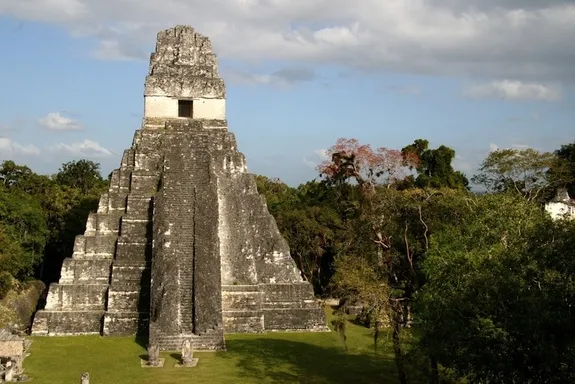
The city states of the ancient Mayan empire flourished in southern Mexico and northern Central America for about six centuries. Then, around A.D. 900 Mayan civilization disintegrated.
Two new studies examine the reasons for the collapse of the Mayan culture, finding the Mayans themselves contributed to the downfall of the empire.
Scientists have found that drought played a key role, but the Mayans appear to have exacerbated the problem by cutting down the jungle canopy to make way for cities and crops, according to researchers who used climate-model simulations to see how much deforestation aggravated the drought.
"We're not saying deforestation explains the entire drought, but it does explain a substantial portion of the overall drying that is thought to have occurred," said the study's lead author Benjamin Cook, a climate modeler at Columbia University's Lamont-Doherty Earth Observatory and the NASA Goddard Institute for Space Studies, in a statement. [Dry and Dying: Images of Drought]
Using climate-model simulations, he and his colleagues examined how much the switch from forest to crops, such as corn, would alter climate. Their results, detailed online in the journal Geophysical Research Letters, suggested that when deforestation was at its maximum, it could account for up to 60 percent of the drying. (The switch from trees to corn reduces the amount of water transferred from the soil to the atmosphere, which reduces rainfall.)
Other recent research takes a more holistic view.
"The ninth-century collapse and abandonment of the Central Maya Lowlands in the Yucatán peninsular region were the result of complex human–environment interactions," writes this team in a study published Monday (Aug 20) in the journal Proceedings of the National Academy of Sciences.
Get the world’s most fascinating discoveries delivered straight to your inbox.
The team, led by B.L. Turner, a social scientist at Arizona State University, concurs that by clearing the forest, the Mayans may have aggravated a natural drought, which spiked about the time the empire came to an end and population declined dramatically.
But this is just one contributing factor to their demise, Turner and colleagues write, pointing out that the reconfiguration of the landscape may also have led to soil degradation. Other archaeological evidence points to a landscape under stress, for instance, the wood of the sapodilla tree, favored as construction beams, was no longer used at the Tikal and Calakmul sites beginning in A.D. 741. Larger mammals, such as white-tailed deer, appear to have declined at the end of empire.
Social and economic dynamics also contributed. Trade routes shifted from land transit across the Yucatán Peninsula to sea-born ships. This change may have weakened the city states, which were contending with environmental changes. Faced with mounting challenges, the ruling elites, a very small portion of the population, were no longer capable of delivering what was expected of them, and conflict increased.
"The old political and economic structure dominated by semidivine rulers decayed," the team writes. "Peasants, artisan – craftsmen, and others apparently abandoned their homes and cities to find better economic opportunities elsewhere in the Maya area."
Follow Wynne Parry on Twitter @Wynne_Parry or LiveScience @livescience. We're also on Facebook & Google+.
