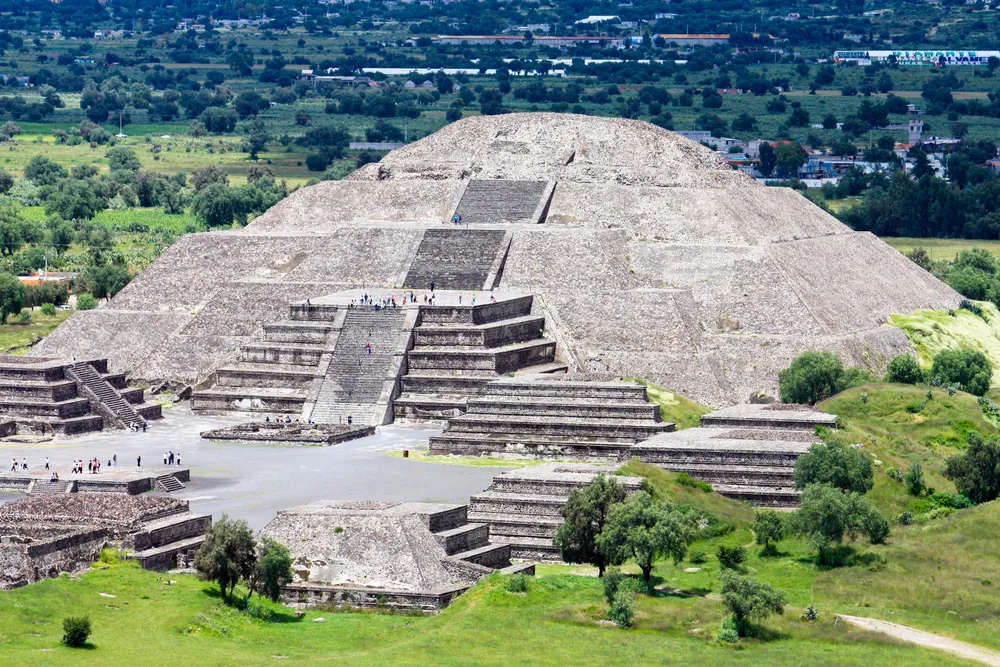
Located about 30 miles (50 kilometers) northeast of modern-day Mexico City, Teotihuacan was one of the largest urban centers in the ancient world. No one knows who built it. The city flourished between 2,100 years ago, when construction began, and about 1,400 years ago, when it went into a period of decline, including a fire that caused great damage. However, even with the decline, the city was never truly "lost" — the Aztecs made regular pilgrimages to the site in later periods.
What the city’s own inhabitants called the city and its structures is unknown. The current name, Teotihuacan, was given to it by the Aztecs and means "the place where the gods were created."
Size and influence
At its zenith, Teotihuacan encompassed an urban core of about 8 square miles (20 square km) with a population estimated at more than 100,000 people. Its influence was felt throughout central Mexico and as far south as Guatemala.
The city was organized using a grid plan, many people living in what scholars refer to as "apartment compounds," containing multiple families. An archaeological mapping project identified about 2,200 of these structures within the city, with excavations showing that some compounds were richer than others, containing more stone and lime plaster in their construction.
Running on a north-south axis is the city’s main street known today as the Avenue of the Dead, from a later Aztec name. It runs for more than 2 miles (3.2 km) and contains three major pyramid complexes.
Pyramid of the Moon
At the northern end of the avenue is the Pyramid of the Moon, from an Aztec name. Recent research suggests it was built in stages between around A.D. 1 and 350. It started off as a small platform and eventually became a 150-foot-high (46 meters) pyramid with a base 550 feet (168 m) by 490 feet (149 m). Its elevated platforms were likely used for rituals that could be witnessed by people on the ground. Tombs found associated with the structure contain both human and animal sacrifices along with grave goods such as obsidian and greenstone.
Pyramid of the Sun
Less than half a mile south of the Pyramid of the Moon is the Pyramid of Sun. At a height of more than 200 feet (63 m) and a base more than 730 feet (225 m) long on each side, this pyramid is one of the largest structures created in the pre-Columbian New World. It would have been completed around A.D. 200.
Sign up for the Live Science daily newsletter now
Get the world’s most fascinating discoveries delivered straight to your inbox.
In 1971, an archaeological team discovered a tunnel underneath the pyramid, its entrance located near the Avenue of the Dead. They dug out the fill in the tunnel finding that it terminated in a cloverleaf shaped chamber which, sadly, had been looted in antiquity. The cave was likely used for rituals of some kind.
Another discovery, announced late last year, was a small treasure trove of offerings that may date to when construction of the pyramid began. Among the items found was a green serpentine mask that may have been a portrait of an ancient individual.
The Temple of Quetzalcoatl, the Feathered Serpent, at Teotihuacan.
Located south of the Pyramid of the Sun is the Temple of the Feathered Serpent, also known as "La Ciudadela," a name Spanish conquistadors gave it. The focal point of this monument is a six-stepped pyramid, smaller than the other two examples on the Avenue of the Dead. Two apartment compounds located nearby may have been inhabited by local elites.
The pyramid is believed to have been completed sometime in the third century A.D. Cut in low relief on the structure are alternating heads showing Quetzalcoatl, a feathered serpent god, and a being that appears to be Tlaloc, an ancient storm god.
Found near the pyramid are the burials of about 200 people. Many of them were young men and the grave offerings suggest that they were warriors, possibly Teotihuacan's own. The fact that many of them were found with their wrists crossed behind their backs suggests that they had been tied up and, for some reason, sacrificed. Young women and a few older men were also found, with offerings.
Mural art
Teotihuacan is well-known for its colorful murals painted on plastered walls. They can be found in the city’s many apartment compounds as well as on other buildings identified as palaces and temples. Among the motifs that can been seen are images of the storm god, Tlaloc, as well as a deity that scholars call the "Great Goddess," likely associated with agricultural fertility. Other motifs include birds, jaguars, coyotes, owls and the feathered serpent.
Writing
Whether pictographic figures found at Teotihuacan constituted a proper writing system is a source of debate. Karl Taube, a professor at University of California Riverside, argues in a paper that the inhabitants "had a complex system of hieroglyphic writing," one complementing the vast and ancient city.
The Temple of the Feathered Serpent was one of the city's pyramids damaged by megathrust earthquakes.
(Image credit: Carolina Jaramillo Castro via Alamy)
Earthquakes
Analysis of some of the city's iconic pyramids have revealed that Teotihuacan was hit by five megathrust earthquakes sometime between A.D. 100 and 600. These earthquakes originated in a subduction zone called the Middle American Trench (MAT), an oceanic trench in the Pacific Ocean that is the boundary between several tectonic plates, including the Nazca and North American. What sets megathrust earthquakes apart is their extraordinary magnitude and relatively infrequent occurrence compared to other seismic events. For example, one megathrust earthquake has the seismic energy similar to that of approximately 32,000 Hiroshima nuclear bombs, Raúl Pérez-López, an earthquake geologist at the Geological and Mining Institute in Spain, told Live Science.
The five seismic events were powerful enough to damage the city's iconic pyramids, which is evidenced in chipped corners and dislodged bricks on the structures' facades. Archaeologists think that the megathrust earthquakes not only did physical damage to the city's pyramids but also may have led to the destabilization of its social and political structures, eventually leading to the city's demise.
Originally published on Aug. 20, 2012 and updated on April 24, 2024 to include information about the megathrust earthquakes.
Owen Jarus is a regular contributor to Live Science who writes about archaeology and humans' past. He has also written for The Independent (UK), The Canadian Press (CP) and The Associated Press (AP), among others. Owen has a bachelor of arts degree from the University of Toronto and a journalism degree from Ryerson University.