It's quick and easy to access Live Science Plus, simply enter your email below. We'll send you a confirmation and sign you up for our daily newsletter, keeping you up to date with the latest science news.
Get the world’s most fascinating discoveries delivered straight to your inbox.
You are now subscribed
Your newsletter sign-up was successful
Want to add more newsletters?
Join the club
Get full access to premium articles, exclusive features and a growing list of member rewards.
An account already exists for this email address, please log in.
Earth hit by biggest 'solar radiation storm' in 23 years, triggering Northern Lights as far as Southern California
Earth's magnetic field was struck by a "severe" solar storm Monday (Jan. 19), triggering vibrant auroras in the U.S. and large parts of Europe. The storm broke a record that had stood for more than two decades.
A geomagnetic storm starting on Monday (Jan. 19) has painted widespread aurora displays across the Northern Hemisphere, particularly in Europe. (This photo was captured in China's Heilongjiang Province.)
Update, Wednesday (Jan. 21) at 11 a.m. ET: Geomagnetic conditions are starting to settle, but auroras are still highly likely in the northern tier of the United States tonight, according to NOAA's latest forecasts. Strong (G3-level) geomagnetic storms remain possible overnight, so be sure to check the skies after dark.
A "severe" and record-breaking geomagnetic storm rocked Earth's magnetic shield last night, shortly after the sun unleashed a powerful X-class solar flare. The epic event, triggered by a stream of superfast solar particles, painted widespread auroras at unusually low latitudes across the Northern Hemisphere, particularly in Europe.
Some outlets have reported that the storm is the "largest" of its kind since 2003, which is an exaggeration (the "Mother's Day storm" of May 2024 was much stronger). However, the latest outburst has broken a specific 23-year-old solar radiation record.
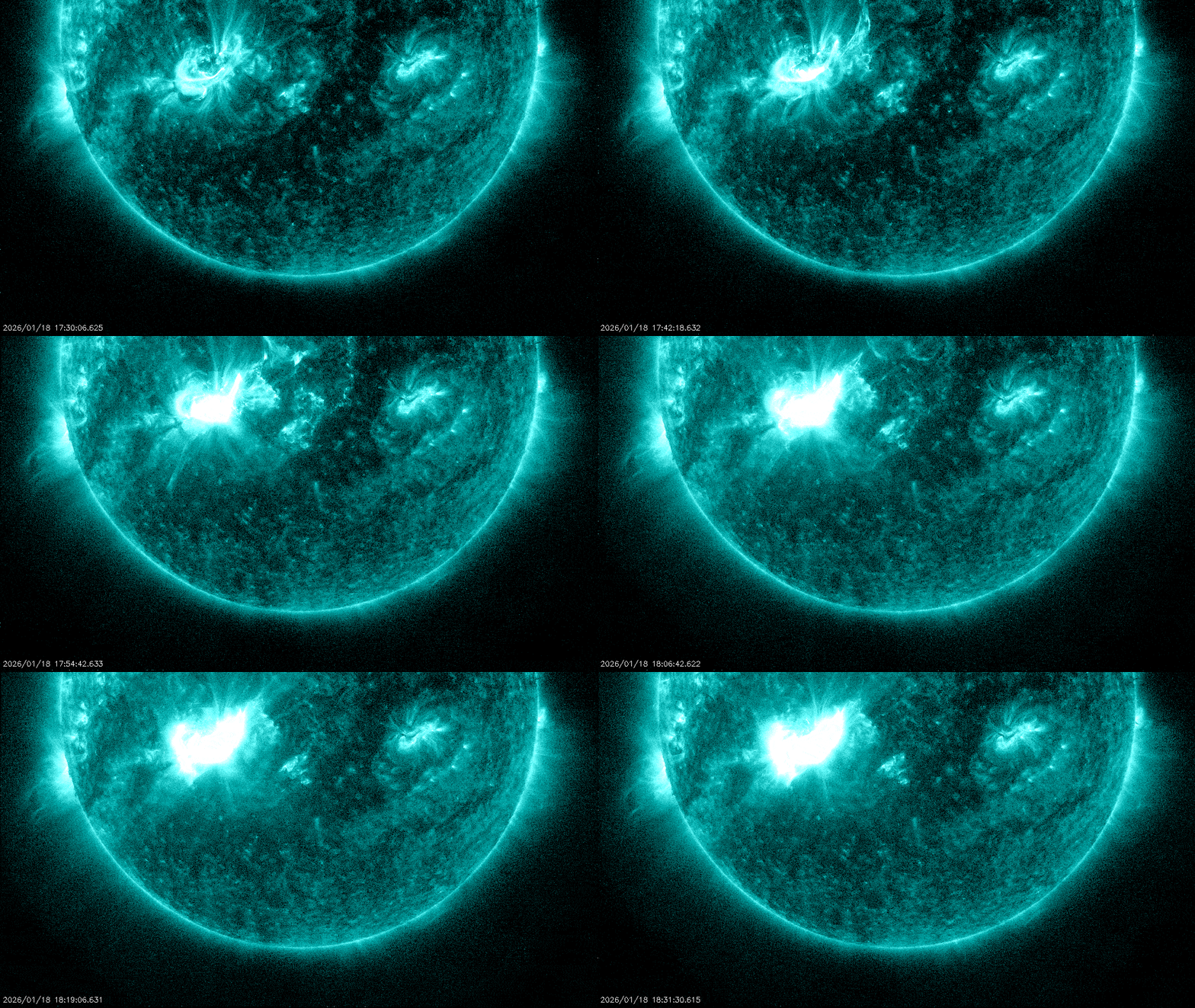
The geomagnetic storm began on Monday (Jan. 19), when a fast-moving cloud of solar radiation, or coronal mass ejection (CME), slammed into Earth's magnetosphere, temporarily disrupting the invisible magnetic field lines surrounding our planet and allowing charged particles to penetrate deeper into the atmosphere. The CME was initially released on Sunday (Jan. 18) when an X1.9 magnitude solar flare suddenly exploded from a dark patch near the sun's equator, Live Science's sister site Space.com reported.
Geomagnetic activity first peaked at 2:38 p.m. EST, when the storm reached G4 ("severe") status, according to the National Oceanic and Atmospheric Administration's (NOAA) Space Weather Prediction Center (SWPC). The storm calmed slightly before reaching G4 status again at 3:23 a.m. EST on Tuesday (Jan. 20), according to a second SWPC report.
G4 is the second-highest level a geomagnetic storm can reach. Under these conditions, solar radiation can cause temporary radio blackouts, disrupt or damage orbiting spacecraft and impact some ground-based infrastructure. However, it is too early to tell what specific issues this storm caused, if any.
The CME that hit Earth was unleashed by an X-class solar flare on Sunday (Jan. 18).
(Image credit: NASA/SDO)
There were widespread aurora displays across the U.K. and parts of Europe — including France, Germany, Switzerland, Austria, Belgium, Norway, Denmark, the Netherlands and Croatia — where the sun had already set before the storm peaked, according to Spaceweather.com.
Sign up for the Live Science daily newsletter now
Get the world’s most fascinating discoveries delivered straight to your inbox.
Experts had predicted that up to 24 U.S. states would see auroras during the storm, according to Space.com. It is unclear if this actually happened, especially as the storm's first peak occurred before sunset in North America. However, skywatchers as far south as Alabama, Georgia, New Mexico and California reported seeing auroras overnight, according to Spaceweather.com.
More auroras are possible tonight, according to Space.com's latest aurora forecast. However, the storm is not expected to reintensify to G4 status.
Image 1 of 3
Vibrant red auroras were spotted above Austria's capital city, Vienna, on Jan.19.(Image credit: MAX SLOVENCIK / APA / AFP via Getty Images)
Skywatchers in western France were treated to some stunning green auroras.(Image credit: Oscar Chuberre / AFP via Getty Images)
Auroras were also spotted shining above Berlin.(Image credit: Florian Gaertner/Photothek via Getty Images)
A 23-year record
Despite some initial reports, last night's display was not the biggest geomagnetic storm of the past two decades. That title goes to the "Mother's Day storm" of May 2024, which reached G5 ("extreme") status for the first time since the infamous "Halloween solar storms" of 2003.
The term solar radiation storm refers to a solar outburst, like a CME, as it travels through space, rather than the actual effect it has on our planet. Big radiation storms often lead to powerful geomagnetic storms, but other factors influence how Earth's magnetic field will respond, such as the orientation of the incoming radiation and its magnetic configuration.
The solar radiation storm that sparked last night's auroras reached S4 ("severe") status — the equivalent of G4 on the solar radiation storm scale. This is the first time this has happened since 2003's Halloween storms, SWPC representatives wrote on the social platform X.
Harry is a U.K.-based senior staff writer at Live Science. He studied marine biology at the University of Exeter before training to become a journalist. He covers a wide range of topics including space exploration, planetary science, space weather, climate change, animal behavior and paleontology. His recent work on the solar maximum won "best space submission" at the 2024 Aerospace Media Awards and was shortlisted in the "top scoop" category at the NCTJ Awards for Excellence in 2023. He also writes Live Science's weekly Earth from space series.
You must confirm your public display name before commenting
Please logout and then login again, you will then be prompted to enter your display name.

 Live Science Plus