Get the world’s most fascinating discoveries delivered straight to your inbox.
You are now subscribed
Your newsletter sign-up was successful
Want to add more newsletters?
Join the club
Get full access to premium articles, exclusive features and a growing list of member rewards.
An account already exists for this email address, please log in.
Giant sunspot that triggered recent solar 'superstorm' shot out nearly 1,000 flares and a secret X-rated explosion, record-breaking study reveals
The massive sunspot that sparked an "extreme" geomagnetic storm in May 2024 unleashed hundreds of other dangerous solar flares, including a hidden X-class outburst, a new paper reveals. The study sets a record for the longest continuous observation of a single active region on our home star.
Sunspot AR 13364 grew to be up to 15 times wider than Earth and unleashed nearly 1,000 different solar flares in its three-month lifespan, including this X-class flare on May. 15, 2024, shortly before it rotated onto the sun's far side from our planet for the first time.
(Image credit: Main: NASA/SDO and the AIA, EVE, and HMI science teams/helioviewer.org; Inset: NASA/SDO/SpaceWeatherLive.com; with annotations by Harry Baker)
A record-breaking study into a giant sunspot that triggered Earth's biggest geomagnetic storm in more than two decades has revealed surprising new details about the explosive dark patch. The monster sunspot unleashed almost 1,000 solar flares in just over three months, and may have discreetly birthed the most powerful outburst of the current solar cycle.
But the giant sunspot's journey didn't end there. Like other massive sunspots, AR 13664 was able to survive several trips around the sun, which enabled researchers to keep tabs on it for longer than usual — and it put on quite the show. (Sunspots only remain visible on the sun's Earth-facing hemisphere for up to two weeks at a time before rotating out of view, but they reappear if they survive the trip across our home star's far side.)
In a new study published Dec. 5 in the journal Astronomy & Astrophysics, researchers analyzed observations of AR 13664 spanning 94 consecutive days between April 16 and July 18, 2024, which equates to roughly 3.3 trips around the sun. Thanks to images captured by NASA's Solar Orbiter, which circles the sun, researchers were able to keep tabs on the sunspot as it rotated out of view.
The May 2024 geomagnetic storm was the most powerful for 21 years and triggered widespread auroras across the planet, including these dancing lights photographed over the Italian Alps.
(Image credit: JFK/APA/AFP via Getty Images)
"It’s a milestone in solar physics," study lead author Ioannis Kontogiannis, a solar physicist at the Swiss Federal Institute of Technology Zurich (ETH Zurich), said in a statement. "This is the longest continuous series of images ever created for a single active region."
In the paper, the team revealed that AR 13664 unleashed a total of 969 solar flares. This included 38 X-class flares and 146 M-class flares, which are also capable of impacting Earth's magnetic field. The rest were lower-level, including C-class and B-class flares, which pose no threat to our planet. Most of the biggest flares were directed away from Earth, which is why more geomagnetic storms did not occur.
Sign up for the Live Science daily newsletter now
Get the world’s most fascinating discoveries delivered straight to your inbox.
The largest flare was a suspected X16.5 magnitude blast, which occurred on the sun's far side from Earth on May 20, 2024. That’s significantly more powerful than an X9 blast that occurred on Oct. 3, 2024, which is currently listed as the most powerful flare of the last 8 years. However, as AR 13664's blast was partially obscured by its location on the sun, researchers cannot officially declare a new record.
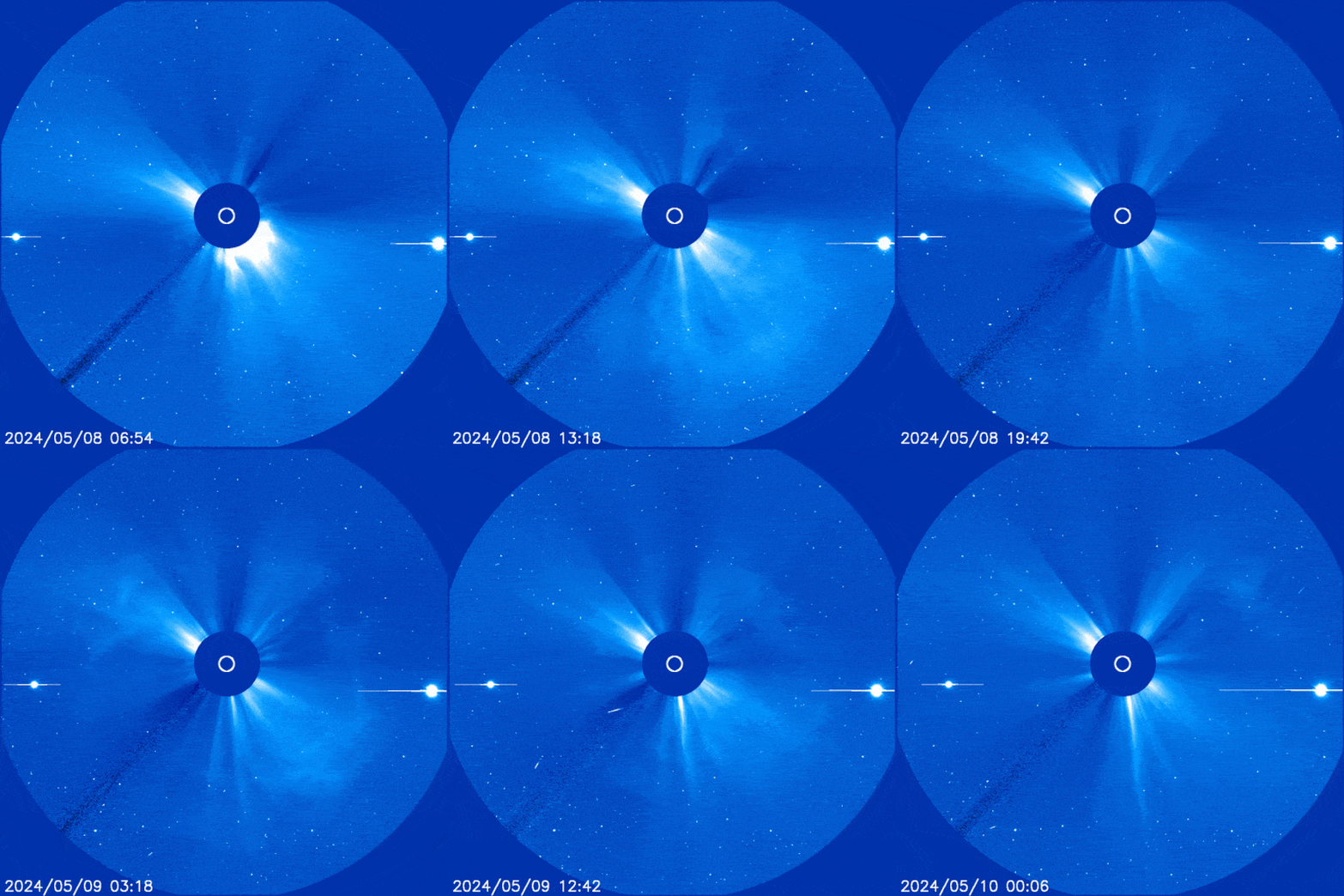
At least five successive CMEs exploded from the sun in early May 2024 before slamming into Earth and triggering a G5-level ("extreme") geomagnetic storm.
(Image credit: NASA/SOHO)
AR 13664's epic journey around the sun is a reminder of the immense power of our home star, especially during solar maximum — the most active phase of the sun's roughly 11-year solar cycle, when the number of sunspots and solar storms sharply rises.
The researchers behind the new study note that studying these events can help scientists to better predict similar events in the future, which is important as they can impact Earth-orbiting spacecraft as well as some ground-based infrastructure.
"We live with this star, so it's really important we observe it and try to understand how it works and how it affects our environment," Kontogiannis said.
Harry is a U.K.-based senior staff writer at Live Science. He studied marine biology at the University of Exeter before training to become a journalist. He covers a wide range of topics including space exploration, planetary science, space weather, climate change, animal behavior and paleontology. His recent work on the solar maximum won "best space submission" at the 2024 Aerospace Media Awards and was shortlisted in the "top scoop" category at the NCTJ Awards for Excellence in 2023. He also writes Live Science's weekly Earth from space series.
You must confirm your public display name before commenting
Please logout and then login again, you will then be prompted to enter your display name.