Get the world’s most fascinating discoveries delivered straight to your inbox.
You are now subscribed
Your newsletter sign-up was successful
Want to add more newsletters?
Join the club
Get full access to premium articles, exclusive features and a growing list of member rewards.
An account already exists for this email address, please log in.
'Revolutionary': Vera C. Rubin Observatory found 800,000 objects of interest in a single night
The Vera C. Rubin Observatory sent scientists nearly 1 million astronomy alerts in one night, showing off changes in the sky. Eventually, the telescope is expected to reach 7 million alerts per night.
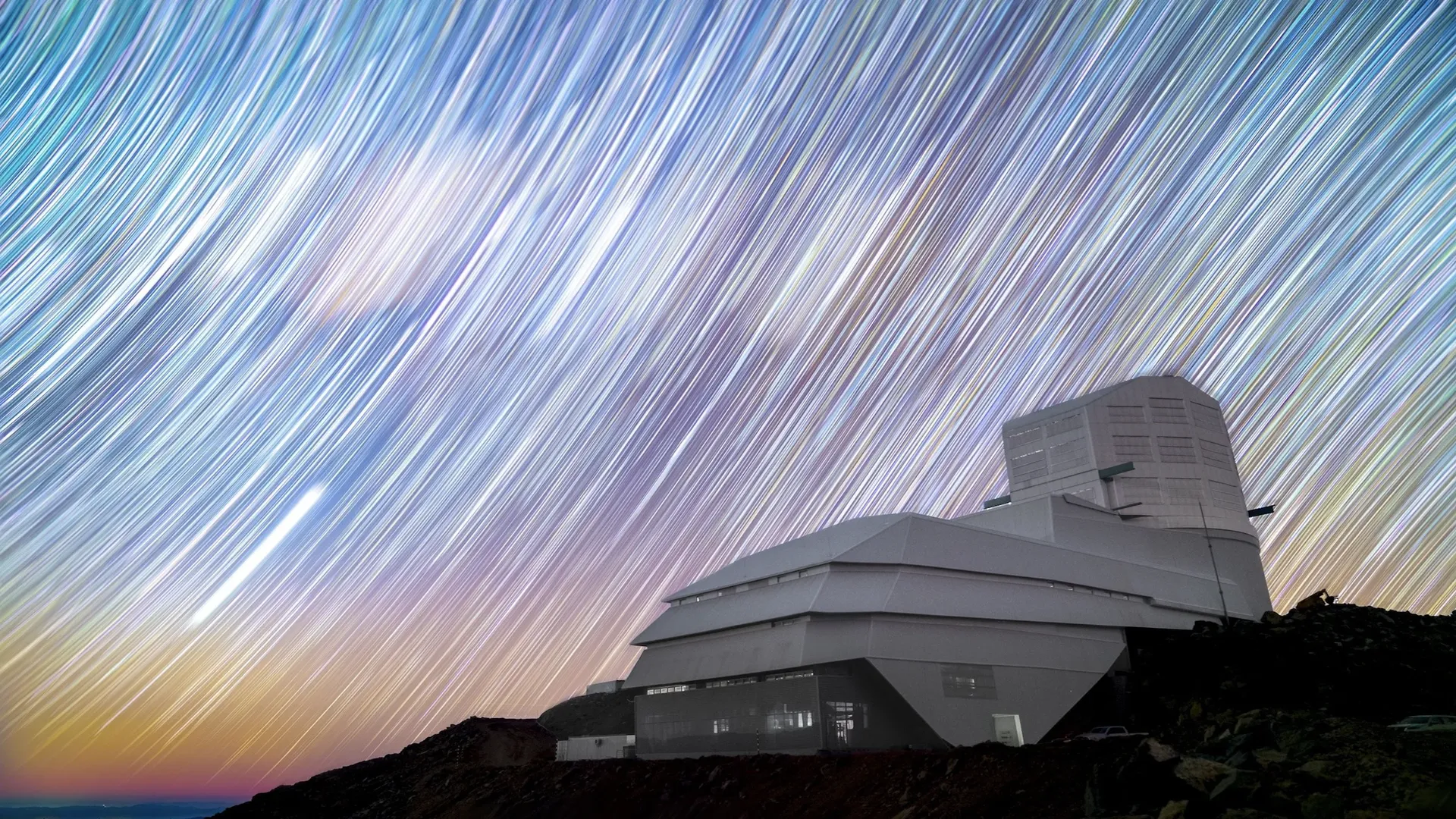
The Milky Way glitters behind the Vera C. Rubin Observatory in Chile. The observatory just passed a critical milestone, alerting astronomers to 800,000 changes in the sky in one night.
The newly commissioned Vera C. Rubin Observatory has issued 800,000 astronomy alerts in just one night — a staggering number of nightly discoveries that is expected to grow nearly tenfold by the end of this year.
The telescope, which scans the full sky from its perch atop Cerro Pachón mountain in Chile, produced the alerts to direct scientists to "new asteroids, exploding stars, and other changes in the night sky," representatives for the U.S. National Science Foundation (NSF) said in a statement.
And Rubin is just getting started, as scientists expect it will eventually issue 7 million alerts every night.
"By connecting scientists to a vast and continuous stream of information, [the observatory] will make it possible to follow the universe's events as they unfold, from the explosive to the most faint and fleeting," Luca Rizzi, an NSF program director for research infrastructure, said in the statement.
Catching supernovas, asteroids, and interstellar objects in the act
A sample of five solar systems objects that changed in brightness or position during Rubin's nightly observations. According to the NSF: "As new images are taken, Rubin Observatory’s sophisticated software automatically compares each one with a template image. The template image, built by combining Rubin’s previous images of the same area in the same filter, is subtracted from the new image, leaving only the changes."
(Image credit: NSF–DOE Vera C. Rubin Observatory/NOIRLab/SLAC/AURA)
These alerts will enable scientists to collaborate to an unprecedented degree, the NSF noted, because Rubin will spot information quickly for follow-up by other telescopes on the ground or in space. Rubin's alerts may also shed light on ongoing astronomical mysteries that require quick wayfinding to gather more information.
"Scientists will have a greater ability to catch supernovae in their earliest moments, discover and track asteroids to assess potential threats to Earth, and spot rare interstellar objects as they race through the solar system," NSF representatives wrote in the statement. "Scientists can then use these data to better understand the nature of dark matter, dark energy, and other unknown aspects of the universe."
Rubin's alert system is starting up shortly before the observatory begins a 10-year program, known as the Legacy Survey of Space and Time (LSST), later this year. Rubin will do nightly sky scans to generate an image of the entire Southern Hemisphere sky every few nights, using the largest-ever digital camera to spot any changes in the view overhead.
Sign up for the Live Science daily newsletter now
Get the world’s most fascinating discoveries delivered straight to your inbox.
"What’s revolutionary about Rubin is its ability to capture both rapid changes and long-term evolution in the sky," Rosaria Bonito, researcher at the Italian National Institute for Astrophysics in Italy and co-chair of the Rubin LSST Transients and Variable Stars science collaboration, said in the statement.
The observatory's debut images, released in June 2025, revealed more than 10 million galaxies in and around the Virgo Cluster — many of them never studied before — as well as 2,000 previously undiscovered asteroids, spotted after just a few nights of observations.
The first year of the LSST program alone is expected to image more night-sky objects than those of all other optical observatories combined throughout human history, according to the NSF. Every night's LSST observations will produce 10 terabytes of data, which also required background engineering in image processing, databases and data distribution to achieve the milestone.
The observatory's alerts are all available to read for free on the public alert broker website ANTARES.
Editor's note: This article was updated on Feb. 26 at 2:50 p.m. to add additional images and quotes.
Elizabeth Howell was staff reporter at Space.com between 2022 and 2024 and a regular contributor to Live Science and Space.com between 2012 and 2022. Elizabeth's reporting includes multiple exclusives with the White House, speaking several times with the International Space Station, witnessing five human spaceflight launches on two continents, flying parabolic, working inside a spacesuit, and participating in a simulated Mars mission. Her latest book, "Why Am I Taller?" (ECW Press, 2022) is co-written with astronaut Dave Williams.
You must confirm your public display name before commenting
Please logout and then login again, you will then be prompted to enter your display name.